ALBANY, N.Y.--(BUSINESS WIRE)--May 18, 2026--
Soluna Holdings, Inc. (“Soluna” or the “Company”) (NASDAQ: SLNH), a developer of green data centers for intensive computing applications, including Bitcoin mining and AI, announced its financial results for the first quarter ended March 31, 2026.
This press release features multimedia. View the full release here: https://www.businesswire.com/news/home/20260518023353/en/
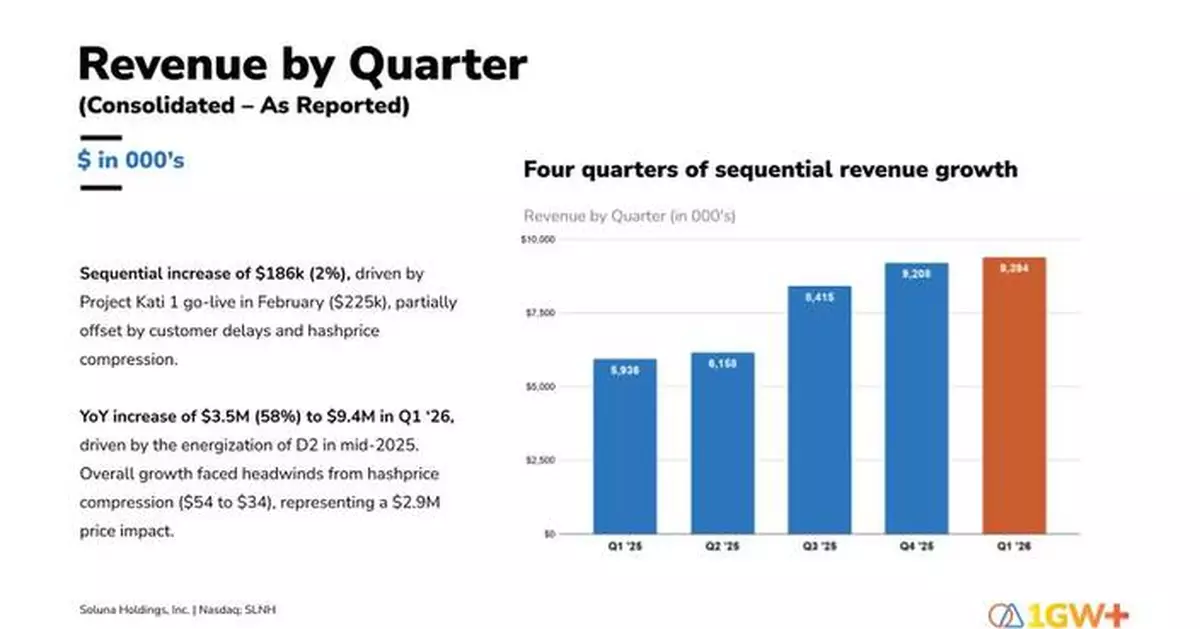
“Our fourth consecutive quarter of sequential revenue growth and 58% year-over-year increase reflects the operating leverage we're building across the portfolio. With Kati 1 now contributing, Dorothy 1A back at full capacity, and Dorothy 2 fully ramped, we're entering the next phase of Soluna's growth from a position of operational strength,” said John Belizaire, CEO of Soluna Holdings.
“Our AI expansion at Kati 2 is well underway, while Briscoe Wind now vertically integrates the power layer supporting Dorothy 3. Together with the full acquisition of Dorothy 1A, these milestones position Soluna for sustained growth and accelerating momentum,” Belizaire continued.
Q1 2026 Operational and Corporate Highlights:
First Quarter Financial Highlights:
Q1 2026 Revenue & Cost of Revenue by Project Site
Q1 2025 Revenue & Cost of Revenue by Project Site
Subsequent Events:
The unaudited financial statements and Quarterly Report on Form 10-Q for the three months ended March 31, 2026, filed with the U.S. Securities and Exchange Commission (“SEC”) on May 15, 2026, are available online.
Our current Investor Presentation is available here.
Soluna’s glossary of terms is available here.
Safe Harbor Statement
This announcement contains forward-looking statements. These statements are made under the "safe harbor" provisions of the U.S. Private Securities Litigation Reform Act of 1995. These forward-looking statements can be identified by terminology such as "will," "expects," "anticipates," "future," "intends," "plans," "believes," "estimates," "confident," and similar statements. Other examples of forward-looking statements may include, but are not limited to, (i) statements of Company's plans and objectives, including the deployment at Kati 2, (ii) statements of future economic performance, (iii) statements regarding financial projections of the Company, and (iv) statements of assumptions underlying other statements about the Company or its business. Soluna may also make written or oral forward-looking statements in its periodic reports to the SEC, in its annual report to shareholders, in press releases and other written materials, and in oral statements made by its officers, directors, or employees to third parties. Statements that are not historical facts, including but not limited to statements about Soluna’s beliefs and expectations, are forward-looking statements. Forward-looking statements involve inherent risks and uncertainties, further information regarding which is included in the Company's filings with the SEC. All information provided in this press release is as of the date of the press release, and Soluna undertakes no duty to update such information, except as required under applicable law.
Non-GAAP Measures
In addition to figures prepared in accordance with generally accepted accounting principles (“GAAP”), Soluna from time to time may present alternative non-GAAP performance measures, e.g., EBITDA, adjusted EBITDA, adjusted net profit/loss, adjusted earnings per share, free cash flow, both on a company basis and on a project-level basis, among others. EBITDA is defined as earnings before interest, taxes, and depreciation and amortization. Adjusted EBITDA is defined as EBITDA adjusted for stock-based compensation costs, gain on sale of fixed assets and right of first refusal amortization, SEPA commitment fee, fair value adjustment loss, and gain on debt extinguishment and revaluation, net. Project-level measures may not take into account a full allocation of corporate expenses. These measures should be considered in addition to, but not as a substitute for, the information prepared in accordance with GAAP. Alternative performance measures are not subject to GAAP or any other generally accepted accounting principles. Other companies may define these terms in different ways. See our annual report on Form 10-K for the year ended December 31, 2025, for an explanation of how management uses these measures in evaluating its operations. Investors should review the non-GAAP reconciliations provided above and not rely on any single financial measure to evaluate the Company’s business.
About Soluna Holdings, Inc. (Nasdaq: SLNH)
Soluna is on a mission to make renewable energy a global superpower using computing as a catalyst. The company designs, develops, and operates digital infrastructure that transforms surplus renewable energy into global computing resources. Soluna’s pioneering data centers are strategically co-located with wind, solar, or hydroelectric power plants to support high-performance computing applications, including Bitcoin Mining, Generative AI, and other compute-intensive applications. Soluna’s proprietary software MaestroOS(™) helps energize a greener grid while delivering cost-effective and sustainable computing solutions and superior returns. To learn more, visit solunacomputing.com and follow us on:
LinkedIn: https://www.linkedin.com/company/solunaholdings/
X (formerly Twitter): x.com/solunaholdings
YouTube: youtube.com/c/solunacomputing
Newsletter: bit.ly/solunasubscribe
Resource Center: solunacomputing.com/resources
Soluna regularly posts important information on its website and encourages investors and potential investors to consult the Soluna investor relations and investor resources sections of its website regularly.
The accompanying notes are an integral part of these unaudited condensed consolidated financial statements.
The accompanying notes are an integral part of these unaudited condensed consolidated financial statements.
The accompanying notes are an integral part of these unaudited condensed consolidated financial statements.
Segments:
The following table details revenue, cost of revenues, and other operating costs for the Company’s reportable segments for three months ended March 31, 2026 and 2025, and reconciles to net loss on the consolidated statements of operations:
For the three months ended March 31, 2026
For the three months ended March 31, 2025
The following table presents the reconciliation of segment operating income to net loss before taxes:
Gross Profit breakout:
The following table summarizes the balances for the project sites for cryptocurrency mining revenue, data hosting revenue, high-performance computing service revenue, demand response revenue, cost of cryptocurrency mining revenue, exclusive of depreciation, cost of data hosting revenue, exclusive of depreciation, cost of high-performance computing services, and cost of depreciation during the three months ended March 31, 2026:
The following table summarizes the balances for the project sites for cryptocurrency mining revenue, data hosting revenue, high-performance computing service revenue, demand response revenue, cost of cryptocurrency mining revenue, exclusive of depreciation, cost of data hosting revenue, exclusive of depreciation, cost of high-performance computing services, and cost of depreciation during the three months ended March 31, 2025:
EBITDA and Adjusted EBITDA Tables:
Reconciliations of EBITDA and Adjusted EBITDA to net loss, the most comparable GAAP financial metric, for historical periods are presented in the table below:
The following table represents the Adjusted EBITDA activity between each three-month period from January 1, 2025 through December 31, 2025.
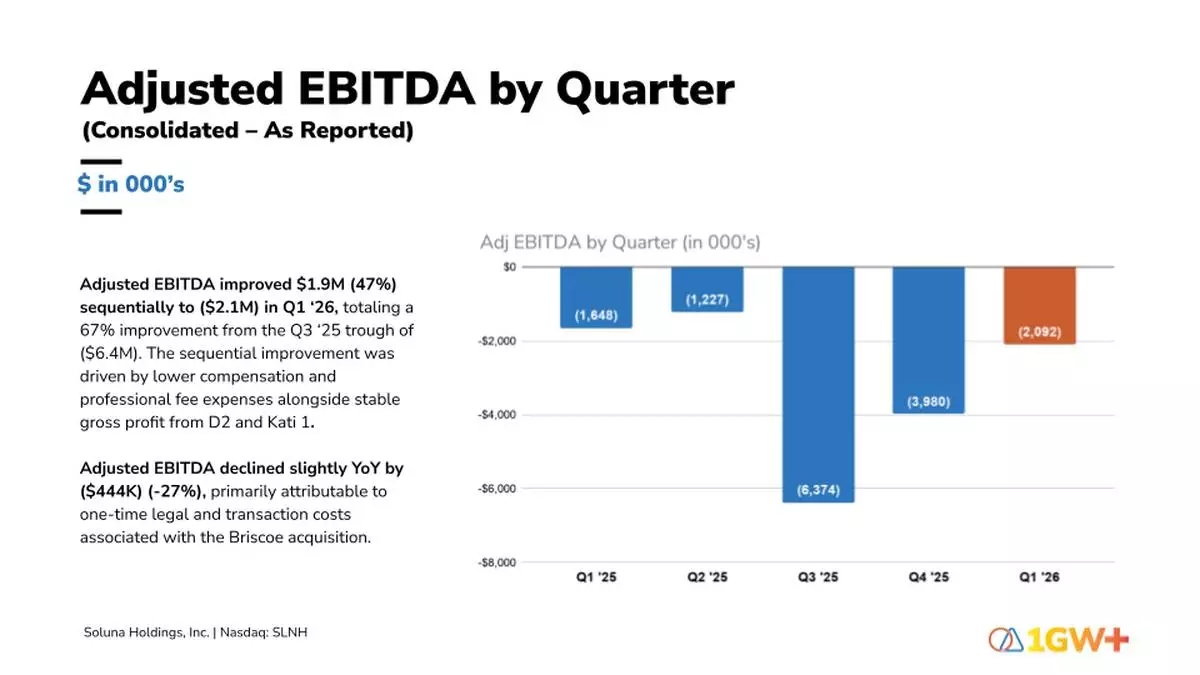
Soluna Holdings, Inc. Reports Q1 2026 Adjusted EBITDA by Quarter
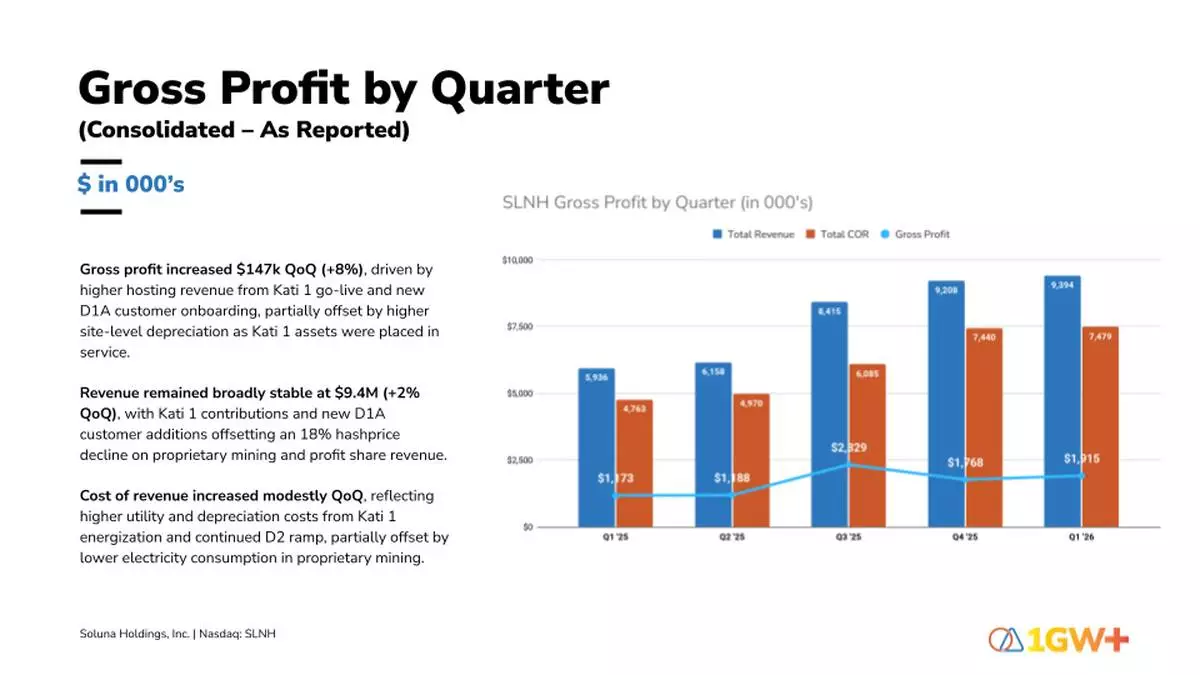
Soluna Holdings, Inc. Reports Q1 2026 Gross Profit by Quarter
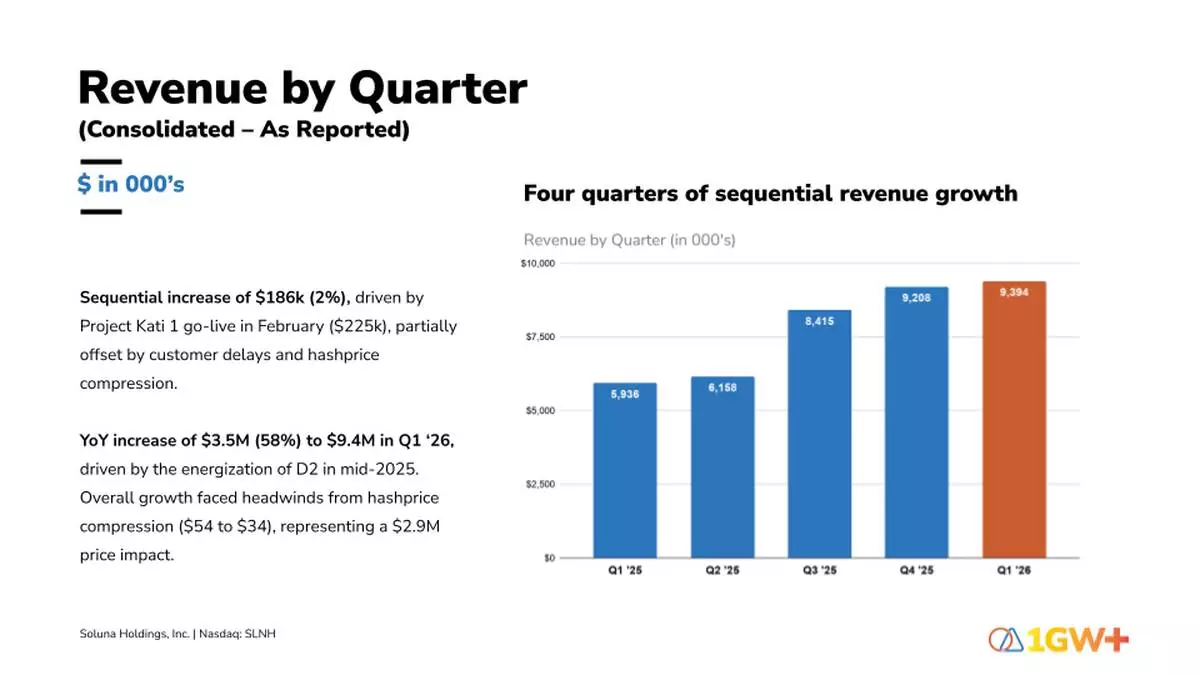
Soluna Holdings, Inc. Reports Q1 2026 Revenue by Quarter
DUBAI, United Arab Emirates (AP) — The U.S. announced a new round of strikes on Iran on Monday, hours after President Donald Trump said Washington is “reinstating” a blockade on Iran in the Strait of Hormuz and, in a seeming policy reversal, will charge other ships for safe passage.
All of that comes as Iran has insisted it actually controls the critical waterway, and as the new exchange of fire threatened a return to all-out war.
U.S. Central Command announced on social media that the U.S. military had begun another round of strikes against Iran.
“These strikes will continue imposing a heavy cost on Iranian forces and degrade their ability to attack innocent civilians and commercial shipping in the Strait of Hormuz,” the U.S. military said.
Moments after the military announced the new strikes, Trump called it “another major attack.”
“We’re hitting them very hard. And it’ll continue, and we’ll see what happens,” he told reporters in the Oval Office. “We’re knocking out all of their offensive capability and we’re controlling the straits. We’re putting the blockade back.”
Trump also provided new details on his administration doing an about-face and suggesting it will charge tolls for ships going through the strait, after previously suggesting that it wouldn’t.
“We’re protecting a very rich portion of the world,” he said. “We’re spending money. And so, what we’ve done is, we are going to be reimbursed for protection.”
It's a change in U.S. policy that, until now, said the strait should remain open to all without tolls — as it was before the U.S. and Israel attacked Iran on Feb. 28. Any attempt by the U.S. or Iran to charge fees would violate global norms on freedom of navigation and raise tensions, likely causing further economic disruption far beyond the region.
The price for a barrel of Brent crude oil, the international standard, rose 7.8% to $81.92 a barrel on Monday, still well below the nearly $120 reached at the height of the war.
Earlier, Trump told conservative radio host Hugh Hewitt that the agreement reached last month was “built to test” Iran, adding that “when you’re dealing with sleazebags don’t mean much.”
Trump said he questioned why the U.S. was entering into a deal to create a ceasefire with Iran rather than moving toward a full deal first. Trump last week declared the ceasefire was “over.”
“They didn’t honor the test,” the president said.
Exchanges of fire in recent days, sparked by Iranian attacks on ships, had already cast further doubt on the interim peace deal. Washington had lifted a blockade it imposed in mid-April as part of that deal, which also called for the strait to be fully reopened.
“We are reinstating the THE IRANIAN BLOCKADE,” Trump said on social media. “All other countries will have fair and open use of the Strait.”
The president said the U.S. would be “reimbursed” by 20% of the value of cargo to help cover “any and all costs necessary to do the job of providing safety and security.”
The U.S. military said it will resume its blockade of Iranian ports Tuesday at 4 p.m. EDT.
Iran asserts it has the right to manage traffic through the strait and potentially charge fees in accordance with the interim peace deal. The U.S. has disputed that.
Iran on Monday vowed to fight back against any U.S. interference in the strait. Iran's Foreign Minister Abbas Araghchi mocked Trump on social media and used his support for tolls to legitimize Iran's position.
“POTUS is absolutely right. Whoever provides secure and safe passage of commercial vessels through the Strait of Hormuz should be compensated for this service,” Araghchi wrote on X. “Iran has always been the GUARDIAN of the Strait and will remain so FOREVER. 20% is of course too much. We will be fair.”
The International Maritime Organization, the United Nations agency overseeing international shipping, said it was waiting to find out more about Trump’s proposal but remained opposed to tolls for passage through international waterways.
“There is no legal basis through which to introduce mandatory tolls simply to transit through a strait,” it said in a statement.
Meeting with Gulf leaders late last month, Secretary of State Marco Rubio had spoken forcefully against Iran charging fees for transit through the strait.
“That’s international waterway. There isn’t a nation on Earth that supports having to pay money to go through the straits,” Rubio told reporters in Bahrain on June 25.
Rubio also said there was “zero support among the Gulf countries for any sort of toll or fees or anything that charges for the use of international waters. The president’s made it clear that’s not going to happen.”
A fifth of the world’s oil and gas passed through the strait before Iran effectively shut it down at the start of the war, driving up global prices of energy, fertilizer and other goods. Traffic had picked up after last month's agreement but remained well below prewar levels.
The American military has tried to establish a route through the strait along the coast of Oman that would be outside of Iranian control. Iran has attacked ships using that route, saying the U.S. is violating the interim peace deal. The U.S. has attacked Iran in response, drawing Iranian attacks on U.S.-allied Arab states.
The U.S. military said it struck dozens of sites Monday, including air defense systems, radar sites, missile and drone equipment, and small boats in response to an Iranian attack on a container ship the day before. The U.S. said it used drone ships for the first time to hit an Iranian ship maintenance facility and submarine on Sunday.
Missile alert sirens sounded three times Monday in Bahrain, home to the U.S. Navy’s 5th Fleet. There was no immediate word on damage.
Separately, Kuwait's Foreign Ministry said its consulate in Iraq had been attacked. It did not immediately blame anyone for the attack or disclose damages or casualties.
The oil-rich kingdom — home to several U.S. military bases — also condemned Iran and “its factions and militias loyal to it in Iraq” for attacking what it described as “several border points” and a maritime oil drilling platform that belonged to the Kuwait Petroleum Corporation.
In Jordan, the kingdom's military said it shot down four Iranian missiles in an incident that “resulted in zero casualties or material damage.” Jordan also hosts U.S. military forces and aircraft.
In Iran, authorities reported attacks in Hormozgan, Khuzestan and Markazi provinces and said at least two people were killed, according to state-run IRNA news agency. Semiofficial Iranian media also reported strikes in the eastern Sistan and Baluchestan province, which is on a coast of the Gulf of Oman.
Those attacks on Iran raised the possibility that Gulf Arab states were retaliating. There were unclaimed attacks on Iran on Thursday.
Iran’s Foreign Ministry spokesperson Esmail Baghaei blamed Washington for the chaos gripping the region. He said Iran wouldn't agree to visits by the International Atomic Energy Agency to nuclear sites the U.S. bombed in 2025. That's where Tehran's stockpile of highly enriched uranium is believed to be entombed.
Trump suggested last week that the interim deal in the war was “over” and the U.S. ended waivers allowing Iran to sell crude oil on the open market in U.S. dollars. But mediators, including Pakistan, Qatar and Egypt, have continued efforts to reach a final agreement to end the war.
Iran and the U.S. are nearly halfway through the 60-day period in which they were supposed to negotiate such an agreement, which was also supposed to address Iran's disputed nuclear program.
Weissert and Toropin reported from Washington. Associated Press writers Mae Anderson in New York, Josh Boak in Washington, Christopher Weber in Los Angeles, Kareem Chehayeb in Beirut, Munir Ahmed in Islamabad and Stella Martany in Irbil, Iraq, contributed to this report.
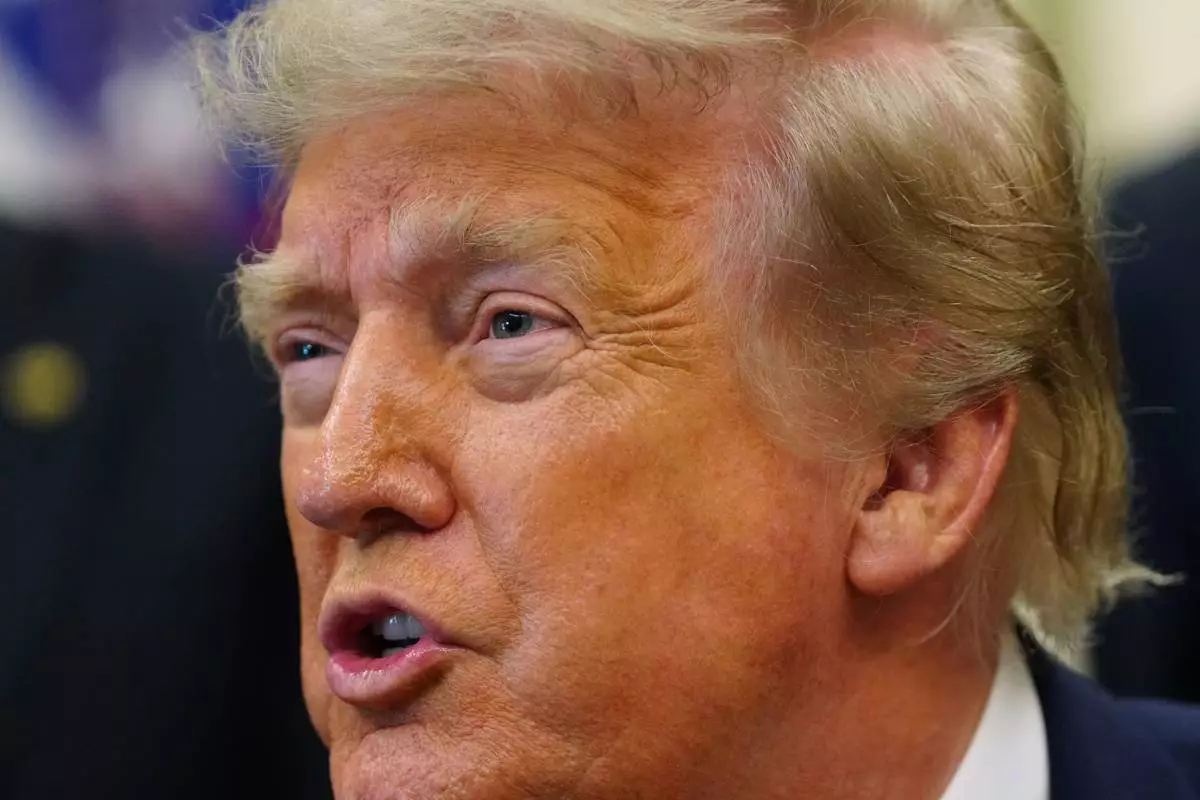
President Donald Trump speaks after signing executive orders modifying the Bears Ears National Monument and the Grand Staircase-Escalante National Monument in the Oval Office of the White House, Monday, July 13, 2026, in Washington. (AP Photo/Julia Demaree Nikhinson)
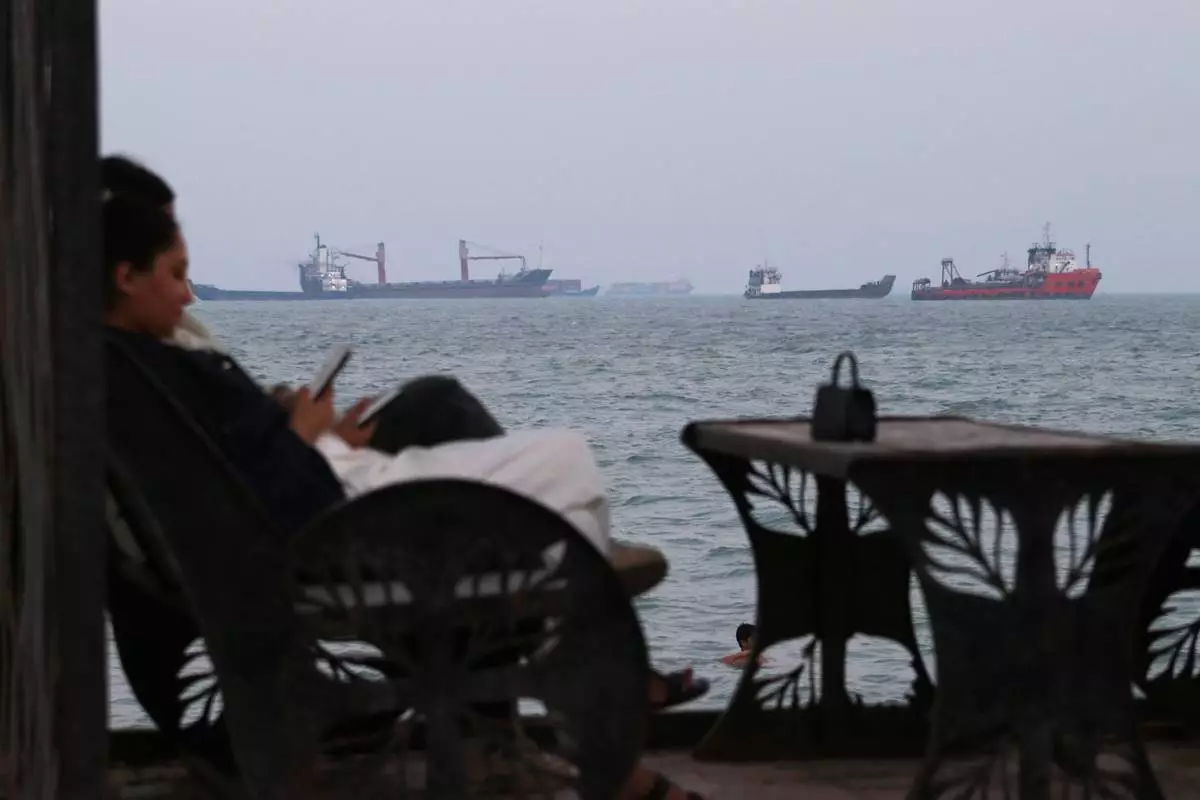
Residents check their cellphones as they sit at a cafe overlooking commercial vessels anchored in the Strait of Hormuz, off Bandar Abbas, Iran, Sunday, July 12, 2026. (Razieh Poudat/ISNA via AP)

People swim and spend time along the shore of the Strait of Hormuz, off Bandar Abbas, Iran, Sunday, July 12, 2026. (Razieh Poudat/ISNA via AP)
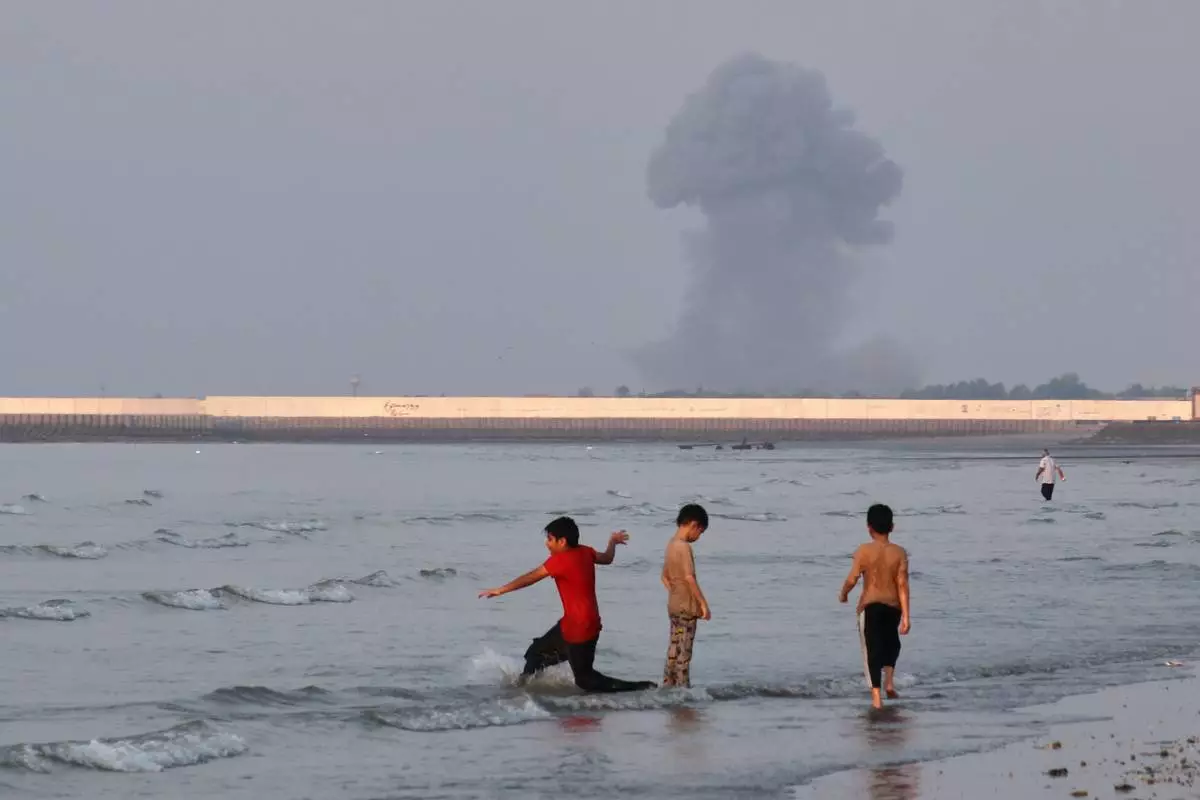
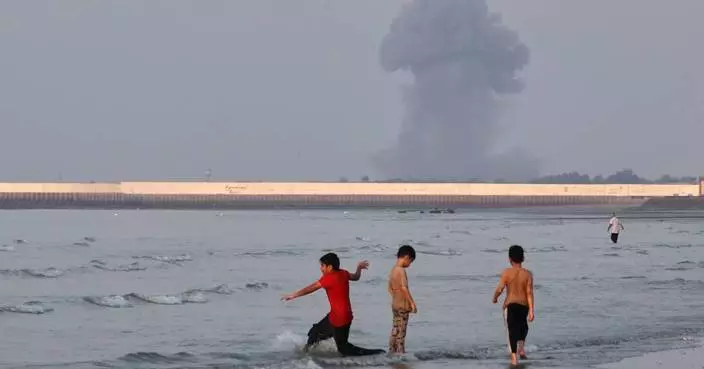
Three boys play in the shallow waters of the Strait of Hormuz, as a plume of smoke rises from an explosion in the background, off Bandar Abbas, Iran, Monday, July 13, 2026. (Razieh Poudat/ISNA via AP)
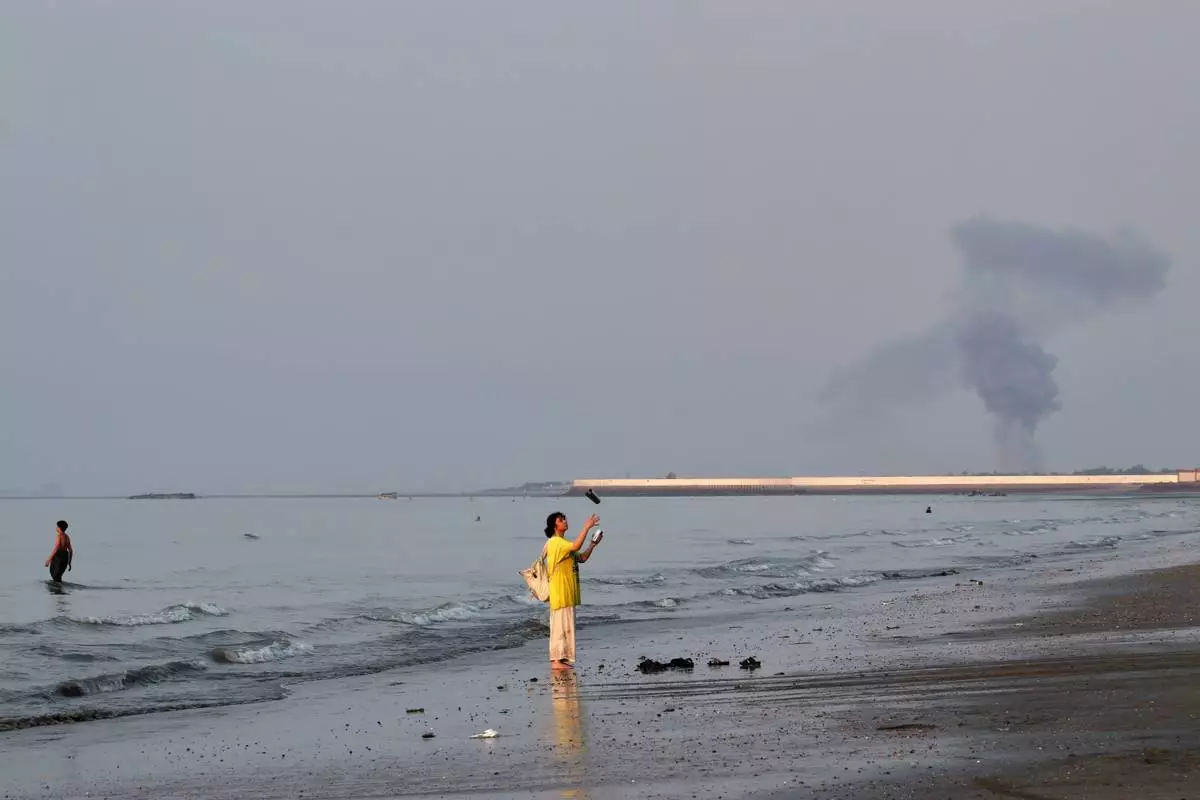
A woman stands at the water's edge along the Strait of Hormuz as a plume of smoke rises in the background following an explosion, off Bandar Abbas, Iran, Monday, July 13, 2026. (Razieh Poudat/ISNA via AP)
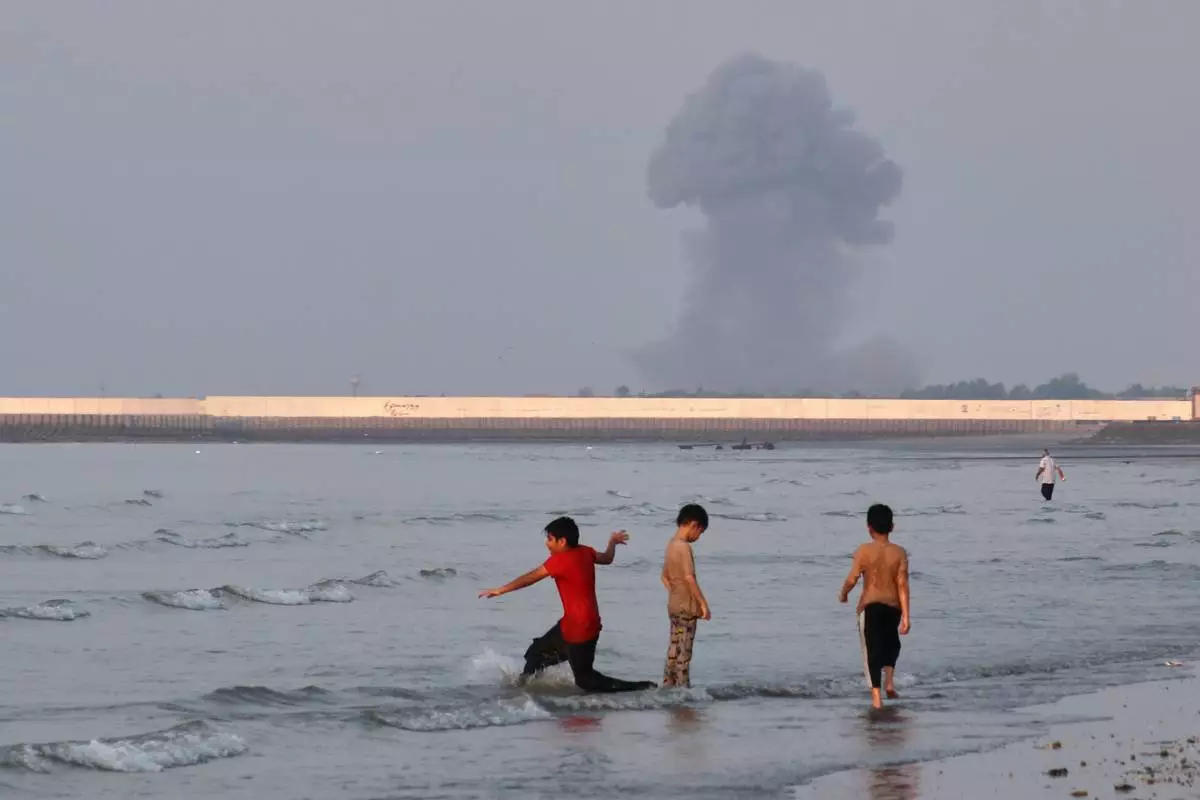
Three boys play in the shallow waters of the Strait of Hormuz, as a plume of smoke rises from an explosion in the background, off Bandar Abbas, Iran, Monday, July 13, 2026. (Razieh Poudat/ISNA via AP)
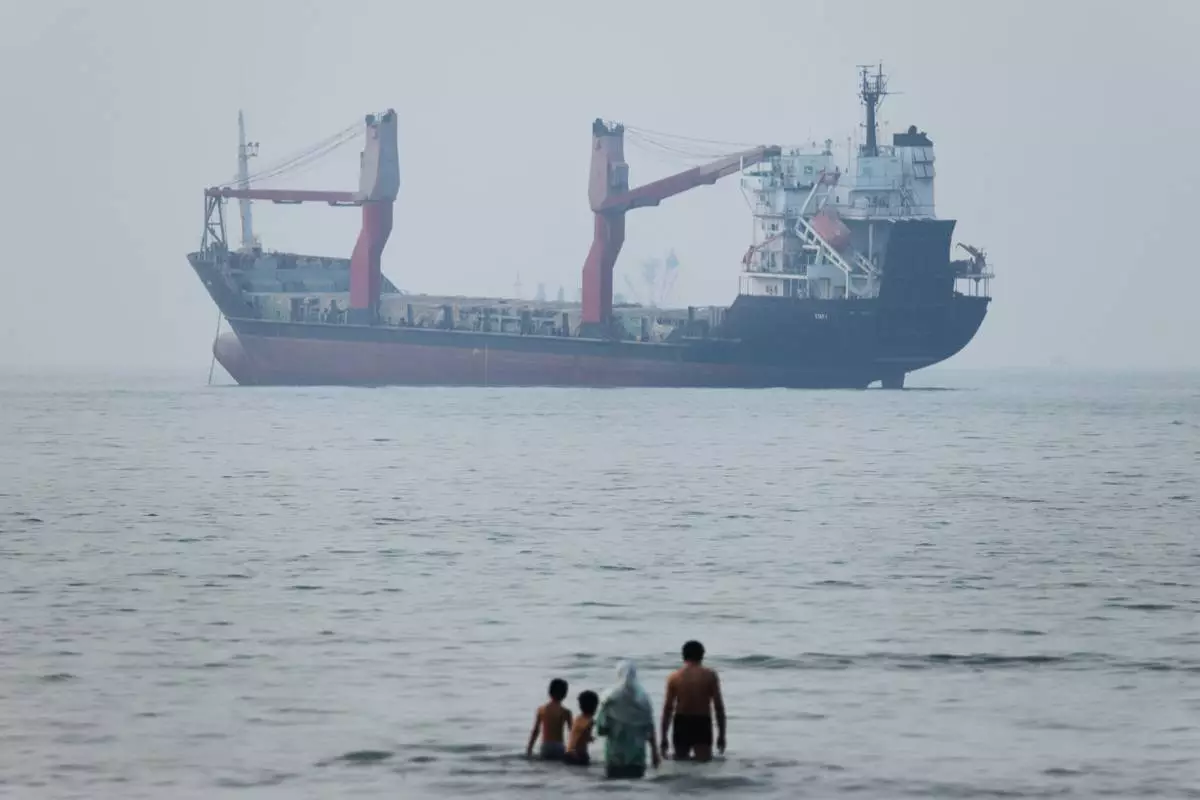
A group of people stands in shallow water as a cargo ship appears anchored in the Strait of Hormuz off Bandar Abbas, Iran, Tuesday, June 30, 2026. (Amirhosein Khorgooi/ISNA via AP)
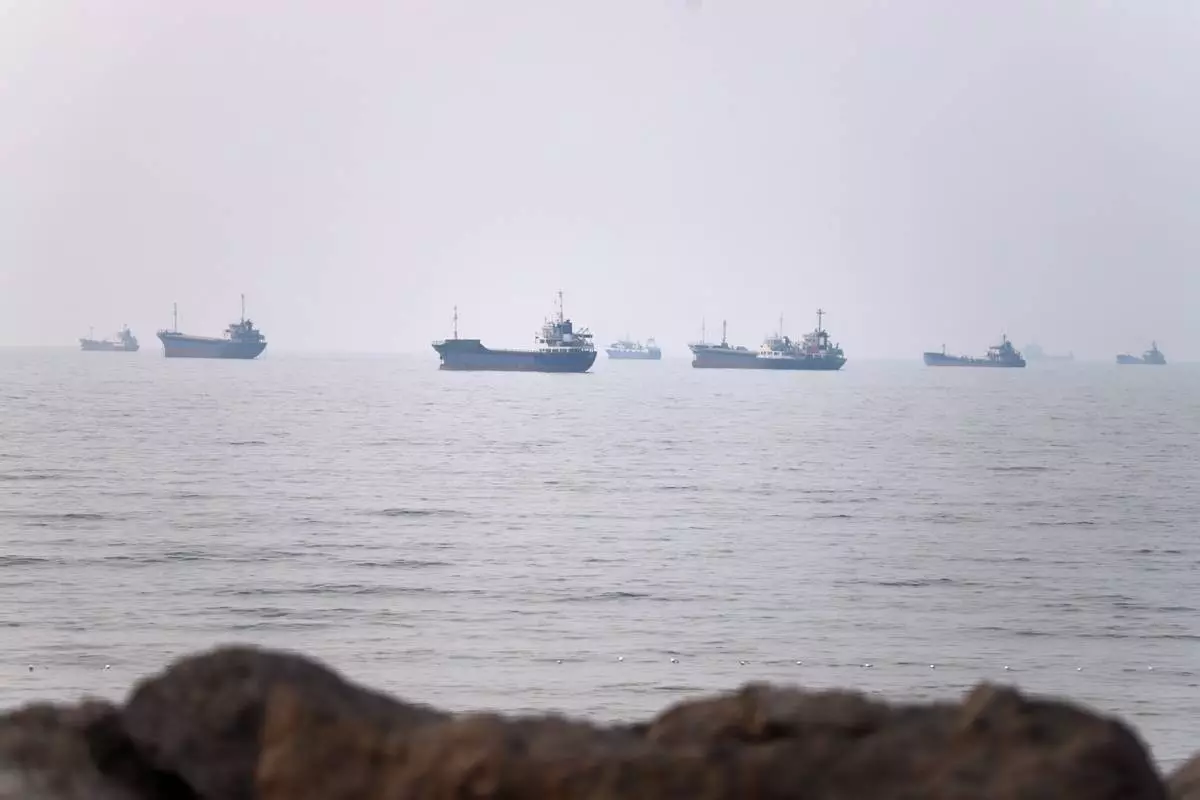
Commercial vessels are seen in the Strait of Hormuz off Bandar Abbas, Iran, Tuesday, June 30, 2026. (Amirhosein Khorgooi/ISNA via AP)