WASHINGTON (AP) — The United States is pausing its participation on a joint board with Canada for continental defense that dates back to World War II, the Pentagon announced Monday, accusing Canada of failing “to make credible progress on its defense commitments.”
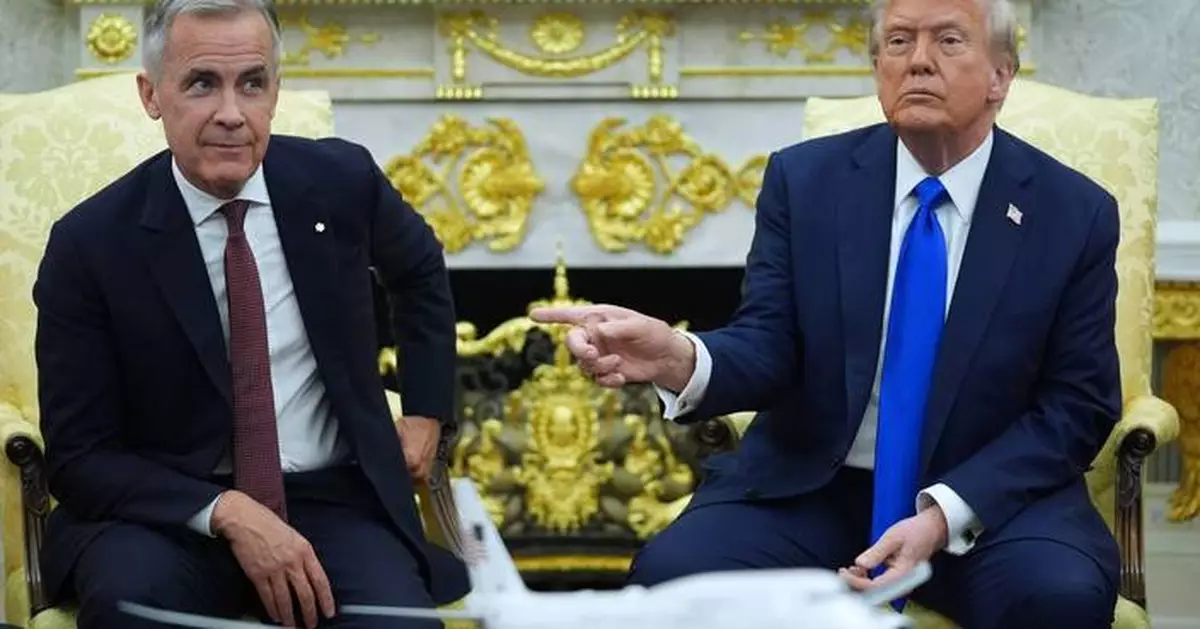
President Donald Trump has long accused Canada and other NATO countries of spending too little on their own militaries, arguing that the U.S. shoulders too much of the defense burden. Tensions with Canada also are simmering over tariffs, an expiring North American trade pact and a feud between Trump and Canadian Prime Minister Mark Carney.
“We can no longer avoid the gaps between rhetoric and reality,” Elbridge Colby, an undersecretary of defense, said in announcing the pause in a string of posts on X. “Real powers must sustain our rhetoric with shared defense and security responsibilities.”
Colby's posts noted the increases in defense spending that Canada and other nations agreed to at a summit in 2025. He said the U.S. will assess how the Permanent Joint Board on Defense, comprised of military and civilian officials from both countries, “benefits shared North American defense.”
European allies and Canada have been investing heavily in their armed forces since Russia launched its all-out invasion of Ukraine in 2022. And NATO countries, including Canada, pledged last year to spend 5% of their gross domestic product on defense by 2035.
Carney said last year the Canadian government would meet the previous 2% target for this year.
The Pentagon said it had nothing further to provide beyond Colby’s posts on X. Carney's office did not immediately respond to an email seeking comment on the Pentagon's announcement.
The announcement reflects a weakening of U.S. relationships with traditional Western allies during Trump's second term. Last week, the Pentagon decided to draw down thousands of American troops in Europe by canceling deployments to Poland and Germany after Trump criticized NATO members for a lack of support for the U.S. and Israeli war against Iran.
Republican Rep. Don Bacon of Nebraska criticized Monday’s decision by the Pentagon, stating in a post on X, “Cooler & wiser brains are needed to preserve a close alliance w/ our neighbor.”
“This all started w/ taunts of ‘Canada will be the 51st state’ & ‘their Prime Minister will be the 51st governor,’" said Bacon, who is not running for reelection. ”The insults gained us nothing but animosity that cost us economically & now militarily.”
The board was established in 1940 — a year before the U.S. entered World War II — by President Franklin D. Roosevelt and Prime Minister Mackenzie King, according to the Congressional Research Service.
Also known as the Ogdensburg Agreement, it helped provide a framework for continental defense during World War II and then the Cold War, according to the Brian Mulroney Institute of Government at St. Francis Xavier University in Nova Scotia.
The board provided advice on the implementation of North American Aerospace Defense Command, or NORAD. The joint command was formed by the two countries in the 1950s to spot potential enemy attacks as tensions rose with the Soviet Union, along with fears of nuclear war.
The board was also involved in the setup of early warning systems using radar stations, the Mulroney Institute said, and advised on the building of the St. Lawrence Seaway, which links the Atlantic Ocean to the Great Lakes.
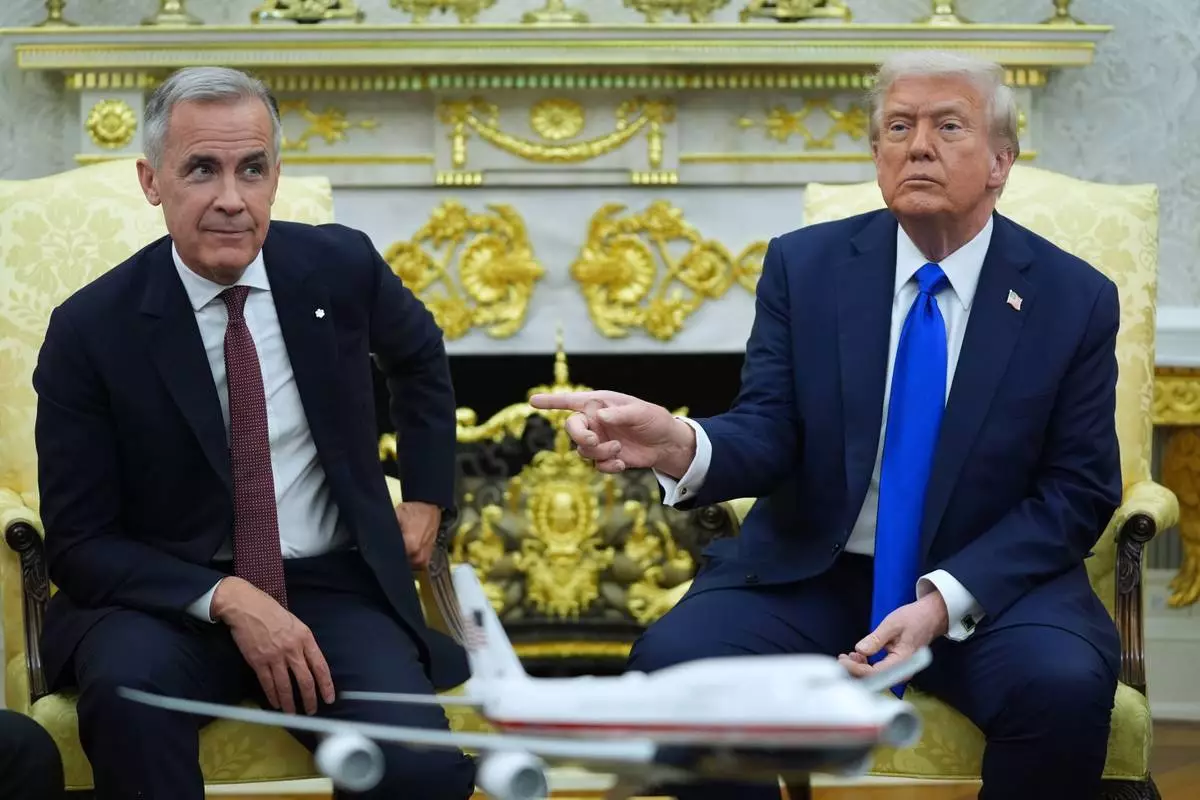
FILE - President Donald Trump gestures alongside Canadian Prime Minister Mark Carney as they meet in the Oval Office of the White House, Oct. 7, 2025, in Washington. (AP Photo/Evan Vucci, File)
The Trump administration's indictment of former Cuban President Raúl Castro in the 1996 downing of civilian planes flown by Miami-based exiles is escalating pressure on the island’s socialist government.
Meanwhile, Senate Republicans are expected to abandon a proposal for $1 billion in security money for the White House complex and Trump’s ballroom on Thursday. And Trump's plan to build a triumphal arch in Washington is getting a second look from the U.S. Commission of Fine Arts, a federal agency that suggested changes before it approved the concept last month.
The Latest:
House and Senate Democrats gathered on the Capitol steps in opposition to Republicans’ funding bill for immigration enforcement.
Democrats are trying to draw a sharp contrast with the upcoming votes by highlighting how the White House has proposed including $1 billion for security for the White House complex and President Donald Trump’s ballroom. Republicans are abandoning that proposal, but Democrats said Congress should be focused instead on making life affordable for everyday Americans.
“Ballroom Republicans are not working for you, they are busy fighting for Trump,” said Senate Democratic leader Chuck Schumer. “The American people are watching and in November, they will be watching.”
House Democratic leader Hakeem Jeffries, for his part, said “immigration enforcement in this country should be fair. It should be just, and it should be humane.”
▶ Read more
Cuba is accusing the Trump administration of hypocrisy for indicting former President Raul Castro in the downing of civilian planes near its coast 30 years ago, noting that the U.S. president is responsible for many more killings of civilians in international waters this year.
“It is highly cynical that this accusation is made by the same government that has murdered nearly 200 people and destroyed 57 vessels in international waters of the Caribbean and the Pacific, far from the territory of the United States,” the Cuban government response said, adding that the killings “qualify as extrajudicial executions, in accordance with International Law, and murders, according to US laws.”
Trump has justified the attacks as necessary to stem the flow of drugs, while offering little evidence that “narcoterrorists” are in the boats.
The Pentagon inspector general announced a review of whether the attacks on alleged drug-smuggling boats followed an established targeting framework, but said it would not probe the legality of the strikes, which have drawn intense scrutiny.
▶ Read more:
The Trump administration is set to loosen a federal rule that requires grocery stores and air-conditioning companies to reduce greenhouse gases used in cooling equipment. The head of the Environmental Protection Agency, Lee Zeldin, said American families will see lower grocery prices as a result. Trump is scheduled to be joined by executives from Kroger, Piggly Wiggly and other grocery chains for Thursday’s announcement.
Just how much or how quickly loosening the refrigerant rule might ease grocery prices is unclear. The 2020 law reflected a broad bipartisan consensus on the need to quickly phase out domestic use of hydrofluorocarbons, or HFCs, that are thousands of times more potent than carbon dioxide and are considered a major driver of global warming.
▶ Read more:
Trump has been escalating talk about regime change in Cuba ever since he sent the U.S. military to capture Venezuelan President Nicolás Maduro in January. Now a federal indictment of former Cuban leader Raúl Castro is raising questions about whether Trump might try something similar in Havana.
Here’s a timeline of U.S. relations with the communist-run island, including repeated meetings with Raúl Guillermo Rodríguez Castro, the grandson of Castro known as “Raúlito.”
“China always firmly opposes illegal unilateral sanctions that lack a basis in international law and have no authorization from the United Nations Security Council and the abuse of judicial measures, and we also oppose external forces exerting pressure on Cuba under any pretext,” Foreign Ministry spokesperson Guo Jiankun said Thursday.
The U.S. should “stop wielding the stick of sanctions and judicial measures” against the country, Guo added. “China firmly supports Cuba in safeguarding its national sovereignty and national dignity and opposes external interference.”
Trump’s plan to build a triumphal arch in Washington is getting a second look from a federal agency that suggested changes before it approved the concept last month.
The proposed 250-foot (76 meter) arch is one of several projects the Republican president is pursuing alongside a White House ballroom to leave his imprint on Washington. Critics of the project, including an overwhelming number of people who submitted public comment in April, said the arch would be taller than any other monument in the capital city and dominate the skyline.
He has said some of his other projects, such as adding a blue coating to the interior of the Lincoln Memorial Reflecting Pool, will beautify the city in time for July 4 celebrations of America’s 250th birthday.
The U.S. Commission of Fine Arts, whose members were appointed by Trump, approved the concept for the arch at its monthly meeting in April. Commissioners are set to consider and possibly vote on updated plans when they meet again on Thursday.
▶ Read more
The more than a dozen young Republicans who gathered with beers and brightly colored cocktails at a bar called dEcORa in Kentucky this week were picking apart the presidential administration they welcomed with high hopes last year.
By now, their enthusiasm for Trump had curdled into frustration. What poured out at the bar was a sense that the Republican establishment — which they initially applauded Trump for disrupting, but which some now see him sustaining — had forsaken them.
That festering feeling has widened a generational gap between younger and older conservatives as the party slowly begins to consider a future without Trump in charge.
The Republican primary defeat of Rep. Thomas Massie — who had earned a younger and anti-establishment following while feuding with Trump — cost them one of their strongest allies in Congress.
▶ Read more
Senate Republican leaders are expected to abandon a proposal for $1 billion in security money for the White House complex and Trump’s ballroom on Thursday after members of their own party questioned the timing and the lack of detail in the Secret Service request.
Pressured by the White House, Republicans have tried to add the money to a roughly $70 billion bill to restore funding to U.S. Immigration and Customs Enforcement and the Border Patrol. But the security proposal met with backlash from some GOP lawmakers who are questioning the cost and how the taxpayer dollars would be used.
The bill’s text has not yet been released, but the Senate hopes to pass it this week and send it to the House before leaving for a weeklong Memorial Day recess.
Sen. Thom Tillis, R-N.C., said the effort to add the security package to the bill was a “bad idea” and he does not think there is enough backing to pass it, even if the cost were reduced.
▶ Read more
Federal prosecutors on Wednesday announced criminal charges against former Cuban President Raúl Castro in the 1996 downing of civilian planes flown by Miami-based exiles as the Trump administration escalated pressure on the island’s socialist government.
The indictment accuses Castro of ordering the shootdown of two small planes operated by the exile group Brothers to the Rescue. Castro, who turns 95 next month, was Cuba’s defense minister at the time. The charges, which were secretly filed by a grand jury in April, included murder and destruction of an airplane. Five Cuban military pilots were also charged.
Asked to what lengths American authorities would go to bring Castro to face charges in the U.S., acting Attorney General Todd Blanche said: “There was a warrant issued for his arrest. So we expect that he will show up here, by his own will or by another way.”
The charges pose a real threat, observers said, following the capture by U.S. forces in January of former Venezuelan President Nicolás Maduro to face drug charges in New York.
▶ Read more
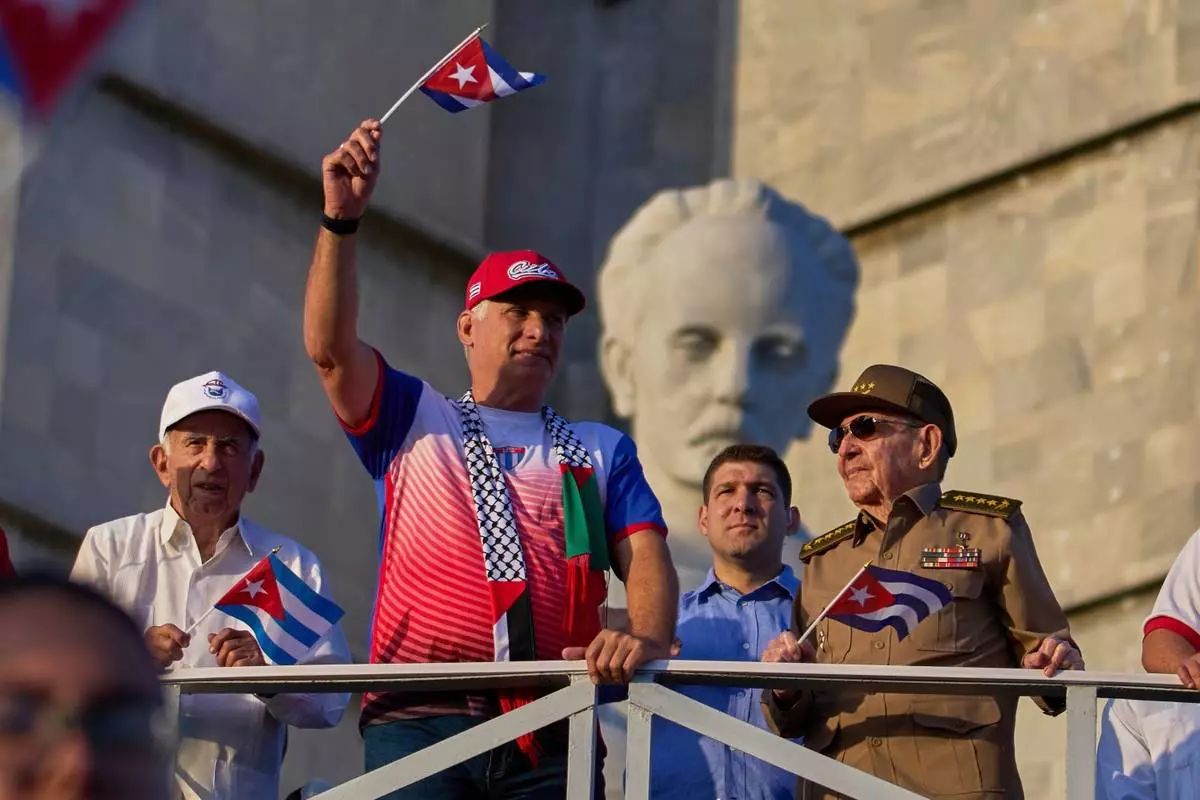
FILE - Raul Castro, right, watches the May Day parade accompanied by Cuba's President Miguel Diaz-Canel, second left, and Castro's grandson, Raul Guillermo Rodriguez Castro, center, at Revolution Square in Havana, May 1, 2025. (AP Photo/Ramon Espinosa, File)
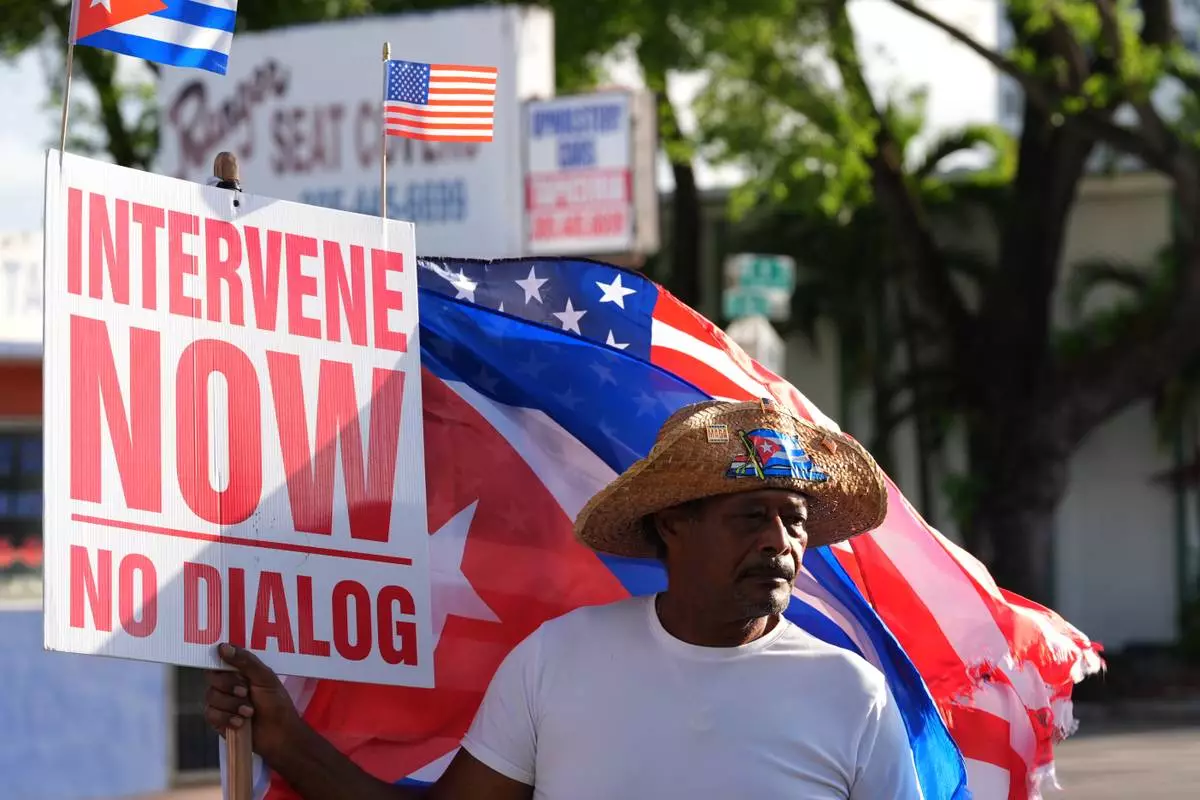
Santiago Ferran holds a sign calling for American intervention in Cuba, as a small group of Cubans turned out to wave flags and hold signs hours after federal prosecutors announced charges against Castro in the 1996 downing of civilian planes operated by Miami-based exiles, Wednesday, May 20, 2026, in Miami. (AP Photo/Rebecca Blackwell)
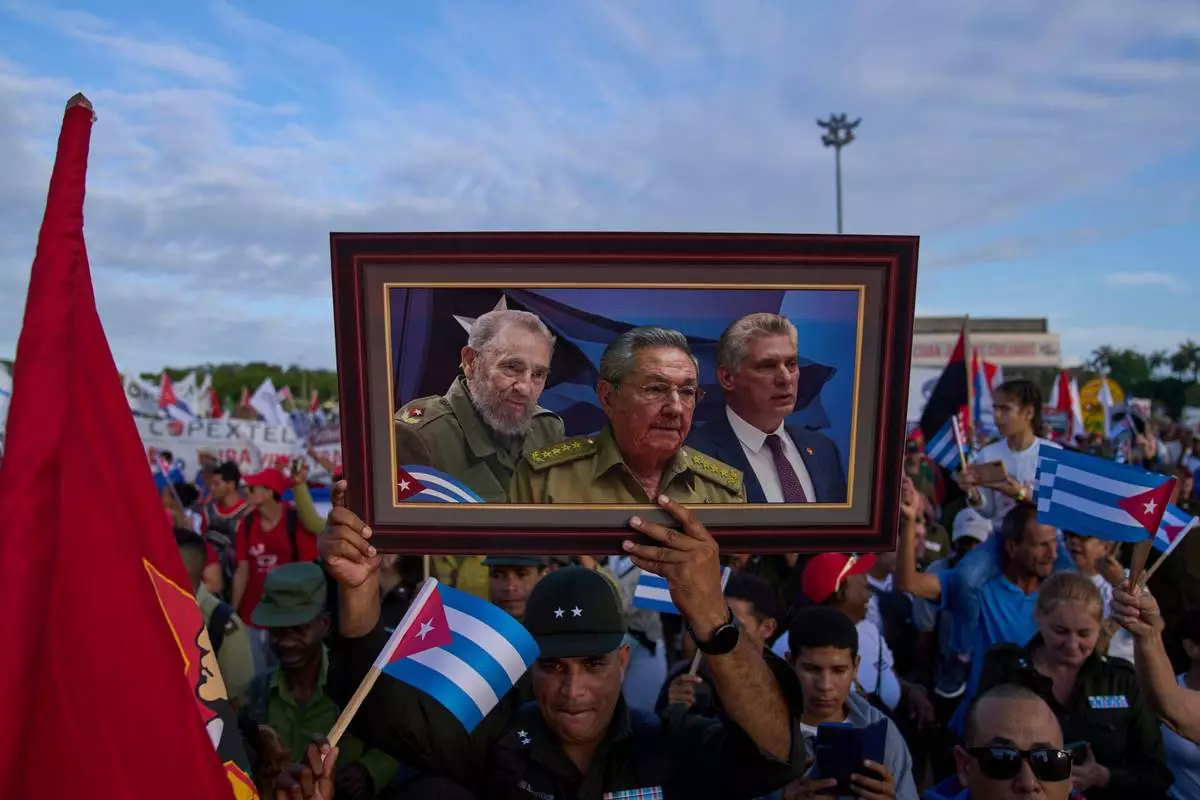
FILE - A marcher holds a framed composite image of Fidel Castro, Raul Castro and Cuba's President Miguel Diaz-Canel, during the May Day parade at Revolution Square in Havana, May 1, 2025. (AP Photo/Ramon Espinosa, File)