NEW YORK--(BUSINESS WIRE)--May 19, 2026--
Nourish, the country’s largest dietitian-led metabolic health clinic, today announced its $100 million Series C, bringing total funding to $215 million. The round was led by Menlo Ventures, with participation from Thrive Capital, Index Ventures, J.P. Morgan Growth Equity Partners, Maverick Ventures, Y Combinator, BoxGroup, Atomico, Daybreak, and Operator Partners. The funding will be used to grow Nourish's clinical network, accelerate investment in AI agents for patients and providers, expand its metabolic clinic care model, and deepen partnerships with health plans, employers, and health systems. With this investment, Menlo Ventures’ partner J.P. Sanday will join the board.
This press release features multimedia. View the full release here: https://www.businesswire.com/news/home/20260512183360/en/
“Chronic disease is the largest cost driver in U.S. healthcare, and the system still isn't built to treat it,” said Aidan Dewar, Co-Founder and CEO of Nourish. “Too often, patients get expensive, reactive, fragmented care that doesn't actually make them healthier. We've built the care model and technology to change that — driving the behavior and lifestyle change that delivers real clinical outcomes at a low cost and great patient experience. The demand from patients, providers, health plans, employers, and health systems has never been clearer, and this round positions us to meet it at scale.”
Nearly 200 million Americans live with nutrition-related chronic conditions, which are the leading drivers of the nearly $5 trillion spent on healthcare annually and more than one million preventable deaths each year. Nourish addresses this through an AI-native metabolic clinic, built to drive behavior change and measurable outcomes. Nourish’s high-quality care produces best-in-class outcomes: 8% weight loss, 1.3 point A1C reduction, 31 point LDL cholesterol reduction, and 23 point systolic blood pressure reduction, resulting in over $2,000 per patient in annual cost savings for health plans.
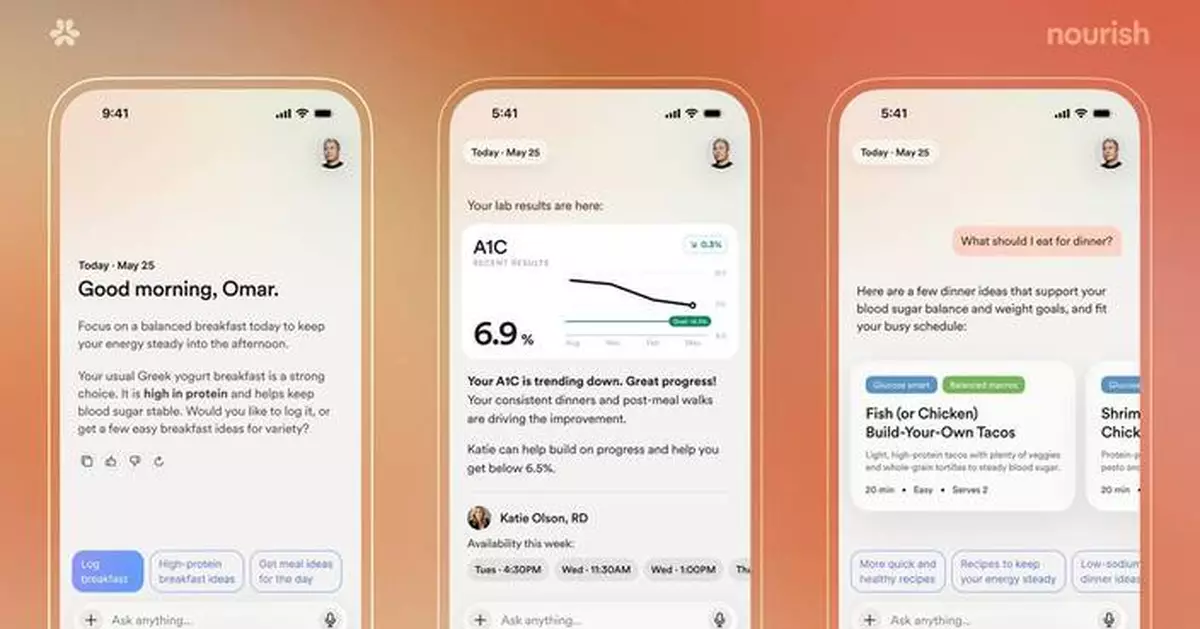
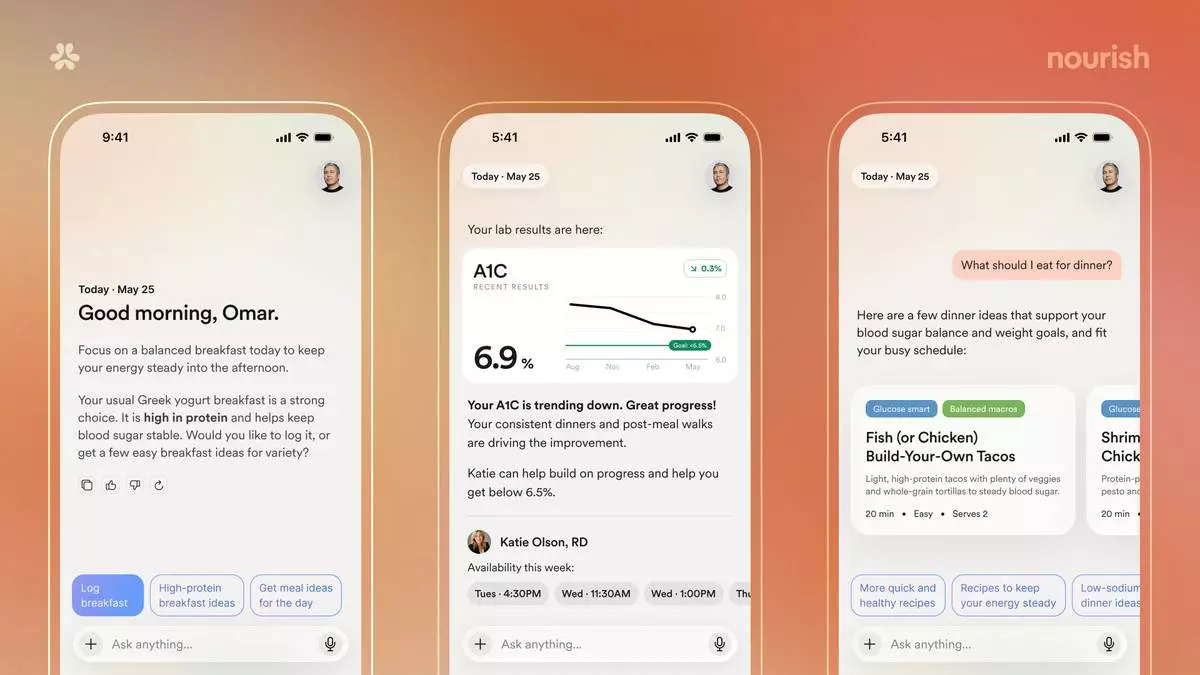
Every Nourish patient works with a Registered Dietitian (RD) virtually and receives a comprehensive care plan — with lab testing, GLP-1 prescribing and medication management, and other virtual medical care layered in based on need, coordinated with each patient's existing providers. Every patient has an AI health agent as part of their care team to proactively support behavior change and coordinate care. Nourish’s AI health agent in its patient-facing mobile app has hundreds of thousands of monthly active users and world-class engagement metrics. For providers, AI copilot agents surface real-time insights and automate administrative work to improve quality of care.
The explosion of GLP-1 medications has accelerated demand for metabolic care, but medication alone is insufficient: fewer than half of patients remain on GLP-1s at six months, and most who discontinue regain the weight without sustained nutrition and behavior support. Payers are under growing pressure to find scalable solutions that actually bend the cost curve. For eligible patients who need access, Nourish integrates responsible prescribing of brand-name, insurance-covered GLP-1s into nutrition-first care, combining medication and lifestyle change into one model that delivers long-term behavior change and sustainable outcomes.
Founded just four years ago, Nourish has scaled its network to over 10,000 Registered Dietitians, has completed millions of appointments, and has more than tripled year-over-year. Nourish has partnered with hundreds of the nation’s leading health plans to provide broad access for more than 200 million covered lives. Nourish has tens of thousands of providers from over 250 health systems referring hundreds of thousands of patients to Nourish’s care model.
“Chronic disease is the central failure of U.S. healthcare — nearly 200 million Americans affected, trillions spent, and outcomes that still don't move. What Nourish has built in four years is remarkable: a care model that actually bends the cost curve, with 10,000 dietitians, deep payer relationships, and clinical outcomes patients stick with,” said J.P. Sanday, Partner at Menlo Ventures. “Most companies get one of those things right. Nourish has all of them. We're proud to lead this round.”
About Nourish
Nourish is the country's largest dietitian-led metabolic health clinic, building the first AI-native virtual care model to tackle America’s healthcare crisis and reverse chronic disease. The company pairs 10,000+ Registered Dietitians with AI agents to deliver insurance-covered, personalized care that produces best-in-class outcomes.
For patients who need access, Nourish integrates GLP-1 medication management, lab testing, and medical care into one care model designed for sustained behavior change. Through partnerships with the nation's largest health plans, health systems, and employers, Nourish is available to over 200 million Americans across all 50 states — typically at no cost. Nourish is actively hiring across clinical and business roles — learn more at nourish.com.
Nourish Raises $100M Series C to Reverse Chronic Disease with AI-Native Metabolic Clinic

Scams in the U.S. have surged to a record high, and most people have been targeted. Americans reported a record $15.9 billion in losses last year to the Federal Trade Commission — a 25% increase from 2024, and likely a huge undercount. The FTC estimates that real losses in 2024 were close to $200 billion, or about $550 million every day.
An investigation by The Associated Press and FRONTLINE found that despite attempts by both the Trump administration and Congress to fight scams, victims still have little recourse. The investigation included interviews with 58 victims.
Here are other takeaways:
— Virtually nobody is immune to scams. Ninety-eight percent of Americans suspect they have been targeted with scam messages, many every day, according to a poll by The Associated Press-NORC Center for Public Affairs Research. Three in 10 said they have personally lost money or information to scams. The 58 victims interviewed by the AP/FRONTLINE were aged 32 to 90, lost several thousand dollars to $4 million each and ranged from IT professionals and academics to people just trying to make ends meet. Several said they contemplated suicide, and two attempted it. Only one got money back, from her bank.
— After the scam, many victims end up paying more in taxes. The IRS often demands that retirees, including scam victims, pay taxes on funds they withdrew from tax-deferred accounts like their retirement savings. Before 2018, victims of theft or fraud could sometimes deduct losses incurred from their taxable income. But under a provision of the Trump administration’s Tax Cuts and Jobs Act, made permanent in 2025, personal losses from many common scams are not eligible for tax breaks. That means victims can owe taxes after money was stolen from them.
— Some victims are also penalized by banks that blame them or even accuse them of being complicit. Victims described having their accounts abruptly frozen or cancelled, along with demands for repayment on loans and legal fees. Earlier this year, American Bankers Association Chair Kenneth Kelly said banks spend “time, money and significant resources” trying to stop fraud, which usually refers to unauthorized transactions. But under current U.S. law, financial institutions are rarely liable for transactions their customers authorize.
— The U.S. lags behind several other countries in protecting consumers. Since late 2024, financial services companies in the United Kingdom have generally had to reimburse clients tricked into sending money to scammers. And trained social workers sometimes visit scam victims. The European Union is also rolling out rules that make financial institutions potentially liable for scammed funds if they don’t put in adequate fraud protections, and its Digital Services Act requires platforms to quickly act on reported scam content. In Australia, financial institutions, telecommunications companies and digital platforms can be fined or forced to compensate victims if they don’t do enough to prevent and respond to scam activity. And in Singapore, banks and telecom companies may have to repay victims of certain phishing scams if they fail to implement required safeguards. Police can temporarily restrict bank transfers of someone who they believe to be a victim, and they sit physically with bank and e-commerce platform staff in a national anti-scam center.
— The rise of cryptocurrency has helped fuel scams because it is a form of digital cash that can be hard to trace to its real owners. China bans crypto-related businesses, while the European Union requires licensing, consumer protections and broad disclosures. But while the Trump administration has backed some cryptocurrency regulation, it has also promised to halt “aggressive enforcement actions and regulatory overreach.” the GENIUS Act signed by President Donald Trump last year to regulate some cryptocurrencies did not require companies to return stolen funds to fraud victims - a gap that consumer advocates, prosecutors and some lawmakers have criticized. Unlike bank deposits, crypto assets are not backed by federal insurance. Many cryptocurrency exchanges operate across borders and through offshore entities where U.S. laws may not apply.
— The U.S. government is waking up to the threat. Congress is considering more than a dozen bills to prevent scams, including one to establish a centralized website for complaints and another to require disclosures on deepfakes and other AI-generated content. The Justice Department in November unveiled a strike force to fight scam centers in Southeast Asia, and the Treasury has levied sanctions on them. President Donald Trump also signed an executive order in March directing the attorney general to prioritize the prosecution of scammers and to submit a recommendation for a program to restore money to victims.
— Fledgling efforts to help victims get money back aren’t keeping up with the tsunami of those who have lost it. Efforts are still piecemeal: At least 13 federal agencies touch on different aspects of these crimes, according to a report issued by the Government Accountability Office. The FBI’s Operation Level Up has stopped about 8,500 people from falling for scams over almost two years by calling them to intervene, according to former FBI Financial Crimes Section chief Rebecca Keithley. But that’s a small fraction of victims, with the FBI receiving nearly 3,000 internet crime complaints a day on average through its IC3.gov portal.
—-
This story is part of an ongoing collaboration between The Associated Press and FRONTLINE (PBS) that includes the documentary “Scammed,” premiering Tuesday, Sept. 29, on PBS and online.
—-
The Associated Press receives financial support from multiple private foundations. AP is solely responsible for all content. Find AP’s standards for working with philanthropies, a list of supporters and funded coverage areas at AP.org.
—-
Contact AP’s global investigative team at Investigative@ap.org or https://www.ap.org/tips/
A text message from a scammer who stole $575,000 from Brian Glick is displayed on Glick's phone as he poses for a portrait at his home, Wednesday, June 25, 2025, in Ballston Lake, N.Y. (AP Photo/David Goldman)
Alice Lin, who fought back to recover some of the $720,000 she and her late husband had saved over their lifetime which was stolen by an online scammer, sits at her computer at home, Saturday, May 9, 2026, in Alhambra, Calif. (AP Photo/David Goldman)
Simon, who was targeted by a scammer that stole $800,000 from his retirement savings and asked not to be identified by his full name because he's too ashamed to tell most of his family about the crime, looks out a window from his home, Wednesday, June 17, 2026, in southeastern New York. (AP Photo/David Goldman)
Chris Colocousis looks at a cryptocurrency deposit he made as part of a scam where $405,000 was stolen from his retirement savings, Tuesday, March 10, 2026, at his home in Raynham, Mass. (AP Photo/David Goldman)
Debra Fox, who had $58,000 stolen from her in a romance scam, looks at her phone, Wednesday, May 13, 2026, at her home in Arvada, Colo. (AP Photo/David Goldman)