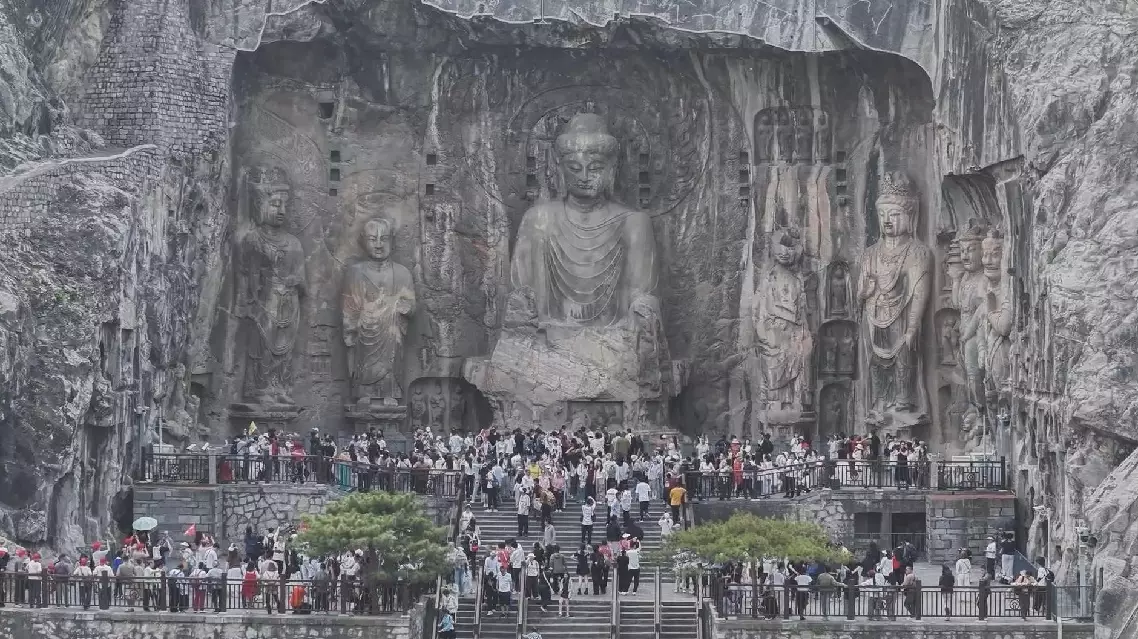
The historic Longmen Grottoes, a treasure trove of Buddhist stone carvings in central China's Henan Province, is drawing growing crowds from home and abroad, with cutting-edge technologies bringing ancient grottoes to life and upgraded services making the site more accessible than ever.
As the UNESCO World Heritage Site enters its peak tourist season, visitors from around the world have been flocking here as early as dawn. They stroll along the banks of the Yihe River, pause to admire carvings dating back more than 1,500 years, and immerse themselves in the brilliance of Tang Dynasty Buddhist art.
"I'm truly awestruck. Standing before these carvings, I can feel the craftsmanship and devotion of the ancients. What they achieved was incredible," said Fan Ke, a visitor.
An increasing number of international travelers are also making their way to the site. Thanks to China's 240-hour visa-free transit policy, the ancient capital of Luoyang has seen a steady rise in inbound tourism.
The Longmen scenic area has upgraded its online ticketing services for overseas visitors, allowing for booking and entry with passports. In addition, payment services for foreign bank cards have been fully rolled out to enhance the travel and spending experience for international guests.
"We now offer guided tours in English, Japanese, Korean, and Russian," said Zhang Peng, a tour guide.
As visitor numbers surge, conservation and maintenance efforts are keeping pace. Using digital tools such as big data monitoring and smart prevention systems, staff can now track in real time the environmental and structural factors affecting the grottoes.
"Our monitoring focuses on the general and micro-environments of key cave areas as well as the condition of the stone carvings themselves. The data helps us carry out preservation work promptly and efficiently," said Liu Yi, deputy chief of the Heritage Monitoring Section at the Longmen Grottoes Academy. Centuries of natural wear have left some of the carvings damaged or incomplete. To restore their original appearance, researchers are using 3D printing technology to put together the lost fragments with the main sculptures and display previously scattered relics.
"This Buddha head is currently held at the Shanghai Museum. Through data sharing, we obtained a digital scan of it. Then we created replicas of this carving using 3D printing. Thanks to this technology, visitors can see what these statues originally looked like," said Zhang Guofeng, deputy chief of the Exhibition and Digital Section at the Longmen Grottoes Academy.
According to the Longmen Grottoes Academy, the site welcomed 8.51 million visitors in 2025, a 10.4 percent increase from the previous year. Inbound tourists soared to 124,000, eight times the number recorded the year before. During this year's May Day holiday alone, the grottoes received 344,000 visitors.
UNESCO heritage site Longmen Grottoes boost services, conservation as visitor numbers climb