NEW YORK (AP) — Call him the Trader in Chief.
Recent presidents have stayed away from trading stocks in companies whose fortunes they could lift or scuttle with the stroke of a pen, but Donald Trump smashed that precedent in the first quarter of this year with more than 3,600 buy and sell orders, many of them involving companies whose profits have been directly impacted by his decisions as head of the government.
Among the Trump trades in a recent report filed with a federal ethics agency was as much as $6 million in Nvidia, whose advanced chips Trump approved for sale to China last year. His portfolio also scooped up stocks of several U.S. military suppliers impacted by the Iran war, including Lockheed Martin, General Dynamics and Northrop Grumman.
“If he were defense secretary, he would be committing a crime,” said Richard Painter, the chief White House ethics adviser in the George W. Bush administration and a big critic of congressional trading, too. “Technically he can do this, but it is a fundamental breach of trust.”
U.S. law bans federal employees from holding financial assets that could be impacted by their policy work, but there is a carveout for the president.
A spokesperson for the Trump family business said the president's portfolio is handled by third parties that have “sole and exclusive” authority to make investment decisions.
“Neither President Trump, his family, nor The Trump Organization plays any role in selecting, directing, or approving specific investments,” spokesperson Kimberly Benza said in a statement. “They receive no advance notice of trading activity and provide no input regarding investment decisions or portfolio management."
Ethics officials have pointed out that just the knowledge of what's in his portfolio is problematic because it could impact the president's decisions on everything from health policy to government contracting to war.
The stock trading report filed with the federal Office of Government Ethics runs more than 100 pages, and shows possibly more than $100 million changing hands over three months as stocks were bought and sold at rapid fire pace — an average of 50 trades every day markets were open.
The report shows more purchases than sales, but the precise ratio is impossible to determine because exact figures for each transaction are not given, just ranges.
Trump has traditionally had very little invested in the stock market relative to his net worth, but that could be changing along with his ballooning wealth, which has included a big cash infusion.
Since he became president again, the Trump Organization has taken in tens of millions in upfront fees from overseas developers that want to put his name on resorts and hundreds of millions from cryptocurrency sales, mostly anonymous, making it impossible to know if the purchaser were trying to curry favor with the president.
All recent U.S. presidents have dumped their stocks before assuming office, put their money in broadly diversified funds or set up a “blind” trust so they couldn’t even know what they owned.
The blind trust route was taken by George H.W. Bush, then Bill Clinton. George W. Bush, the son, dumped his stocks. Barack Obama was in broadly diversified mutual funds. Joe Biden didn't trade.
In addition to Nvidia, the president's portfolio includes shares in Apple, Boeing and Tesla. The CEOs of all four companies accompanied Trump on his visit to China recently.
The portfolio also includes Intel, the chipmaker in which the government took a 10% stake last year.
Among many others, the portfolio of the fast-food loving president recently added stock in Shake Shack, Papa John's and Cheesecake Factory.
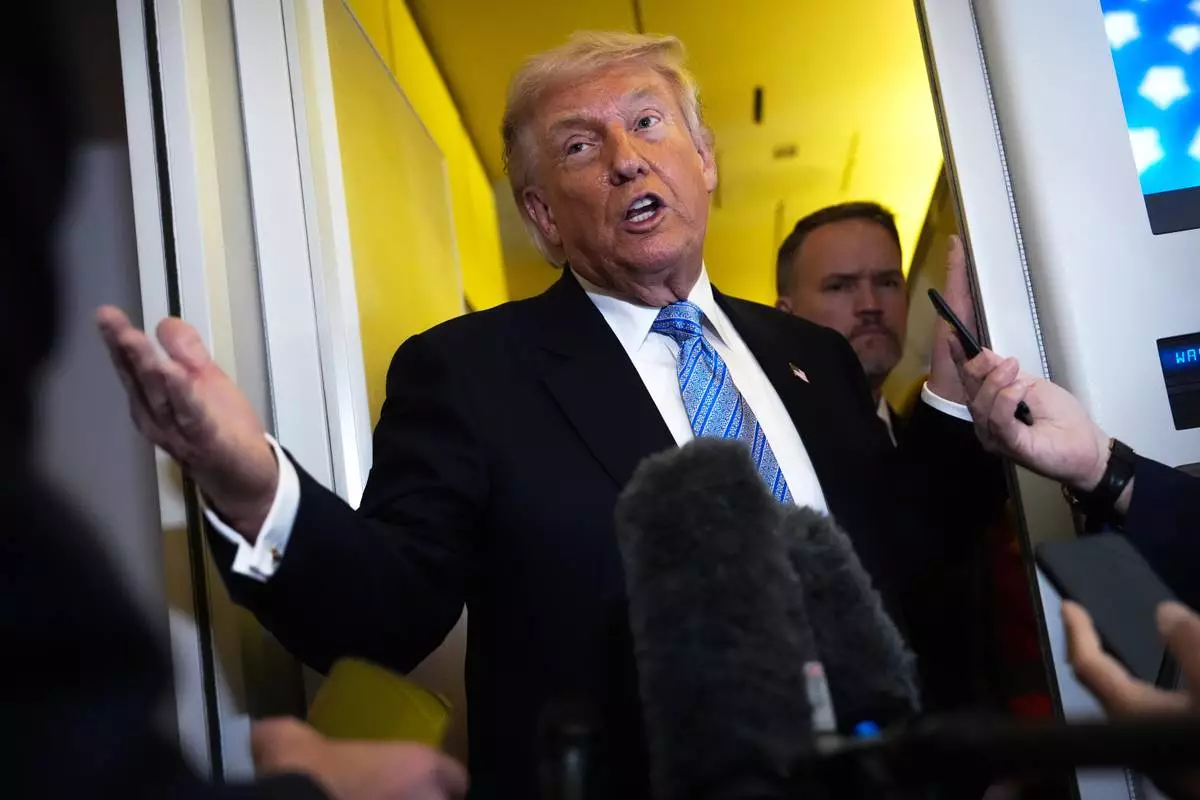
President Donald Trump speaks to reporters aboard Air Force One, Friday, May 15, 2026, as he returns from a trip to Beijing, China. (AP Photo/Mark Schiefelbein)
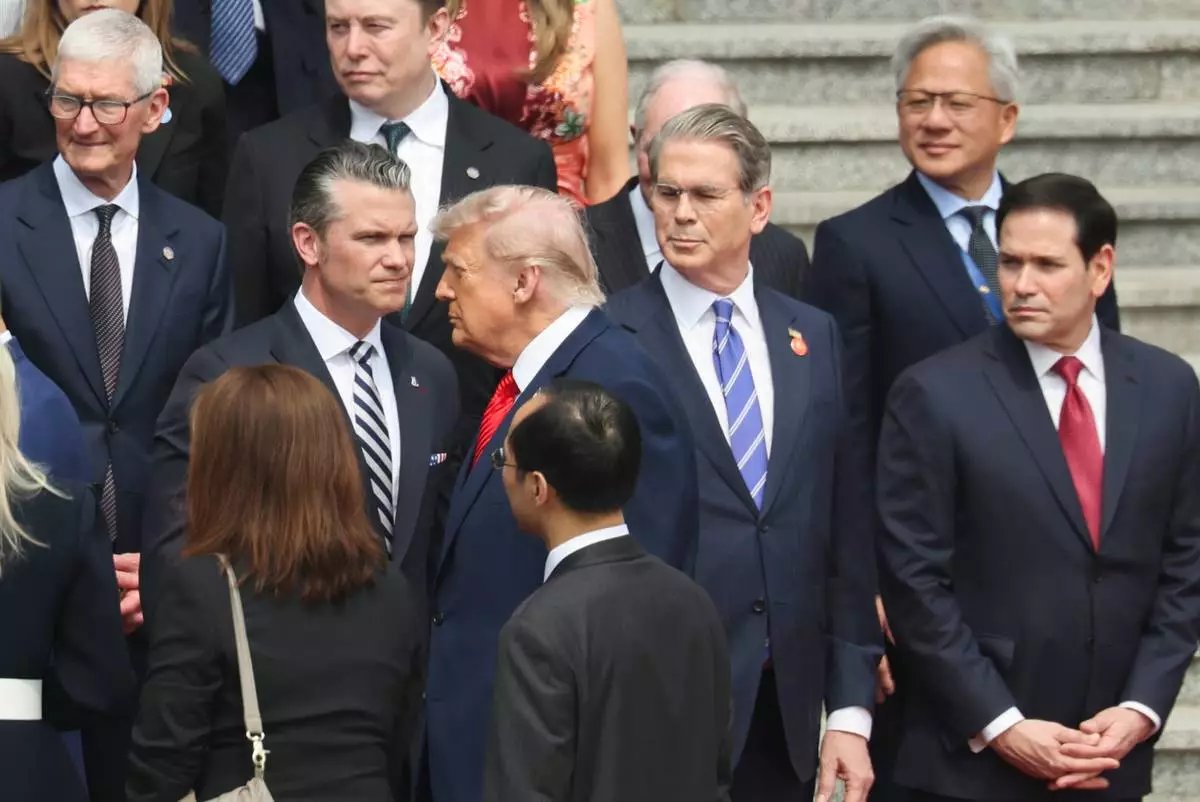
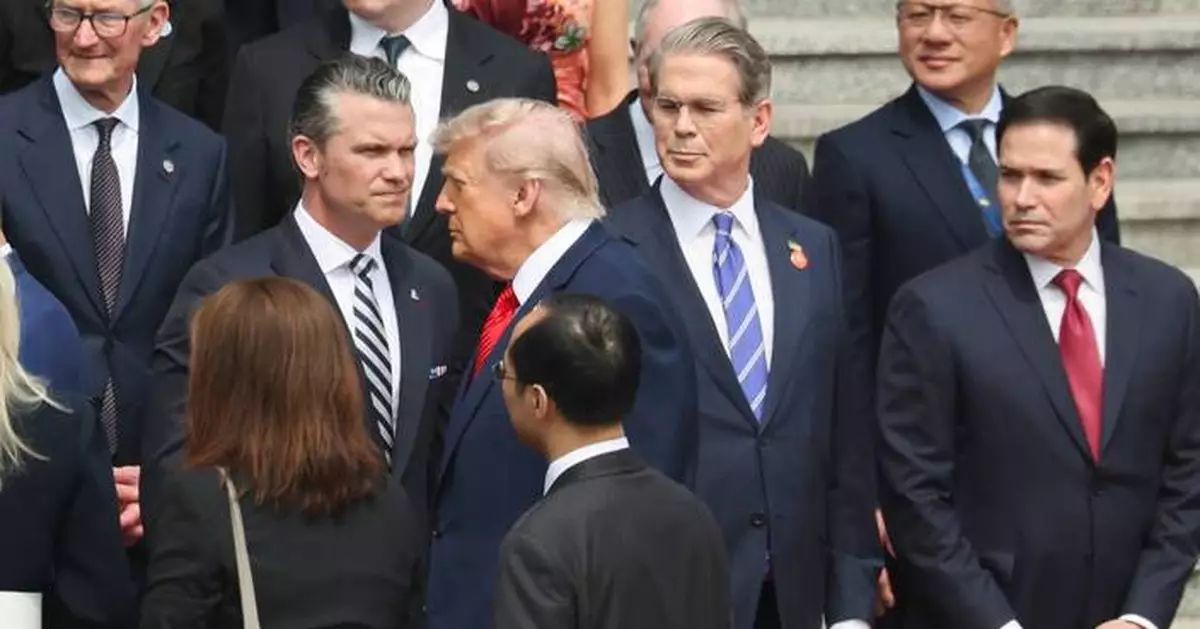
U.S. President Donald Trump looks on next to, from bottom right, U.S. Secretary of State Marco Rubio, U.S. Treasury Secretary Scott Bessent, U.S. Defense Secretary Pete Hegseth, Nvidia CEO Jensen Huang, top right, Tesla CEO Elon Musk, Apple CEO Tim Cook, top left, and others during a welcome ceremony at the Great Hall of the People in Beijing, Thursday, May 14, 2026. (Maxim Shemetov/Pool Photo via AP)
WASHINGTON (AP) — The NAACP and Congressional Black Caucus are calling on Black athletes and fans to boycott the athletic programs of public universities in states that are taking steps that the nation's oldest civil rights group says are restricting Black voting rights.
Launched on Tuesday, the NAACP's “Out of Bounds” campaign urges current and prospective Black athletes, their families, alumni and fans to “withhold athletic and financial support” from major public universities in states that “have moved to limit, weaken or erase Black voting representation.”
If Black athletes participate in the boycott, it could deplete rosters for powerhouse football and basketball programs across the Southeastern Conference and Atlantic Coast Conference.
The NAACP’s campaign calls out Alabama, Florida, Georgia, Louisiana, Mississippi, Texas and South Carolina as states to boycott, arguing that the athletic programs of those states’ major universities are especially reliant on Black athletic talent and should protect Black political interests.
NAACP President Derrick Johnson, during a news conference in front of the U.S. Capitol, accused Republican-led Southern states of “seeking to reinstitute a sharecropping reality” by recruiting Black athletic talent to play for flagship universities while limiting, in his view, “our ability to elect candidates of our choice.”
The ACC, SEC, Florida State University, the University of Alabama, four Historically Black College and University conferences -- the SWAC, MEAC, SIAC and CIAA -- and chapter members of the National African American Athlete Alliance in both Texas and Florida did not return The Associated Press’ request for comment.
The NAACP is among groups responding to a wave of gerrymandering in the aftermath of a U.S.Supreme Court ruling that winnowed a key provision of the Voting Rights Act of 1965. Johnson repeatedly noted that Black athletes have been a core engine of the college sports business, which drives billions in TV deals, revenue and reputational prestige.
“Black athletes should not be asked to generate wealth, prestige, and power for state institutions while those same states strip political power from Black communities,” Johnson said.
“We will fight with all we have in solidarity with the Congressional Black Caucus to ensure that we have representation, or if we don’t, we will withhold the talent that plays on the football field or on the basketball court, be they male or female,” Johnson told reporters.
The boycott is part of a coordinated effort by Black political leaders and civil rights activists to dissuade Republican-led states from redistricting longtime majority-Black congressional districts. Civil rights activists have mobilized across the South to protest moves by state legislatures to change their maps, while voting rights groups and Democratic lawmakers have filed lawsuits seeking to block potential changes to the districts.
And on Monday, the CBC said that it would unanimously oppose the SCORE Act, a bill backed by major athletic conferences that would set new rules for the payment of college athletes, unless the sports leagues oppose the redistricting efforts of GOP-led states.
“The Congressional Black Caucus cannot support legislation benefiting major athletic institutions that continue to remain silent while black voting rights and black political power are being systematically dismantled across the South,” Rep. Yvette Clarke, chair of the Congressional Black Caucus, told reporters.
“The Congressional Black Caucus believes institutions that profit from Black talent and Black communities have a responsibility to stand with those communities when their fundamental rights are under attack,” the CBC said in a Monday letter to the commissioners of the SEC and ACC athletic conferences, as well as NCAA President Charlie Baker. “Silence in the face of injustice is not neutrality — it is complicity.”
After the caucus' announcement, the SCORE Act was pulled from the schedule of the House committee overseeing the bill. Clarke said the decision showed that "silence from our institutions in moments of injustice carries consequences.”
House Minority Leader Hakeem Jeffries said that the boycott was meant to oppose “a dramatic return to racially oppressive Jim Crow-like tactics." He added that while athletes ultimately had to make individual choices, they would be supported by lawmakers and civil rights leaders in their decision-making process.
“We’re going to support them, and we know they have options,” Jeffries said.
The timing of the initiative comes at a moment in the college athletic calendar that might make it difficult for it to have any immediate impact. The transfer portals for the high-profile Division I sports of football and basketball are all closed until 2027.
There may be an opportunity to influence prominent high school recruits who are still weighing their college prospects for the fall of 2027 and beyond. While many schools have received nonbinding verbal agreements from football and basketball players, those agreements won’t become official until late fall at the earliest.
The signing window for basketball opens in mid-November -- about a week after the midterm elections -- and the 72-hour early signing period for football arrives in the first week of December.
There is a chance that recruits could attempt to put pressure on flagship institutions in the targeted states by threatening to sign somewhere else. The reality, however, is that the pockets of those schools run deep, and asking a teenager to factor politics into a decision that could produce a life-altering financial windfall before they are even old enough to vote could prove tenuous.
Brandon Copeland, CEO of Athletes.org, the emerging college players association that aims to represent student athletes, told reporters that opposition to the SCORE Act and redistricting efforts are linked.
“It's really a control mechanism,” Copeland said of the SCORE Act's proposed changes. “That same tool is being used to suppress our voices, suppress our votes,” he said. Copeland, a former professional football player, said his organization will “stand tall alongside our athletes, but also alongside our mothers, our uncles, our aunts, our cousins, and everyone in this nation who deserves a voice.”
Activists have sought pressure points to dissuade GOP-led states from redistricting maps, including calls for mass protests and economic boycotts, though Johnson and the Black Caucus members did not endorse further measures, like calling for major Southern companies to relocate or for Black voters to leave states that take up redistricting plans.
Johnson cited the 2015 decision by the University of Mississippi to remove the Confederate flag from its campus, and Mississippi's later decision to change its flag entirely, as successful demonstrations by Black student athletes, who in both cases expressed opposition to the flag's presence on campus.
In 2024, the NAACP urged student-athletes to reconsider attending Florida universities due to the state's bans on diversity, equity and inclusion policies and policies on the teaching of history in schools.
Lawmakers and activists have made such calls in the past, like when in 2021 Black lawmakers, activists and clergy called for a boycott of Georgia companies over the Republican state legislature's implementation of a sweeping law that Democrats accused of enacting “Jim Crow 2.0.”
Major League Baseball decided to move its All-Star Game from the state that year over the protests, a move that enraged Republican lawmakers, who saw the effort as misguided. The All-Star Game returned to the Atlanta area in 2025.
Associated Press sports writer Will Graves in Monroeville, Pennsylvania, contributed.
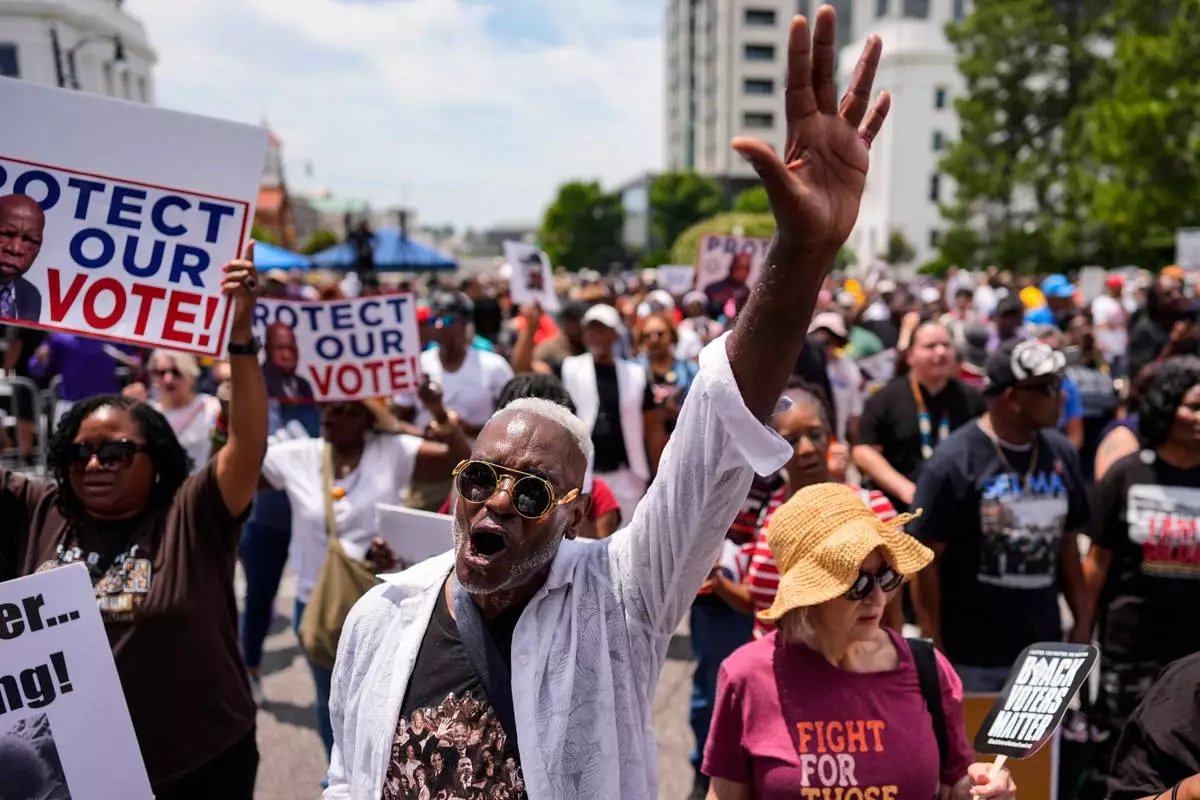
A man sings a spirtual song during a voting rally, Saturday, May 16, 2026, in Montgomery, Ala. (AP Photo/Mike Stewart)
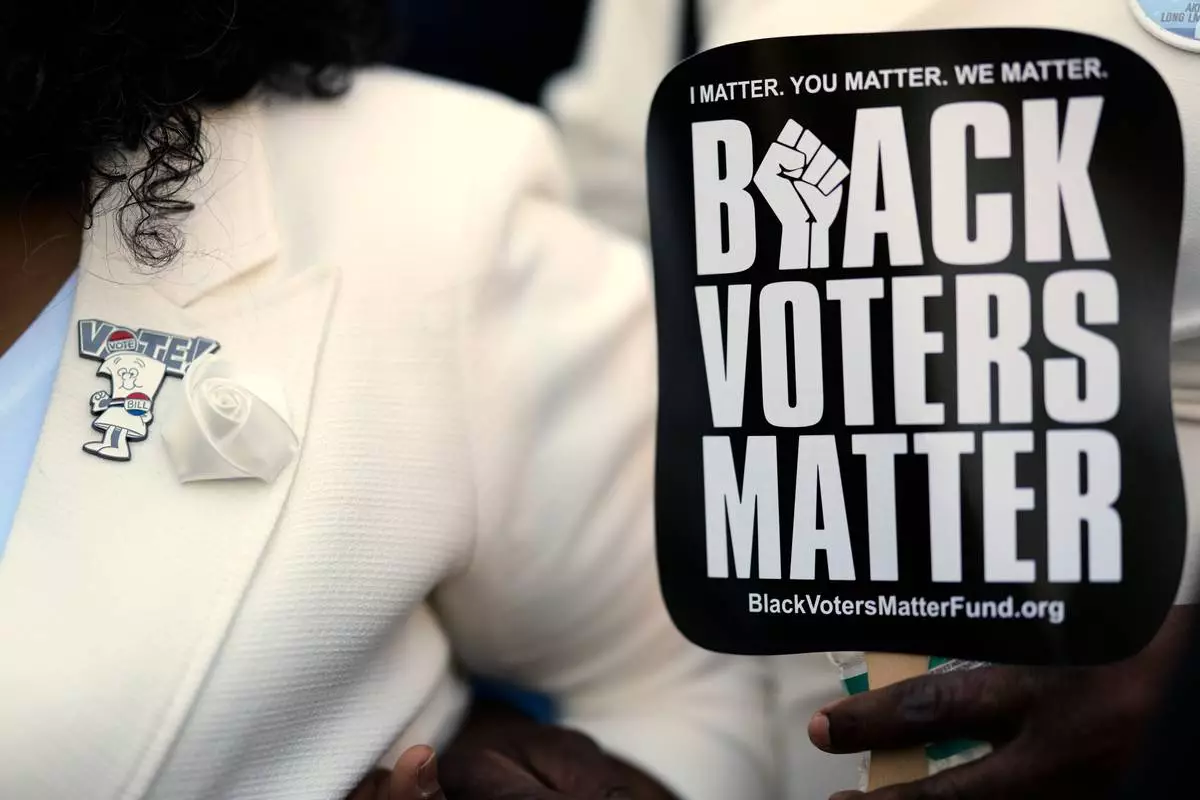
A vote pin is seen on the lapel of Sen. Raumesh Akbari, D-Memphis, during a rally after a special session of the state legislature to redraw U.S. Congressional voting maps Thursday, May 7, 2026, in Nashville, Tenn. (AP Photo/George Walker IV)
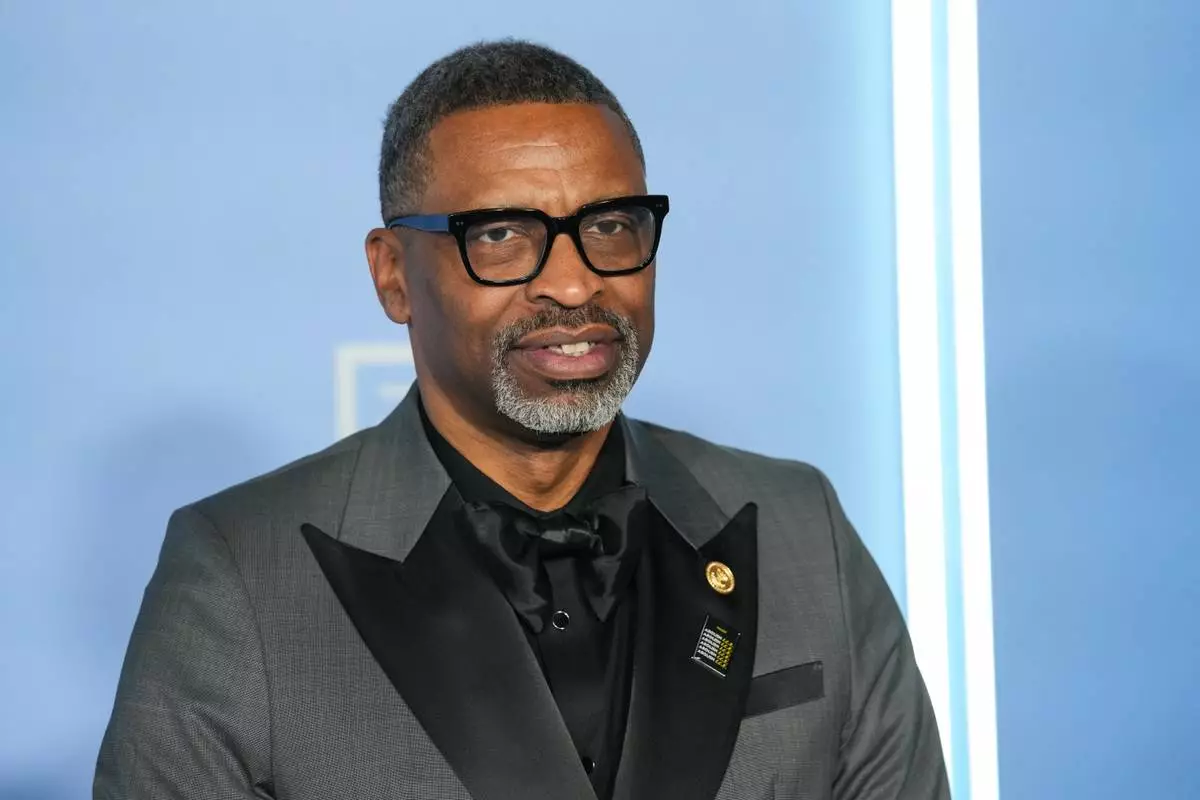
FILE - NAACP President Derrick Johnson arrives at the 57th NAACP Image Awards, Feb. 28, 2026, in Pasadena, Calif. (AP Photo/Chris Pizzello, File)