SEOUL, South Korea (AP) — Management and union leaders at Samsung Electronics failed to reach a last-minute deal over wages Wednesday, raising prospects for a strike at the South Korean electronics giant that could rattle global semiconductor supplies and the country’s trade-dependent economy.
Government officials have threatened to invoke rarely used emergency powers to force a settlement at Samsung, where the union, which represents more than 70,000 workers, says the company has failed to offer adequate compensation despite its soaring profits fueled by the global boom in artificial intelligence.
After the latest round of talks ended without a breakthrough on Wednesday, union leader Choi Seung-ho told reporters that unionized workers will begin an 18-day strike from Thursday.
Both the union and the management held each other responsible for a failure to reach a deal. Choi accused management of refusing to accept a government-mediated proposal whose details he refused to disclose. The management accused the union of calling for excessive compensation packages for workers at loss-making units.
The two sides said they will continue efforts to reach a deal. The two sides met again Wednesday afternoon at the arrangement of Labor Minister Kim Younghoon, according to Kim’s ministry.
Samsung and its cross-town rival, SK Hynix, together produce about two-thirds of the world’s memory chips, which are seeing surging demand driven by AI. Samsung said last month its operating profit for the January-March quarter jumped eightfold to a record 57.2 trillion won ($38 billion).
Union leaders have demanded a compensation structure in which Samsung would commit to spend 15% of its annual operating profit on employee bonuses and scrap bonus caps, which are currently set at 50% of annual salaries. The company says the demands are excessive, citing the highly cyclical nature of the semiconductor business.
Prime Minister Kim Min-seok, the government’s No. 2 official after President Lee Jae Myung, said in a televised statement Sunday that the strike could cause up to 100 trillion won ($66 billion) in economic damage by disrupting Samsung’s highly complex semiconductor manufacturing processes.
The planned strike also has a potential global impact. Given that supply in the global memory semiconductor market is struggling to keep up with demand, the Samsung strike was expected to further drive up prices and push back AI infrastructure investments in other countries, said Lee Jun, an expert at the Korea Institute for Industrial Economics and Trade.
The strike was expected to hurt operations of Samsung’s production of smartphones and other consumer electronics as well, observers say.
A local court on Monday partially granted the company’s request for an injunction against the planned strike, ruling that the union must maintain certain staffing levels to prevent damage to facilities and materials and ensure safe operations. The Suwon District Court also barred unionists from occupying key facilities and offices.

The logo of the Samsung Electronics Co. is seen at its office in Seoul, South Korea, Wednesday, May 20, 2026. (AP Photo/Ahn Young-joon)

The logo of the Samsung Electronics Co. is seen at its office in Seoul, South Korea, Wednesday, May 20, 2026. (AP Photo/Ahn Young-joon)
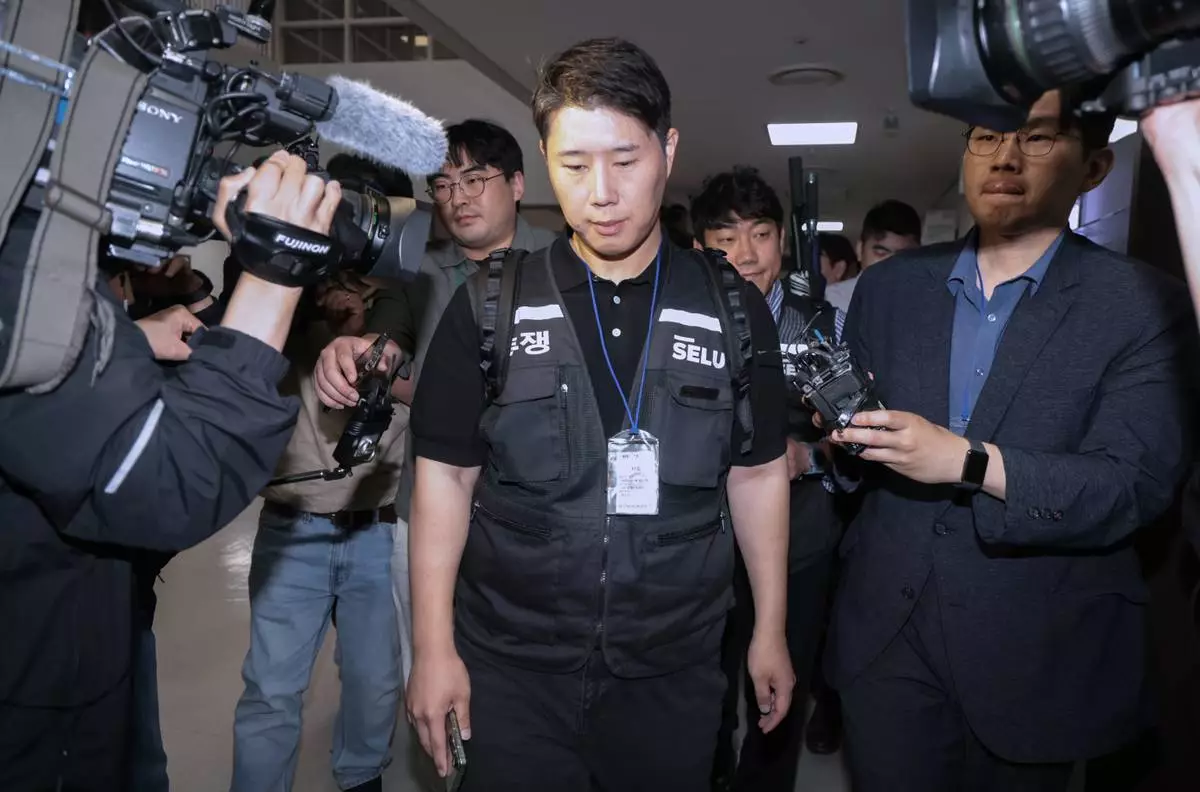
Choi Seung-ho, a leader of the Samsung Electronics labor union, leaves after attending the government-led mediation talks with management at the National Labor Relations Commission office in Sejong, South Korea, Wednesday, May 20, 2026 (Yonhap via AP)
VILNIUS, Lithuania (AP) — Residents of Vilnius were told to take shelter and Lithuania's president and prime minister were taken to safe locations Wednesday because of an alarm over drone activity near the border with Belarus, underlining jitters on NATO's eastern flank over incursions related to Russia's war with Ukraine.
An emergency announcement from the military told people in the Vilnius region to “immediately head to a shelter or a safe place.”
The alert, which lasted for about an hour, also led to the closure of the airspace over Vilnius Airport. President Gitanas Nauseda and Prime Minister Inga Ruginiene were taken to shelters, and there was also an evacuation order at Lithuania's parliament, the Seimas, the BNS news agency reported.
It was the first major alert that sent residents and political leaders in a European Union and NATO capital rushing to shelters since Russia’s full-scale invasion of Ukraine in February 2022.
Lithuania borders Russia-allied Belarus to the east and Russia's Kaliningrad exclave to the west. Wednesday's alert came after the military said it detected drone activity in Belarus, but no drones were sighted over Lithuania.
On Wednesday, NATO Secretary-General Mark Rutte commended the alliance’s reaction to several drone incidents in recent days, saying that they had been met with “a calm, decisive and proportionate response.” Rutte said: “This is exactly what we planned and prepared for,” and he blamed Russia’s war on Ukraine for the problem.
In recent months, Ukrainian drones aimed at Russia have crossed or come down in NATO territory on numerous occasions. Western officials have blamed what they say is likely Russian electronic jamming of the drones. Russia, meanwhile, has renewed threats that it would retaliate if Ukrainian drones are launched from Baltic countries or if those countries are complicit in their use against Russia.
On Tuesday evening, Lithuanian Foreign Minister Kęstutis Budrys wrote on social media that “Russia is deliberately redirecting Ukrainian drones into Baltic airspace while waging smear campaigns” against Lithuania, Latvia and Estonia. “It’s a transparent act of desperation — an attempt to sow chaos and distract from a simple reality: (Ukraine) is hitting Russian military machine hard.”
Budrys' comment came hours after a NATO jet shot down a Ukrainian drone over southern Estonia. Ukraine apologized for that “unintended incident,” without specifying what had happened.
Last week, Latvia’s government collapsed following an argument over the handling of multiple incidents involving stray drones suspected to be from Ukraine. The defense minister was forced to quit after his party withdrew its support for him, and the prime minister then resigned. The governing coalition had been under strain for months over several other issues.
In a recent escalation of aerial attacks, Russia and Ukraine have sometimes fired hundreds of drones a day at each other.
Ukraine’s air force said Wednesday that it shot down 131 out of 154 drones that Russia launched overnight. The ones that got past air defenses killed three civilians and wounded 18 others, including two children, officials said.
Ukraine, meanwhile, continued its aerial campaign against Russia’s vital oil industry, with the General Staff reporting its drones struck a major Russian oil refinery and a pipeline pumping station overnight.
Russian media reports also indicated that a chemical plant in the southern Stavropol region was hit and caught fire, although local officials didn’t confirm any direct hit.
The U.K. government, a strong supporter of Ukraine's war effort, has loosened strict sanctions on Russian oil refined into diesel and jet fuel in third countries as prices rise due to the Iran war.
The waiver begins Wednesday and reflects growing supply concerns over certain fuels due to the effective blockade of the key Strait of Hormuz waterway.
That step comes two days after U.S. Treasury Secretary Scott Bessent announced that Washington was granting a 30-day extension for countries to import Russian oil that is already in tankers at sea, a move that is meant to reduce the oil supply shortages.
The announcement marked a continued policy reversal by the Trump administration, which had previously said the sanctions on Russian oil would resume. Originally announced in early March, the temporary waiver on the sanctions was first renewed in April.
Geir Moulson in Berlin, Lorne Cook in Brussels, Hanna Arhirova in Kyiv, Ukraine and Barry Hatton in Lisbon, Portugal contributed to this report.
Follow the AP’s coverage of the war in Ukraine at https://apnews.com/hub/russia-ukraine
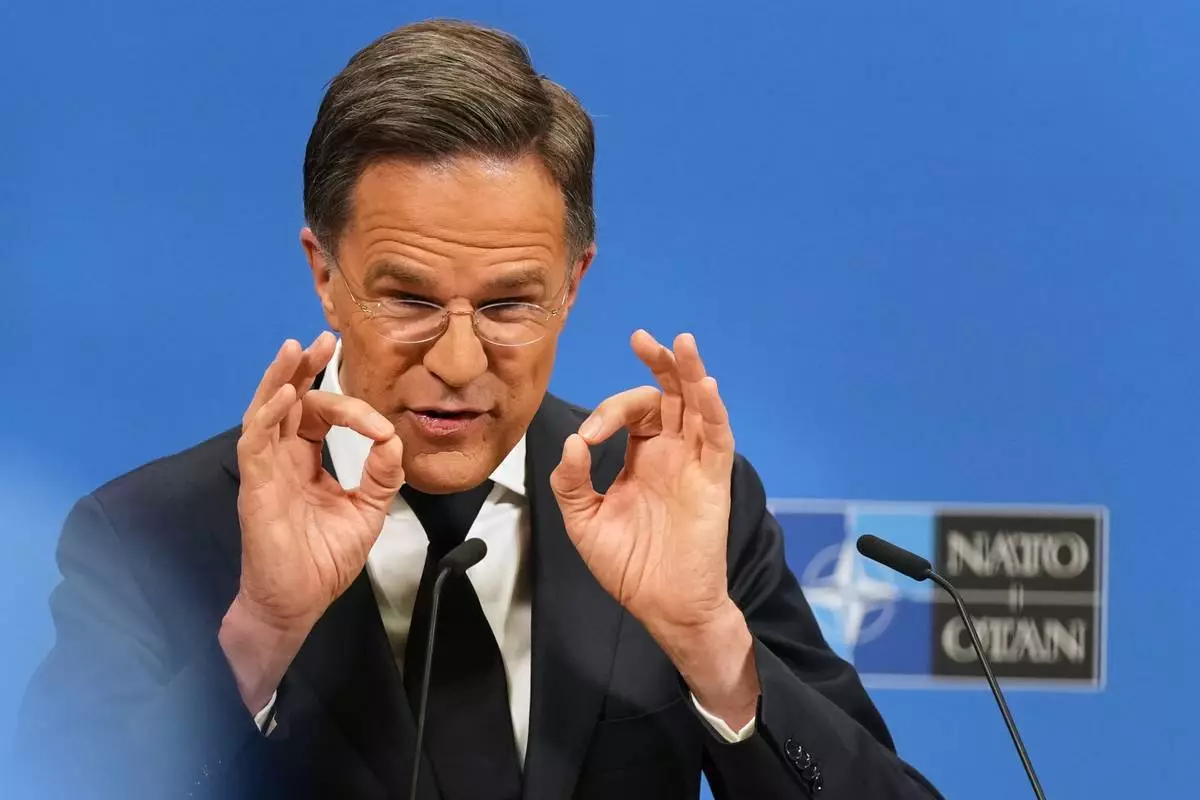
NATO Secretary General Mark Rutte speaks during a media conference at NATO headquarters in Brussels, Wednesday, May 20, 2026. (AP Photo/Virginia Mayo)

People take shelter in an underground car park during an air raid alert in Vilnius, Lithuania, Wednesday, May 20, 2026. (Vygintas Skaraitis/Lrytas via AP)

People take shelter in an underground car park during an air raid alert in Vilnius, Lithuania, Wednesday, May 20, 2026. (Vygintas Skaraitis/Lrytas via AP)
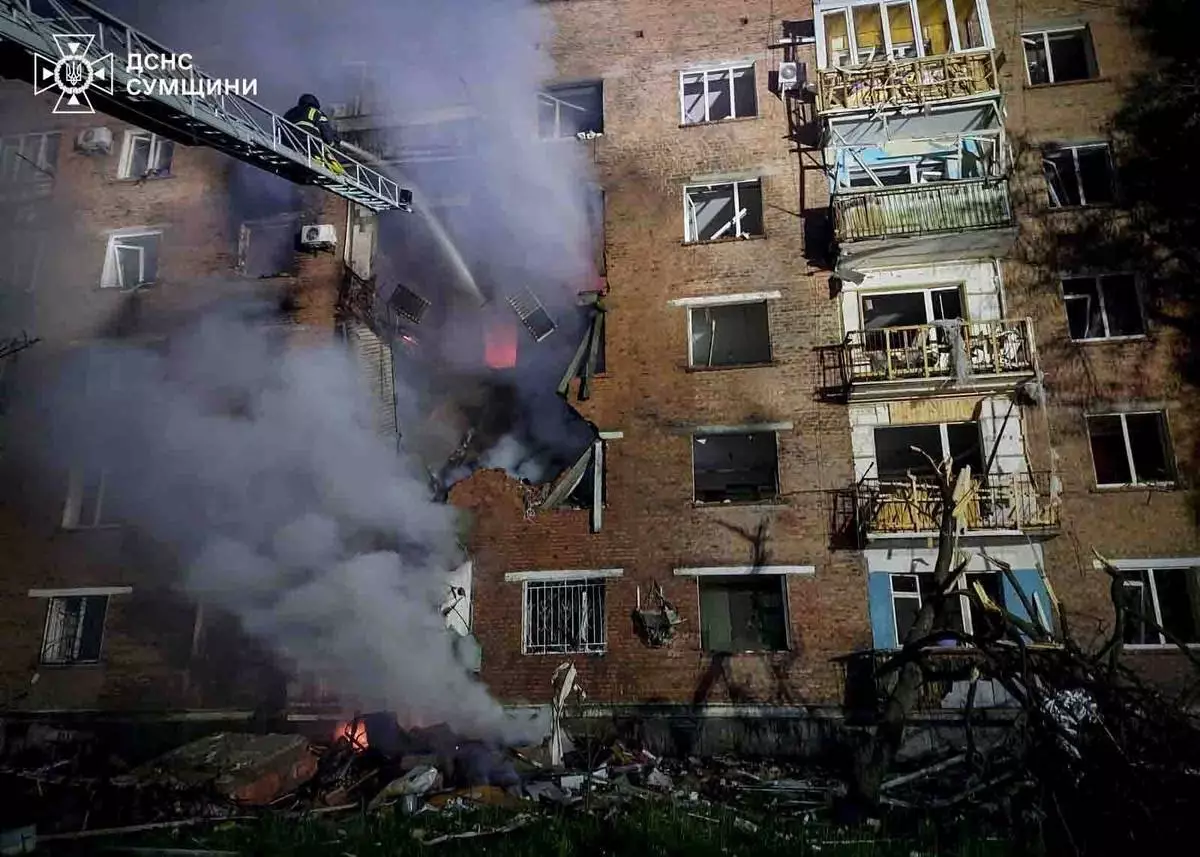
In this photo provided by the Ukrainian Emergency Services on Wednesday, May 20, 2026, rescue workers put out a fire of a residential building damaged after a Russian strike on Konotop, Ukraine. (Ukrainian Emergency Service via AP)

The phone shows the received message "The Lithuanian military reports: "AIR DANGER. Hurry to cover or a safe place without delay, take care of your loved ones, wait for further recommendations. We will inform you about the end of the danger in a separate message", in Vilnius, Lithuania, Wednesday, May 20, 2026. (AP Photo/Mindaugas Kulbis)
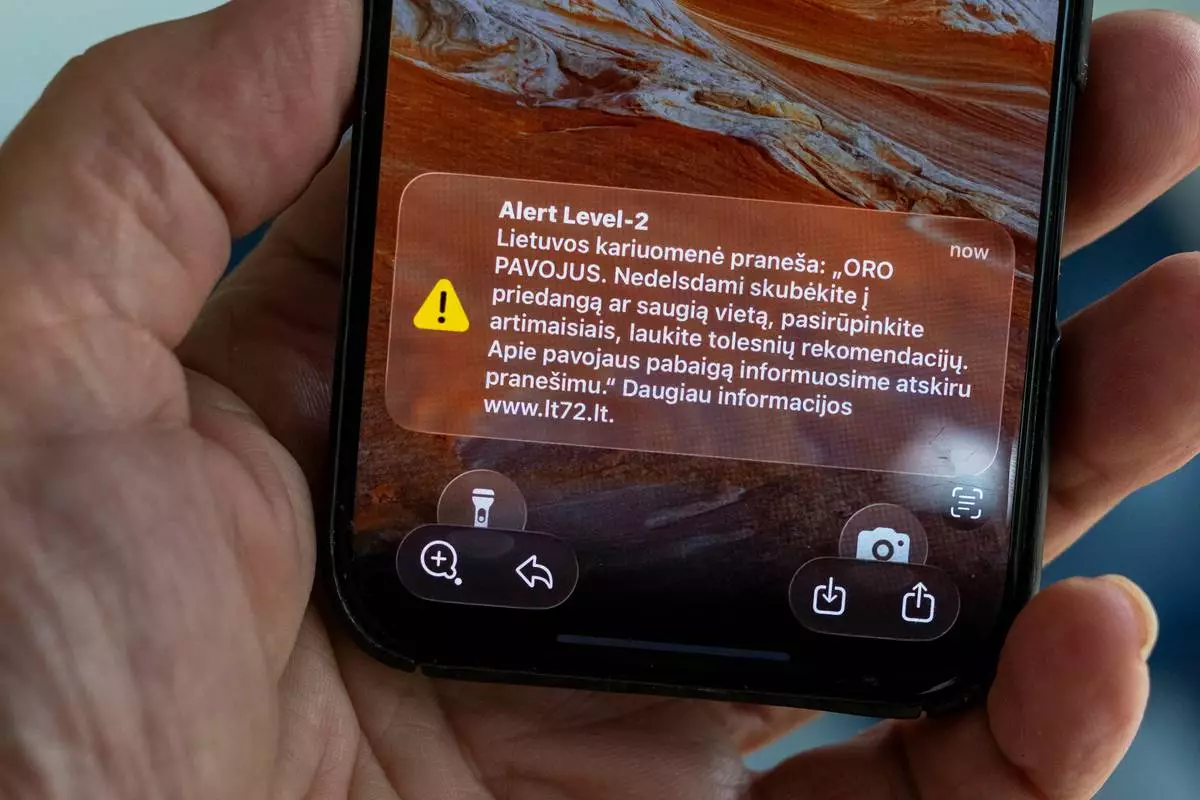
The phone shows the received message "The Lithuanian military reports: "AIR DANGER. Hurry to cover or a safe place without delay, take care of your loved ones, wait for further recommendations. We will inform you about the end of the danger in a separate message", in Vilnius, Lithuania, Wednesday, May 20, 2026. (AP Photo/Mindaugas Kulbis)