China opposes armed attacks on peaceful nuclear facilities and calls on all parties to abide by international law, ensure the safety of nuclear power plants, and exercise maximum restraint to avoid renewed conflict in the Middle East, said Fu Cong, China's permanent representative to the United Nations (UN), on Tuesday.
Fu made the statement at an open meeting of the UN Security Council on the Middle East, which came after the Barakah nuclear power plant in the United Arab Emirates (UAE) was hit by a drone strike on Sunday.
The drone attack on the Barakah nuclear power plant caused a fire in an electrical generator outside the inner perimeter of the plant.
According to the International Atomic Energy Agency (IAEA), radiation levels at the plant remain normal and there were no injuries reported.
IAEA Director General Rafael Grossi said the agency is maintaining close contact with the UAE authorities and is ready to dispatch nuclear safety and security experts to provide on-site support if necessary.
He warned that attacks on operating nuclear power plants are extremely risky. A direct hit or a cut to power supply lines could lead to a severe radioactive leakage, potentially requiring protective measures including evacuation, sheltering, administration of stable iodine and food restrictions.
In his remarks, Fu said the drone attack is a dangerous and irresponsible act and has sounded an alarm for the international community.
"China expresses grave concern over the incident. We oppose armed attacks on peaceful nuclear facilities and call on all parties to comply with international law, including the Convention on Nuclear Safety, and to effectively ensure the safety of nuclear power plants. The sovereignty, security and territorial integrity of all countries in the Gulf region in the Middle East must be respected. Civilians and non-military targets should be protected," Fu said.
He noted that as long as the armed conflict continues, the safety risks it poses to regional nuclear facilities will persist. The ongoing hostilities in the Middle East have already caused severe losses to the people of regional countries, including Iran and Gulf states, while also seriously disrupting the global economy and undermining the common interests of the international community, he said.
A ceasefire is an urgent call of the international community, and any resurgence of hostilities must be avoided, he said. At present, the ceasefire between the United States and Iran is generally holding, but the risk of escalation remains. Fu said all parties should exercise maximum restraint, adhere to the ceasefire arrangements, and refrain from irresponsible rhetoric or military adventurism that could further escalate tensions.
The Chinese envoy stressed that there is no military solution to the conflicts -- dialogue and negotiation are the only viable path. China encourages the U.S. and Iran to stay committed to political resolution, continue to address their differences, including the nuclear issue, through negotiation, with the aim of reaching solutions that take into account the concerns of all parties and help restore peace and stability in the Middle East and the Gulf region at an early date.
Fu also pointed out that the situation in the Strait of Hormuz is a major example of the conflict's spillover effects. Disruption of shipping lanes in the Strait has severely impacted global supply and industrial chains, international trade and energy stability, imposing huge socioeconomic costs on the Global South.
He said that based on a sustained ceasefire, the Strait of Hormuz should be reopened as soon as possible, and the fundamental solution to the issue lies in achieving a permanent and comprehensive ceasefire.
Fu said since the outbreak of the conflict, China has been working actively to promote a ceasefire and peace. He said China will continue to work with the rest of the international community to play a constructive role in bringing a swift end to the hostilities and restoring peace and development in the Middle East.
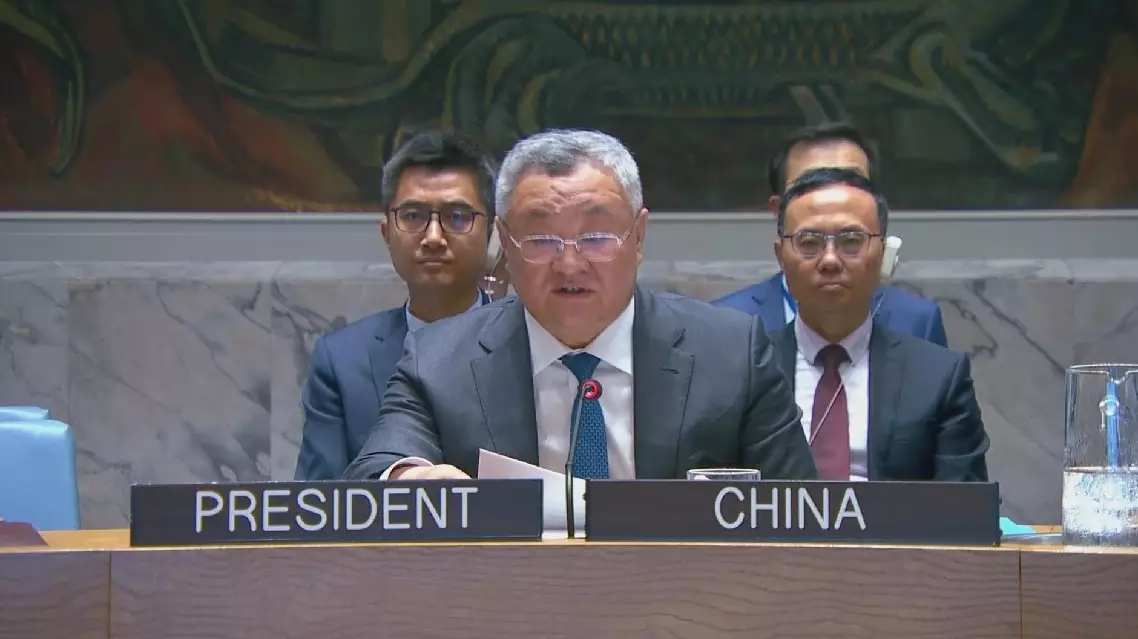
China opposes armed attacks against peaceful nuclear facilities: envoy