A lawsuit filed Wednesday on behalf of students and community organizations in Massachusetts argues the state is illegally maintaining schools that are racially segregated, concentrating Black and Latino students in high-poverty districts with fewer opportunities.
The lawsuit challenges the state's practice of assigning students to schools based solely on where they live, which can lead to patterns of housing segregation being replicated in school systems.
The case is the latest example of efforts to address segregation and funding inequities through state-level litigation. Even before the Trump administration began taking steps to release districts in the Deep South from court-ordered desegregation efforts, integration efforts had fallen far from their peak decades ago when the federal government intervened in school systems around the U.S.
The plaintiffs include nine students and four community organizations from segregated school districts across Massachusetts, including Springfield, Holyoke, Boston, Lawrence, Brockton, Lynn, and Worcester. The districts border more affluent, predominantly white districts where the plaintiffs are unable to enroll.
In response to the lawsuit, the Massachusetts Department of Elementary and Secondary Education said it does not have the authority to change school district boundaries, nor the power to compel schools to allow students from other districts to enroll. It said in a written statement the state has invested in efforts to reduce gaps in graduation rates, and sought additional investments for high-poverty districts.
“Massachusetts leads the nation in student achievement, and we are committed to building on this progress to strengthen our education system for every student in our state,” spokesperson Jacqueline Reis said.
A 2024 state advisory council report found that 63% of all schools in Massachusetts are segregated or intensely segregated, and that the state education department had fallen short in its oversight duties. Schools that have higher concentrations of students of color saw worse outcomes on metrics like graduation and college matriculation.
While the state constitution guarantees students a right to an adequate education and equal protection under the law, it has failed to do so in practice for Black and Latino students, said Jillian Lenson, senior attorney at Lawyers for Civil Rights, which filed the suit with Brown's Promise.
“It's not student potential, it's the conditions of their schools that drive these disparate outcomes, conditions that the state has maintained and perpetuated for decades,” Lenson said.
The lawsuit filed in Massachusetts state court in Suffolk County asks to compel the state to address the disparities that emerge from rules assigning students to schools in areas where they live.
GeDá Jones Herbert, chief legal counsel at Brown's Promise, said the lawsuit is not seeking mandatory integration, but rather an investment in evidence-backed practices that benefit all students.
Those include expanding regional magnet programs and investing more in under-resourced schools. The state has regional vocational schools and voluntary inter-district transfers, but a complex system of opt-outs and the small size of most programs prevent equal access, the plaintiffs said.
“Black and Latino students are blocked out of access to those opportunities, and that's unconstitutional,” Jones Herbet said.
Other recent examples of state-level litigation also have focused on addressing residential segregation.
In 2018, the Latino Action Network and the New Jersey chapter of the NAACP, among other plaintiffs, filed a suit arguing that the state’s system of assigning students based on their residence has created racially segregated schools. And in Minnesota, a 2015 lawsuit asserted that the segregation of schools in Saint Paul and Minneapolis led to inadequate and unequal educations for students of color.
Both cases have been winding their way through state courts, with no decisive resolution.
The state cases come amid shifts in federal enforcement of desegregation in schools. By the early 2000s, a series of Supreme Court cases had significantly limited the tools available to districts to meaningfully integrate schools on the basis of race.
State constitutions, which often have clauses enshrining equality and education, can serve as a pathway for challenges to segregation that results from economics and housing patterns, said Robert Williams, a professor of law emeritus at Rutgers University.
“The government knows about it, but it’s not the government that did it directly,” Williams said. “These cases argue that having so many different school districts that align with housing patterns and having laws that say that you have to go to school where you live, all of those things sort of amount to government segregation.”
The Associated Press’ education coverage receives financial support from multiple private foundations. AP is solely responsible for all content. Find AP’s standards for working with philanthropies, a list of supporters and funded coverage areas at AP.org.

FILE - School backpacks hang on a rack at an elementary school in Orange, Calif., March 18, 2021. (AP Photo/Jae C. Hong, File)

FILE - Public school buses are parked in Springfield, Ill., on Jan. 7, 2015. (AP Photo/Seth Perlman, File)
WASHINGTON (AP) — When acting Attorney General Todd Blanche signed off on a nearly $1.8 billion fund meant to compensate President Donald Trump's allies for alleged political prosecution, he may have pleased his boss.
But the eyebrow-raising move — the latest in his push to prove his loyalty to Trump — has agitated the same Republican lawmakers he would need to secure the permanent job.
Blanche insists he’s not auditioning for the job of attorney general. But a succession of splashy steps the Justice Department has taken under his watch since he took the position on an acting basis last month, including an indictment of former FBI Director James Comey, has left no doubt about the impression he’s hoping to make on the president who appointed him.
The fund in particular has put Blanche at the center of a Republican firestorm at a time when he aims to establish himself as the perfect person for the job for the remainder of Trump’s term. And it sharpened concerns from Democrats and other Blanche critics that he has not shed his mantle as the president’s personal attorney.
“So the nation’s top law enforcement official is asking for a slush fund to pay people who assault cops? Utterly stupid, morally wrong — Take your pick,” Republican Sen. Mitch McConnell of Kentucky, the former majority leader, said in a statement.
A former federal prosecutor in New York, Blanche came to public prominence for his lead role on Trump's defense team, including during the Republican's hush money trial in New York. That perch afforded him, he has said, a firsthand look at what he contends was the weaponization of the criminal justice system against Trump.
He was brought into the Justice Department as deputy attorney general, the No. 2 job, then was elevated last month after Trump ousted Pam Bondi.
Now he finds himself the latest Trump-appointed attorney general to simultaneously confront expectations from subordinates to uphold institutional norms and demands from the president to do his bidding.
Trump's first attorney general, Jeff Sessions, was forced out after the 2018 midterms after infuriating the president over his recusal from an investigation into ties between Russia and the 2016 presidential campaign. Another, William Barr, resigned after their relationship fizzled over Barr's refusal to back Trump's baseless claims of massive election fraud. Bondi was removed after struggling to bring successful prosecutions against Trump's political opponents.
Two weeks after becoming acting attorney general, Blanche announced the appointment of Joseph diGenova, an 81-year-old former Justice Department prosecutor from the Reagan administration, to a special position inside the department. He'll oversee a Florida-based investigation into whether former law enforcement and intelligence officials conspired over the last decade to undermine Trump.
“At some point, at the right time, that will be made public and the American people will see exactly what happened to this administration and President Trump over the past decade," Blanche told Fox News.
Prior government reviews of the FBI's Trump-Russia investigation, a centerpiece of the current conspiracy investigation, have failed to produce criminal charges against senior officials or evidence of criminal conduct by them. It's not clear what, if any, new information the continuing investigation has developed.
The Justice Department also last month obtained an indictment charging Comey, a Trump foe whose prosecution the president has long called for, with threatening Trump through a social media photo of seashells in the numerical arrangement of “86 47" — a case legal experts say will be challenging for prosecutors. Comey has said he wouldn't be surprised if the Justice Department pursues additional indictments.
In other moves, Blanche announced an indictment of the Southern Poverty Law Center, a nonprofit that has been the target of conservative outrage, with misleading donors about its activities, and has publicly defended a Justice Department crackdown on leaks to the news media, including subpoenas to reporters.
Arguably the most audacious demonstration of loyalty to Trump came this week when the Justice Department announced the creation of a $1.776 billion fund to compensate people who feel they've been unjustly investigated and prosecuted, coupled with a guarantee of immunity from tax audits for Trump and his eldest sons.
As Republican concerns grew, Blanche held a tense meeting with GOP lawmakers Thursday. Shortly afterward, Senate Republicans abruptly left Washington without voting on a roughly $70 billion bill to fund immigration enforcement agencies.
Blanche, who defended the fund at a congressional hearing this week, has said anyone who believes they've been persecuted can apply for compensation regardless of political affiliation. But the fund has been widely understood as a boon to Trump allies investigated during the Biden administration.
“It’s pretty clear that he’s not the attorney general for the United States as much as he's the attorney general for President Trump,” said Stephen Saltzburg, a George Washington University law professor and senior Justice Department official in the 1980s. He said Blanche would get an A+ if report cards were issued for fealty to Trump.
David Laufman, a former chief of staff to the deputy attorney general in President George W. Bush's administration, said that rather than protecting the Justice Department's independence, Blanche has been a “willing and ardent accomplice for carrying out any partisan or corrupt scheme the White House may devise.”
Blanche’s supporters dismiss the suggestion he is trying to curry favor with Trump to secure the permanent job.
“What he is doing is he is seeking justice based on facts and the law,” said Jay Town, who served as a U.S. attorney in Alabama during the first Trump administration. “And I don’t think that will ever change about him, whether he is the attorney general going forward or doesn’t spend another day in the administration. He is an honorable man and anybody that knows him knows that to be true.”
Blanche also says he is not angling to keep his job or feeling pressure to placate Trump.
He has told reporters he would be honored to be nominated but, "if he chooses to nominate somebody else and asks me to go do something else, I will say, ‘Thank you very much. I love you, sir.’ I don’t have any goals or aspirations beyond that.”
In recent days, he's functioned as the fund's public face and most visible defender, a role consistent with his comfort in the spotlight. He sometimes holds multiple press conferences a week and grants interviews to a variety of news outlets, a contrast to Bondi, who largely stuck to Fox News appearances.
His defenders say his experience as a federal prosecutor has made him a more sophisticated communicator for the department than Bondi, but his statements have at times invited backlash, including his refusal to rule out that violent Jan. 6 rioters could be eligible for payouts.
Though Blanche will appoint the five commissioners tasked with processing claims, his precise role in the fund’s implementation is unclear. He told CNN it was developed through negotiations with Trump’s private lawyers, not him.
For some Democrats, that's a difference without a distinction.
“Mr. Attorney General, you are acting today like the president's personal attorney," Sen. Chris Van Hollen, a Maryland Democrat, told Blanche during a combative exchange in a Senate hearing, "and that's the whole problem."
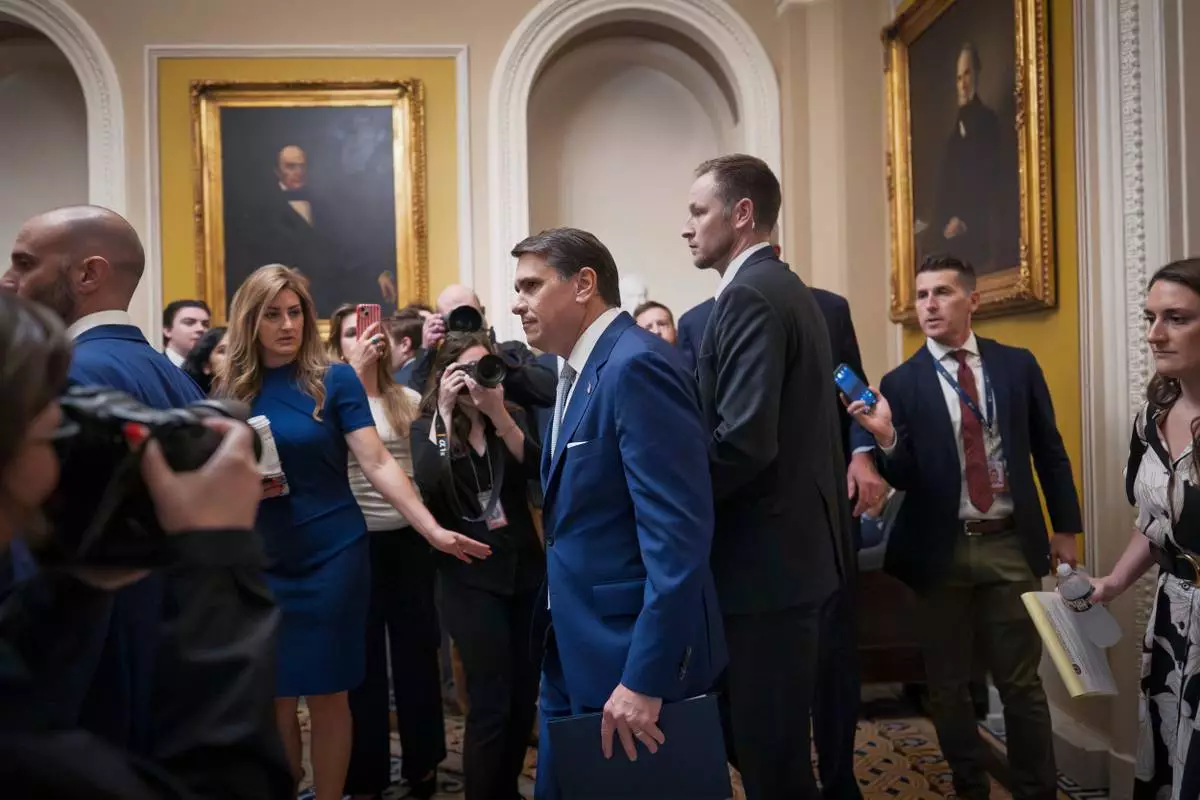
Acting Attorney General Todd Blanche arrives for a closed-door meeting with Republican senators who are expected to abandon a proposal for $1 billion in security money for the White House complex and President Donald Trump's ballroom after it has failed to win enough party support, at the Capitol in Washington, Thursday, May 21, 2026. (AP Photo/J. Scott Applewhite)
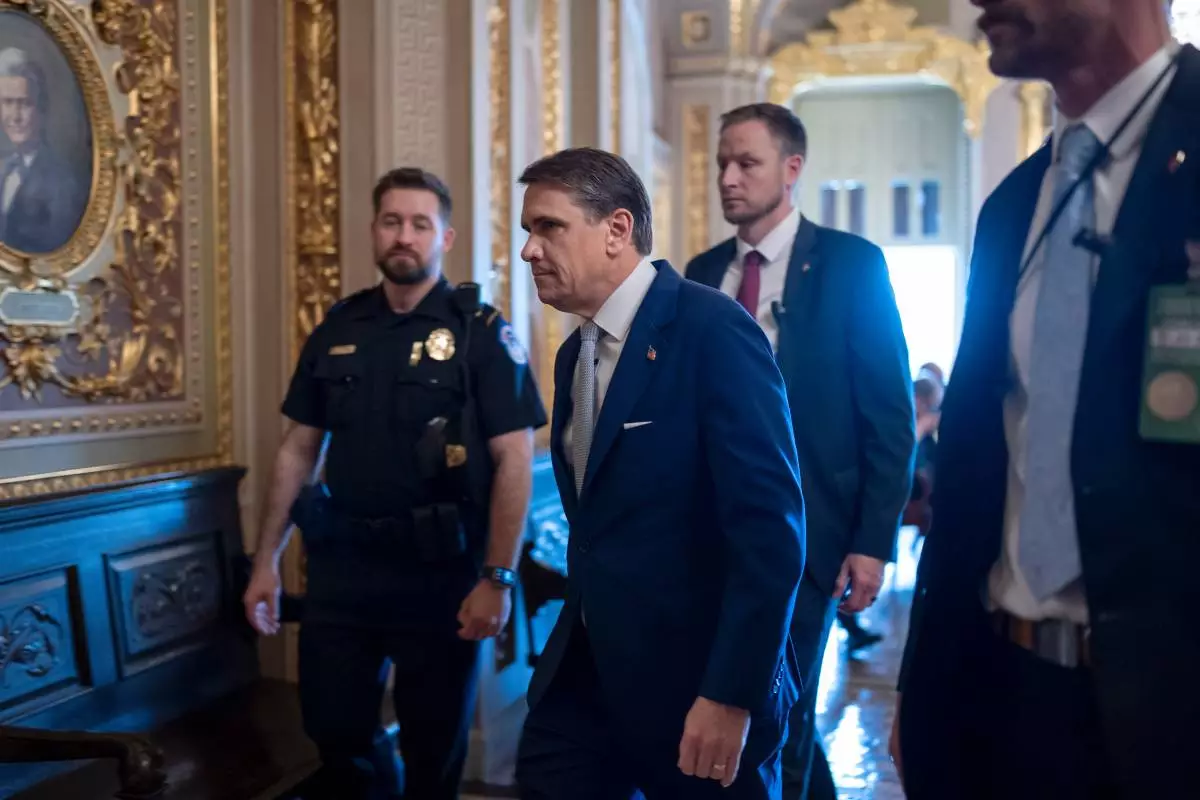
Acting Attorney General Todd Blanche arrives for a closed-door meeting with Republican senators who are expected to abandon a proposal for $1 billion in security money for the White House complex and President Donald Trump's ballroom after it has failed to win enough party support, at the Capitol in Washington, Thursday, May 21, 2026. (AP Photo/J. Scott Applewhite)