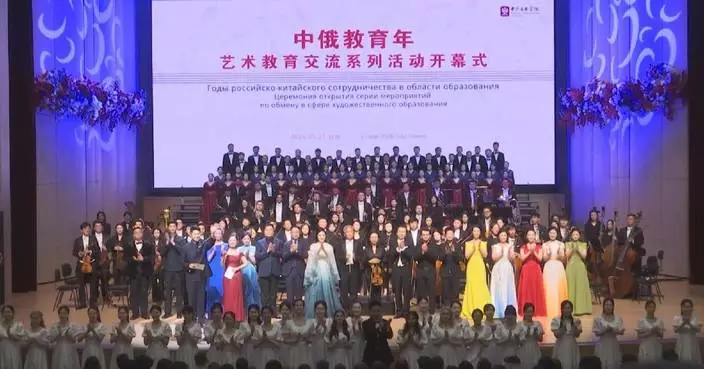
Cooperation between Chinese and Russian higher-level education institutions is reaching a new level as part of the "China-Russia Years of Education" initiative, opening up new opportunities to the young generation from each country.
The two countries have designated 2026 and 2027 as the China-Russia Years of Education which aims to inject new momentum into bilateral exchanges in education and people-to-people cooperation.
Cooperation has expanded from mass Chinese language classes and student exchanges to the launch of the first dual master's programs and exhibitions at leading Chinese universities.
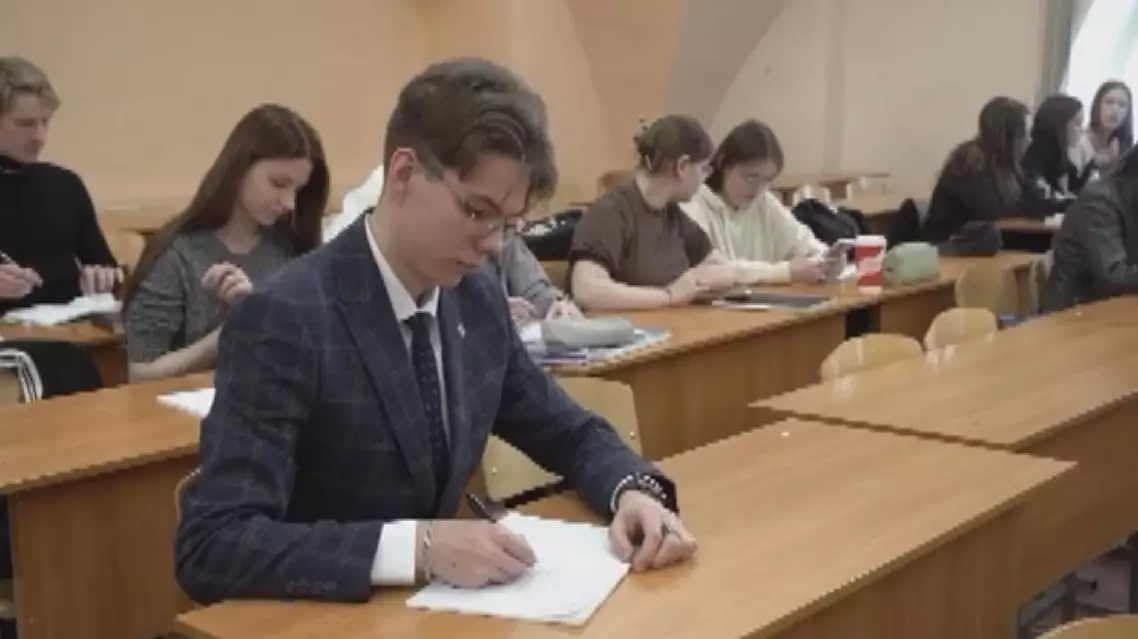
Aleksey Zasimov, a student in the Faculty of Economics at St. Petersburg State University of Economics, has studied Chinese since third grade. His dream to visit China is coming true, as he recently won the university's competition and will participate in a year-long exchange at Shandong University of Finance and Economics.
"For me, China is first and foremost a friend. Then comes technology, economics, a strong country that is interesting to study and build further relations with," said Alexey.
St. Petersburg State University of Economics maintains partnerships with over 50 Chinese institutions, with hundreds of students participating in exchanges. In March 2026, the university signed an agreement with Renmin University of China to launch the country's first dual-degree master's program in industrial economics taught in Chinese.
At the Faculty of Asian and African Studies, students passionately practice Chinese characters and pronunciation, nurturing a new generation of sinologists -- many of whom plan to continue their studies in China.
"St. Petersburg University offers over 500 educational programs, and each one offers the opportunity to study Chinese. China is a country with powerful culture and technology. Cooperation with China is very promising and opens up the broadest opportunities for our university," said Alexey Rodionov, senior deputy dean of the Faculty of Asian and African Studies at St. Petersburg University.
The relationship between St. Petersburg University and Chinese universities is deeply entrenched at the national level. Chinese President Xi Jinping is an honorary doctor of St. Petersburg State University, and Russian President Vladimir Putin has visited, among other places, Harbin Institute of Technology, where a joint campus has been established.
In spring 2025, St. Petersburg State University signed an agreement with Shanghai Theatre Academy to strengthen artistic exchange, and the Saint Petersburg Repin Academy of Arts has long hosted Chinese students -- 140 of its 160 international painting students are Chinese. Recent exhibitions held at Chinese universities showcased nearly 200 artworks, emphasizing art's role in fostering understanding and collaboration.
"We deliberately held these exhibitions at educational institutions so that students could have free access, so they could see the exhibition, bringing art closer to their school. This is a way to help these students, about whom we must constantly think. After all, it's for them that we exist here," said Semyon Mikhailovsky, rector of the Saint Petersburg Repin Academy of Arts.
Currently, approximately 56,000 Chinese students study at Russian universities, with 17,000 in St. Petersburg, while about 22,000 Russians are studying in China. Both countries aim to increase their academic exchange participants to 100,000.
China-Russia higher-level education cooperation reaches new level