China's Yangtze River Delta region, with its integrated robotics development, is forging the country's intelligent future.
In 2018, Chinese President Xi Jinping announced at the first China International Import Expo that China would support the integrated development of the Yangtze River Delta Region as a national strategy.
Since then, the region has become more deeply connected than ever, boosting development of many high-tech industries, including humanoid robots.
The region covers east China's Jiangsu, Zhejiang, Anhui provinces and Shanghai, and is home to the most humanoid robot companies in China.
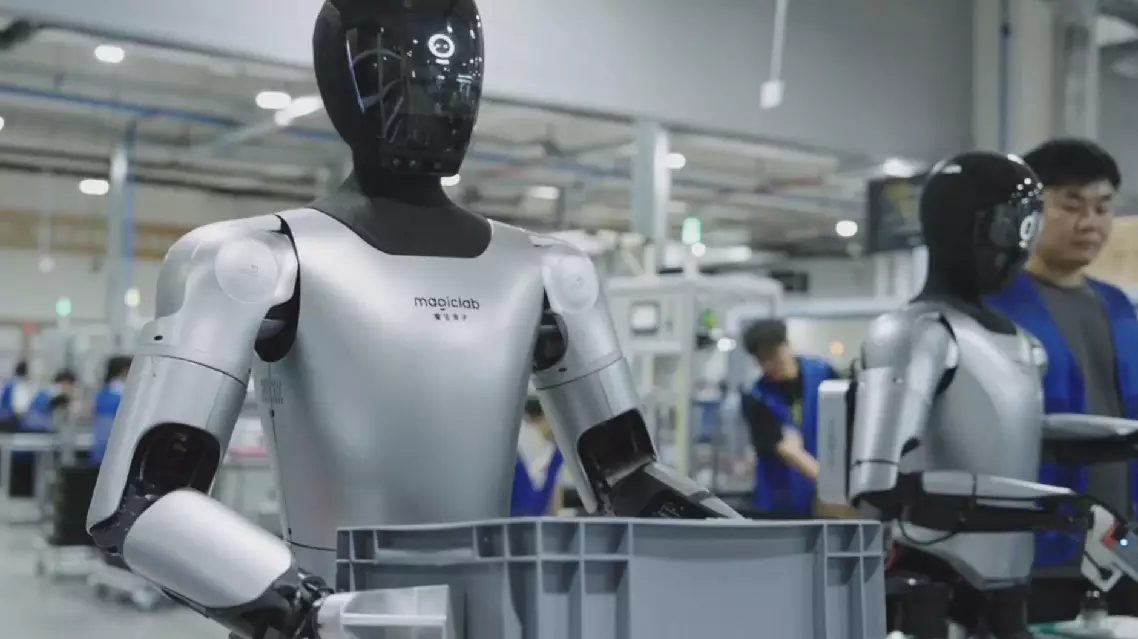
In Suzhou City in Jiangsu, the latest humanoid robots manufactured by local companies are capable of incredible moves, from vividly mimicking human walking and running to performing extremely difficult gymnastic maneuvers.
"For a robot to perform this movement, one factor is crucial: the function of its joint modules. They are like human muscles and must generate enough explosive power," said Chen Chunyu, Chief Technology Officer (CTO) of MagicLab, a global embodied intelligence technology company.
Manufacturing robot bodies has been made significantly more efficient by Jiangsu's highly developed industrial ecosystem, which offers strong support for producers across the sector.
"If I place an order here today, many of the materials can be delivered within a week, allowing us to upgrade our products quickly. That's why so many companies choose to stay and grow in Jiangsu," Chen said.
In Anhui, a growing network of industrial "valleys" are emerging as key drivers of those capabilities.
At the Sensor Valley in Bengbu City, one of the core technologies being developed is Micro-Electro-Mechanical Systems (MEMS).
With the tiny, lightweight, and extremely sensitive components that make up MEMS, robots can perceive and interact with the world around them.
A single robot can require around 50 sensors to interpret its environment. Nearly 200 sensor-related companies have gathered in Bengbu, forming an industrial cluster that supports the rapidly expanding robotics sector.
Hangzhou, the capital of Zhejiang, is now home to more than 800 companies connected to embodied intelligence.
According to one local company representative, Hangzhou is a pioneering hub in robotics.
"I consider myself a new Hangzhou citizen. Overall, I feel that Hangzhou is full of energy and a spirit of innovation. Whether it's policy support or access to the cutting-edge talent we need, Hangzhou has an abundance of both," said Fan Zhongyang, sales director at Hangzhou Xynova Technology Co., Ltd.
Hangzhou is also home to some of the world's leading humanoid robotics companies, including Unitree, whose kung fu robots were a sensation during the 2026 Spring Festival Gala broadcast.
Wang Xiaogang, a Chinese AI scientist and chairman of ACE Robotics in Shanghai, is focusing on a technology known as a "world model" which he says is "essentially a native brain designed for robots."
A world model helps robots perform various tasks and complete complex operations, according to Wang.
"The world model learns by imitating how humans interact with their environment across different scenarios and by understanding deep physical laws. Such a model helps robots perform various tasks and complete complex operations," said Wang.
Yangtze River Delta forges intelligent future with integrated robotics development