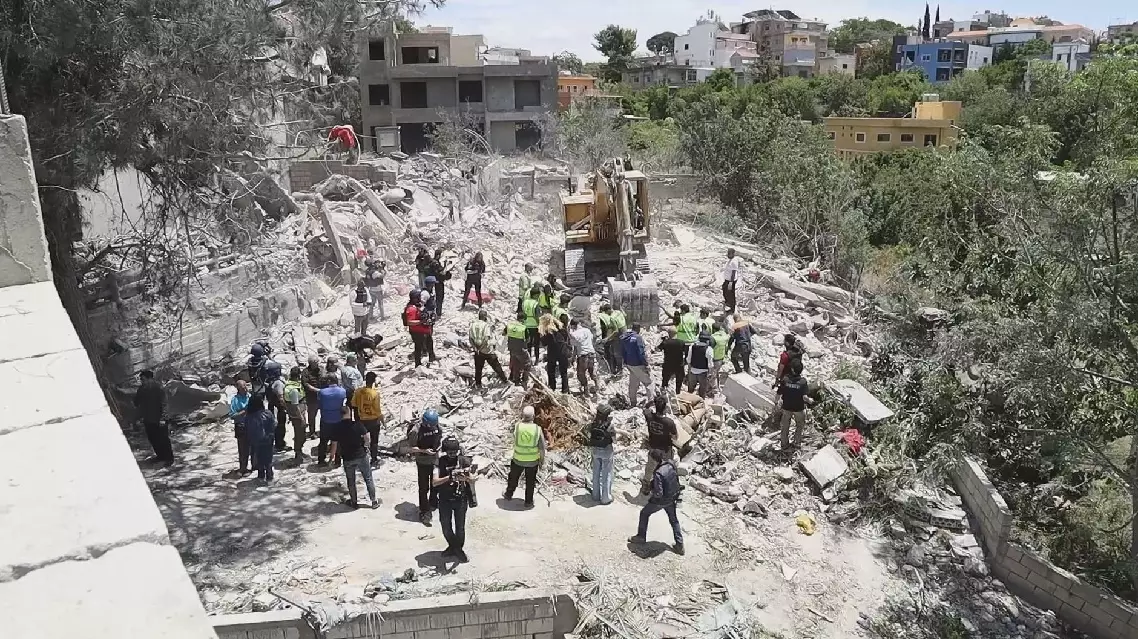
Lebanese health officials said 14 people were killed on Tuesday in Israeli airstrikes on Deir Qanoun al-Nahr in southern Lebanon, and shelling also destroyed a key health center in the town of Maashouq.
The attacks came despite a 45-day ceasefire extension announced by the U.S. State Department on May 16, worsening the humanitarian crisis amid rising casualties and displacement.
"We have a station here. We heard about the airstrike and immediately began working to evacuate the wounded and the martyrs. Today, we came to continue searching for the missing. There are two or three people still missing. Most of the casualties here are five children and three women. There are many body parts, and their families will identify them through DNA testing," said Ali al-Abd, a paramedic with the Islamic Health Organization.
"The airstrike hit, and we felt as if we were thrown from our seats by its force. My home isn't far from here, and we were here at 12:16. At 12:36, they carried the martyrs out in black bags. It was a scene beyond description, and it violated all international, humanitarian, and ethical norms," said Hassan Hariri, a resident of Deir Qanoun al-Nahr.
In Maashouq, Israeli strikes destroyed the Imam Khomeini Medical Center after an evacuation warning. Israel claimed the facility was being used by Hezbollah, but residents described the attack as a devastating blow to their community.
"This strike has broken us all, without distinction. This center provided treatments, medications, MRI scans, and X-rays, and today, we truly feel the loss caused by this strike. Where will we get medical care now? Everyone knows that hospitals are expensive, and this center served us for free. I hope it will be rebuilt as soon as possible," said Hussein Badran, a resident of Maashouq.
"The Imam Khomeini Center in the Maashouq area is one of the primary healthcare centers in the Ministry of Health's network of centers. It is supported by the Ministry and the International Red Cross. This center is the largest healthcare facility in the region because it is densely populated and impoverished," said Dr. Fadi al-Atrash working at the center.
According to the Lebanon's Ministry of Health, since the conflict between Israel and Hezbollah reignited in early March this year, more than 3,000 people have been killed and over 9,000 wounded. More than one million have been displaced, and tens of thousands of homes destroyed across the country.
Israeli strikes kill 14 in southern Lebanon despite ceasefire