The 8th high-level forum on the integrated development of the Yangtze River Delta, one of China's main metropolitan areas and major economic hubs, unveiled plans to forge one of the world's most dynamic industrial ecosystems. The forum, which was held in Shanghai on Thursday, unveiled a list of 10 new cross-regional public service projects. These initiatives will streamline government services for businesses, expand mutual recognition of medical test results to at least 400 institutions, and boost joint cultural and tourism events.
A total of 12 innovation consortia were also announced, pooling regional talent in fields such as AI and biotechnology, all supported by a plan for 44 new transportation links. This synergy is best illustrated by the region's "four-hour industrial circle," with the humanoid robot at its core.
The process is a powerful relay: Shanghai leads with research and development and final assembly, while neighboring Jiangsu Province supplies critical components such as motors and joints. Zhejiang Province provides the "senses," with advanced data training and tactile "e-skin" for the robot's hands, while Anhui Province develops precision micro-sensors that act as the robot's "nerve endings."
This integration creates a systemic force, transforming individual strengths into a unified competitive advantage on the global stage.
"This rapid growth is impossible without the Yangtze River Delta's complete industrial chain. Our core suppliers can respond within hours. This has cut our entire development cycle -- from prototype to mass production -- from over a year down to just six months," said Zhan Kun, senior vice president of AGIBOT Supply Chain. "This geographical proximity doesn't just cut logistics costs. It enables rapid response and collaborative innovation. We form joint teams with our partners, engaging deeply from the product definition stage to solve problems and iterate quickly," said Chen Wankai, CEO of Wuxi Quanzhibo Technology Co., Ltd.
"We create a data feedback loop, using tactile and visual data from the robot for imitation learning in simulations. Our flexible sensors offer a new path to solve AI's 'perception blind spot' in the physical world," said Xu Ting, a technical expert of Zhejiang Tsinghua Institute of Flexible Electronics Technology.
"Anhui is now home to over 200 enterprises, breaking reliance on foreign suppliers for core sensors and filling a critical hardware gap. In the future, the four regions will combine our unique strengths, turning scattered resources into a unified industrial force," said Zhao Hui, a researcher at the AI Science and Technology Division of the Department of Science and Technology of Anhui Province.
In 2025, the Yangtze River Delta region, with only 4 percent of China's land area, generated 34.66 trillion yuan (about 5.07 trillion U.S. dollars) in GDP, accounting for 24.9 percent of the country's total.
The Yangtze River Delta region, which covers Shanghai Municipality and the provinces of Jiangsu, Zhejiang and Anhui, all in east China, is one of China's most economically dynamic, open and innovative areas, playing a key role in national development and driving high transportation demand.
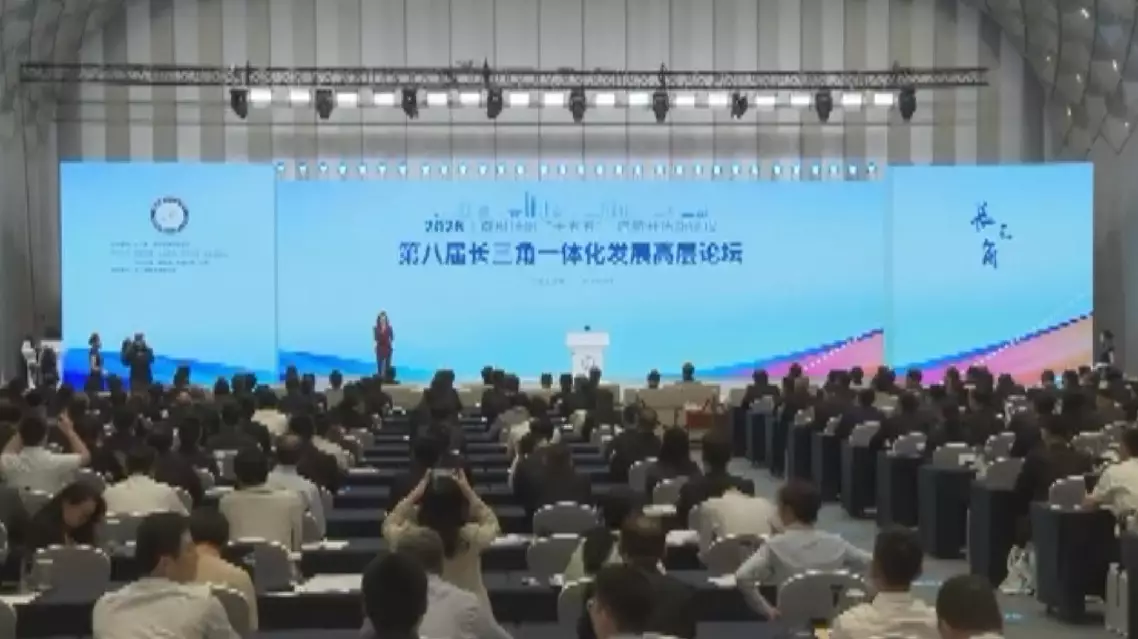
Forum on integrated development of Yangtze River Delta unveils deeper regional integration plans