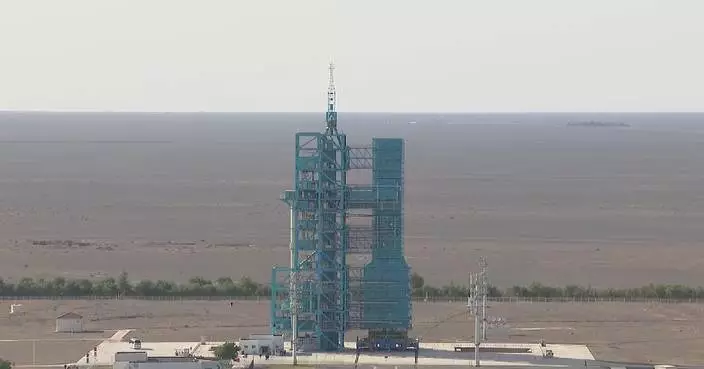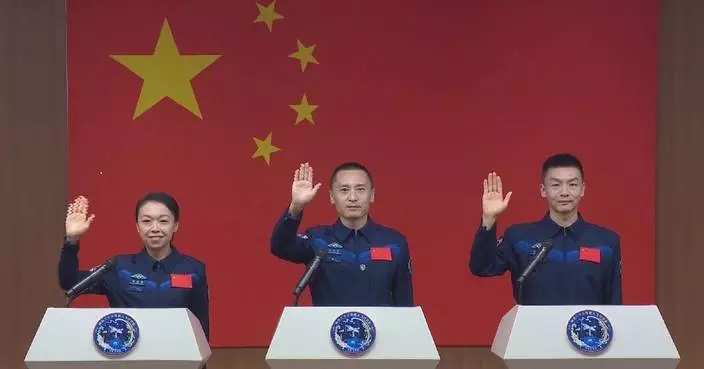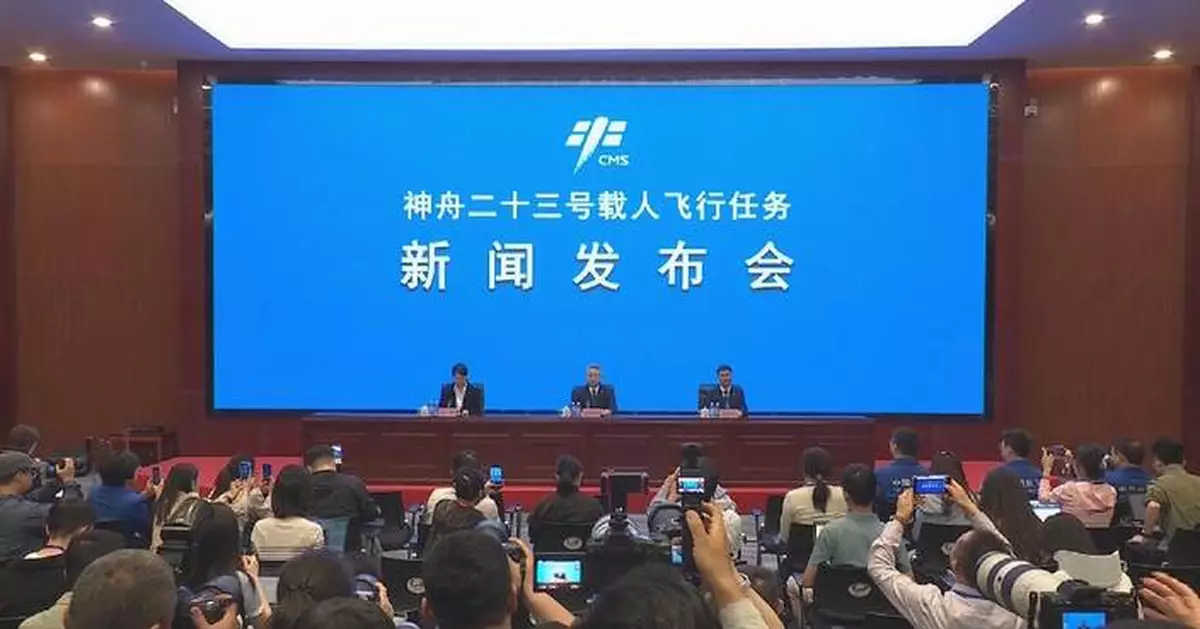
A female astronaut from Hong Kong Special Administrative Region (HKSAR) is in top shape for China's upcoming Shenzhou-23 mission, said Zhang Jingbo, spokesman of the China Manned Space Agency (CMSA), at a press conference ahead of the launch of the crewed spaceship on Saturday.
According to CMSA, the Shenzhou-23 spaceship is scheduled to be launched at 23:08 Sunday (Beijing Time) from the Jiuquan Satellite Launch Center in northwest China.
Chinese astronauts Zhu Yangzhu, Zhang Zhiyuan and Lai Ka-ying will carry out the mission, and Zhu will be the commander, the spokesman announced at the press conference.
Zhang said Lai, the first astronaut from HKSAR, is selected as a payload specialist for the mission.
"Astronaut Lai Ka-ying joined the team in August 2024. Since then, she has completed over 200 training modules across eight major categories, totaling more than 1,700 training hours. She has passed the flight qualification assessment with excellent grades. In accordance with the mission schedule, she has completed intensive training for flight tasks including space scientific research and technical experiment, management of the space station combination, and the operation of the crewed spacecraft and the robotic arms. She has met all the requirements of the mission and will serve as the payload expert for the Shenzhou-23 mission. She's currently in good condition and cooperating with the other teammates very well," Zhang said.
The spokesman noted Hong Kong boasts international strength to contribute to the country's space program.
"We believe that under the policy of One Country, Two Systems, Hong Kong will fully leverage its international strength to further attract and cultivate top sci-tech innovation talents and make contributions to the nation's manned space program," he said.
Shenzhou-23 is the seventh crewed mission during the application and development stage of China's space station, and the 40th flight mission of China's manned space program.
Hong Kong astronaut in top shape for China's Shenzhou-23 mission: spokesman

As the lingering U.S.-Iran conflict over the Strait of Hormuz disrupts global oil and gas supply, the Asia-Pacific Economic Cooperation (APEC) forum's energy ministers met in Beijing Thursday to chart a way forward, on whether the region can turn the crisis into opportunities.
The disruption of the Strait of Hormuz since late February 2026 has caused the largest oil supply shock on record, with ongoing daily shortfalls in the multi-million-barrel range. This energy supply shock has exposed the structural vulnerabilities of the Asia-Pacific region, the world's largest energy-consuming area.
As the APEC host this year, China has taken an open and inclusive approach, creating a multilateral dialogue platform. At the current energy ministerial meeting, it is pushing for a full exchange of practical experience among economies and channeling shared wisdom into real cooperative results.
"Since the beginning of this year, navigation through the Strait of Hormuz has been disrupted. China has fully leveraged its energy production, supply and marketing system, actively strengthened cooperation with all other parties, and made important contributions to safeguarding global energy security," said Chinese Vice Premier Ding Xuexiang in addressing the meeting.
The APEC Energy Ministerial Meeting, returning to Beijing after a 12-year hiatus, took place at a critical juncture following this "stress test."
"From our end in Papua New Guinea, we face the impacts of the war in Iran. We are an import-based economy. It did affect us in a great way," said Conrad Kumul, a delegate from Papua New Guinea, on the sidelines of the meeting.
Yet, many see that crises can also serve as catalysts for energy transition.
"The idea now is to push very much forward with the energy transition, even more than before. Now actually, the oil prices are so high that the comparatively renewable energies are very low in price," said Steivan Defilla, president assistant of the APEC Sustainable Energy Center, a high-level international energy think tank led by China's National Energy Administration.
China will hold the 33rd APEC Economic Leaders' Meeting in Shenzhen, south China's Guangdong Province, in November, which marks the country's third time hosting the event following Shanghai in 2001 and Beijing in 2014.
APEC ministers explore new pathways for energy security amid Hormuz crisis