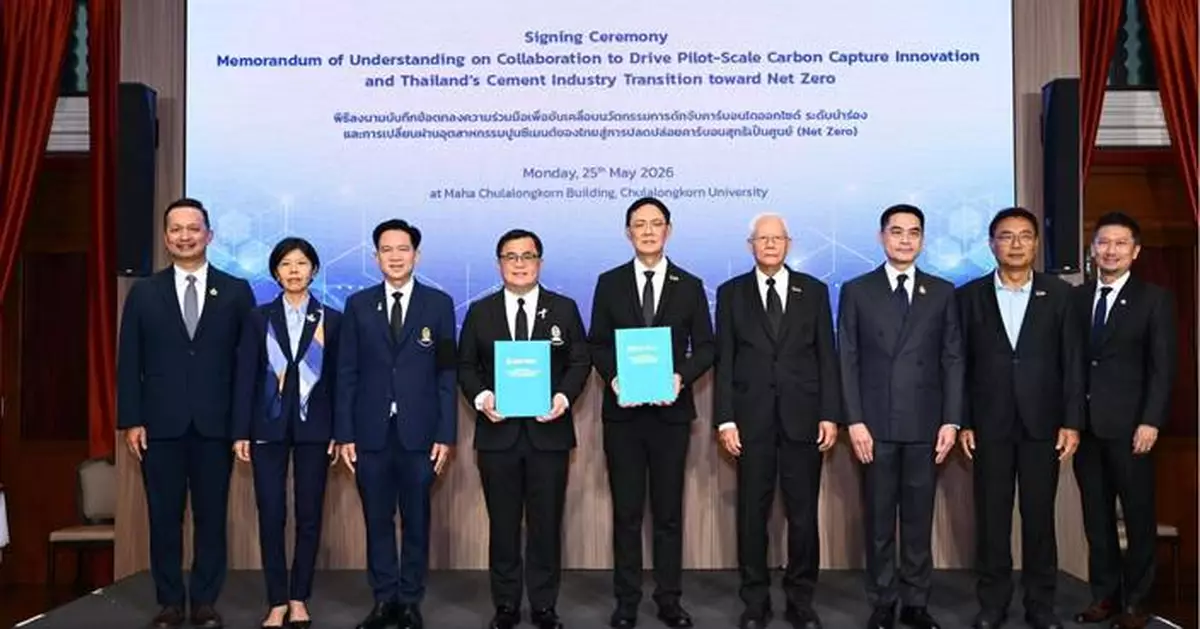
BANGKOK, THAILAND - Media OutReach Newswire - 25 May 2026 - Thai Cement Manufacturers Association (TCMA) has signed a Memorandum of Understanding (MoU) with Chulalongkorn University to advance a strategic collaboration on knowledge, and technology, with support from international partners. The partnership aims to develop and pilot carbon capture technologies in SARABURI SANDBOX, paving the way for industrial-scale deployment and future policy development. This marks a significant step in laying the foundation for Thailand's low-carbon industrial ecosystem and supporting the country's Net Zero 2050 target.
Mr. Surachai Nimla-or, Chairman of TCMA, stated that the collaboration reflects the proactive role of the industrial sector in advancing the country's climate commitments through a Public–Private Partnership (PPP) model. The initiative brings together industry, academia, government, and international partners, including Environment and Climate Change Canada (ECCC), the United Nations Industrial Development Organization (UNIDO), and the Global Cement and Concrete Association (GCCA), to accelerate the transition toward a low-carbon cement industry in line with the Thailand 2050 Net Zero Cement and Concrete Roadmap.
"This collaboration with Chulalongkorn University elevates our efforts into a long-term platform, from knowledge development and workforce readiness to pilot-scale technology deployment. It will be strengthened by Canadian expertise and real-world testing in the SARABURI SANDBOX, which will serve as a learning platform to develop scalable solutions for industrial application" Mr. Surachai said.
Professor Dr. Wilert Puriwat, President of Chulalongkorn University, emphasized the university's role as a Strategic Knowledge Partner in bridging research and real-world implementation, while fostering "Green Talent" to support industrial transformation.
"Chulalongkorn University sees this collaboration as a strategic mechanism to strengthen the knowledge base in low-carbon technologies alongside human capital development. This will enhance workforce capabilities in line with the transition and support Thailand's long-term green economy" Professor Dr. Wilert said.
H.E. Ping Kitnikone, Ambassador of Canada to Thailand, expressed Canada's strong support for the initiative, highlighting over 65 years of bilateral relations and shared commitment to climate action.
"This collaboration encompasses knowledge transfer, technology, and expertise in greenhouse gas mitigation, particularly through technical experts and capacity building. Carbon capture technology will serve as a bridge between innovation and industrial application, helping drive the transition toward a low-carbon economy," the ambassador noted.
From the government side, Dr. Pirun Saiyasitpanich, Director General of Department of Climate Change and Environment, Ministry of Natural Resources and Environment stated that the cement industry is a strategic sector in reducing national greenhouse gas emissions toward Net Zero 2050, while strengthening climate resilience.
"This collaboration serves as a key policy mechanism linking project-level implementation to national-level action, with SARABURI SANDBOX acting as a testbed for learning and development. The outcomes will inform policy design and enable effective scaling at the national level" Dr. Pirun said.
Mr. Teeratas Isarangkul Na Ayudhaya, Deputy Director General of the Department of Industrial Works, Ministry of Industry added that the initiative aligns with the "One MIND" policy, which integrates regulation with the promotion of green industry.
"The Department stands ready to support this collaboration in developing a scalable industrial model that enhances Thailand's competitiveness in a sustainability-driven global economy" Mr. Teeratas said.
Dr. Chana Poomee, Honorary Chairman of TCMA and President of ASEAN Federation of Cement Manufacturers (AFCM), highlighted the initiative as a key step in positioning Thailand as a "regional model" for industrial decarbonization.
"By integrating cross-sector collaboration through PPP, linking policy, technology, knowledge, and workforce development to real-world implementation, this initiative will establish the foundation of a Low-Carbon Industrial Ecosystem and evolve into a system-level model that can be scaled across the region," he said.
This collaboration marks the starting point of Thailand's low-carbon industrial ecosystem, connecting knowledge, technology, innovation, human capital, and policy into real-world applications and commercial pathways. It is expected to accelerate the transition to a low-carbon economy, strengthen climate resilience, and enhance the country's competitiveness in an increasingly sustainability-driven global landscape.
Hashtag: #TCMA #CementActionToNetZero #Decarbonization #NetZero2050 #CarbonCapture #CCU #Technology #Innovation #CU #DCCE #DIW #AFCM
The issuer is solely responsible for the content of this announcement.
** This press release is distributed by Media OutReach Newswire through automated distribution system, for which the client assumes full responsibility. **

TCMA x Chulalongkorn University Join Forces with Canadian Partners to Advance Strategic Collaboration for a Low-Carbon Industry toward Net Zero 2050
New Merck Hong Kong Centre to Connect Global Expertise with Local Innovators and Accelerate R&D Commercialisation
HONG KONG SAR – Media OutReach Newswire – 26 October 2026 – Hong Kong Science and Technology Parks Corporation (HKSTP) and Merck, a leading science and technology company in life science, healthcare and electronics, signed a collaboration agreement today to establish their strategic partnership. Under the agreement, Merck will establish the "Merck Hong Kong Centre" at Hong Kong Science Park, dedicated to bringing in advanced scientific products, showcasing live technological demonstrations, and providing expert consultation services. Through technical training and clinical advisory sessions, an innovation scouting programme, and the co-hosting of an annual flagship event, the partnership will connect HKSTP's I&T ecosystem with Merck's domain expertise and global networks, supporting local startups and I&T talent, accelerating the translation of R&D outcomes into real-world applications, and jointly capturing opportunities across the Guangdong-Hong Kong-Macao Greater Bay Area (GBA) and international markets.
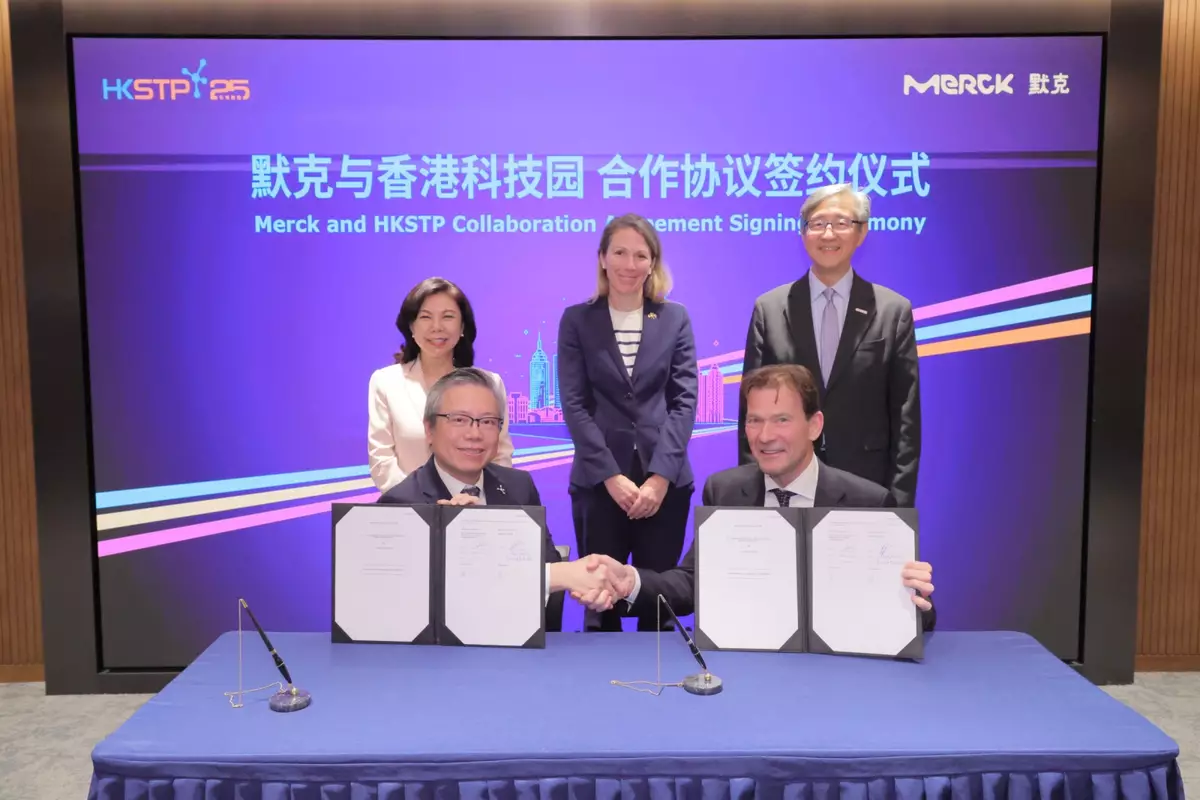
Witnessed by Dr Annika Bolten-Drutschmann, Consul General of Germany (Second row middle), Ms Cordelia Chung, Chairman of HKSTP (Second row first from left), and Mr Peter Yan, Director-General of the OASES (Second row first from right), Mr Terry Wong, Chief Executive Officer of HKSTP (Front row first from left), and Mr Rogier Janssens, President of Merck China (Front row first from right), signed the partnership agreement to establish their strategic partnership.
The HKSAR Government's recently announced First Five-Year Plan places a strong focus on strategic industries, including life and health technology, artificial intelligence (AI), and new industrialisation, while the latest Policy Address sets out Hong Kong's ambition to accelerate its development into an international health and medical innovation hub, progressively expanding access to the GBA, international markets, and capital markets. Arriving at a pivotal moment as Hong Kong I&T development enters a new phase, the partnership will bring together top-tier global scientific resources and inject fresh momentum into the city's I&T sector.
Witnessed by Dr. Annika Bolten-Drutschmann, Consul General of Germany, Ms Cordelia Chung, Chairman of HKSTPand Mr. Peter Yan, Director-General of the Office for Attracting Strategic Enterprises (OASES), Mr. Terry Wong, Chief Executive Officer of HKSTP, and Mr. Rogier Janssens, President of Merck China, signed the partnership agreement. The signing was followed by the "Merck x HKSTP Groundbreaking Ceremony", marking the official commencement of the Merck Hong Kong Centre and turning the partnership to a new chapter.
Mr. Terry Wong, Chief Executive Officer of HKSTP, said, "We are delighted to welcome Merck, a leading science and technology company, in establishing a strategic partnership with HKSTP and Hong Kong's I&T ecosystem. As Hong Kong enters an exciting new phase of I&T development, collaboration with global leaders like Merck is crucial to foster the growth of the life and health tech sector. Our shared vision goes beyond offering physical space: we are bringing Merck's advanced technologies, scientific expertise and global networks closer to our startups and researchers, helping them turn discoveries into practical solutions and explore opportunities for pilot projects, commercial partnerships and investment. Powered by the city's unique positioning as the super connector between the Chinese Mainland and global markets, this partnership will catalyse collaboration between Merck's global excellence in life sciences and HKSTP's thriving ecosystem — taking the discovery and commercialisation of R&D results in the life and health sector to the next level, creating global impact and benefiting humankind."
Mr. Rogier Janssens, President of Merck China, said, "Hong Kong's first Five-Year Plan places innovation and technology at the heart of the city's future, giving science and technology companies like Merck a clear direction for lasting engagement. For 358 years, Merck has advanced science and technology with a patient, generational outlook, and we are now deepening our presence in the Greater Bay Area's innovation landscape. Merck Hong Kong Centre is the first step of that commitment in Hong Kong. Located next to HKSTP's shared biomedical laboratory, it places our products and experts alongside the scientists and startups driving the research. We can help them build reliable, reproducible workflows from early experimentation to scale-up, and we can understand earlier what their science needs. Together with HKSTP, we aim to prove this approach in Hong Kong and replicate it elsewhere in China and beyond."
Under the agreement, the collaboration will focus on four key initiatives:
- Merck Hong Kong Centre: The dedicated physical facility at Hong Kong Science Park will provide Park startups and researchers with advanced scientific product supply, live demonstrations of cutting-edge technologies and expert consultation services. The Centre will serve as a physical hub connecting local innovators with Merck's technology resources.
- Training and Consultation Initiative: Connecting Merck's industry experts with HKSTP's startups and researchers through technical training, clinical advisory and professional consultation services to promote knowledge exchange and strengthen research and application capabilities.
- Innovation Scouting Program: Establishing a structured mechanism to identify, evaluate and connect high-potential startups directly with Merck's global innovation network, exploring collaboration opportunities including commercial partnerships, proof-of-concept pilot projects and strategic venture investment opportunities.
- Merck Innovation Day: An annual flagship event held at Hong Kong Science Park focusing on life science, healthcare and electronics, bringing together startups, academia and industry leaders to showcase innovations and foster cross-sector exchange and co-development.
HKSTP is committed to building a vibrant I&T ecosystem and is currently home to around 400 life and health technology companies, supported by comprehensive R&D infrastructure and one-stop support services that help turn ideas into real-world applications. The partnership will further connect Park companies with Merck's global resources, while providing Merck with a platform to access emerging technologies, research talent and high-potential companies in Hong Kong and the GBA, fostering two-way innovation exchange and opening up long-term collaboration opportunities.
Hashtag: #HKSTP
The issuer is solely responsible for the content of this announcement.
HKSTP
More information about HKSTP is available at www.hkstp.org.
** This press release is distributed by Media OutReach Newswire through automated distribution system, for which the client assumes full responsibility. **