Skip to Content Facebook Feature Image

Federal court blocks Alabama plan for new congressional districts that could help Republicans

News

Federal court blocks Alabama plan for new congressional districts that could help Republicans
News

News

Federal court blocks Alabama plan for new congressional districts that could help Republicans

2026-05-26 22:57 Last Updated At:23:00

Federal judges on Tuesday blocked Alabama’s plan to use a congressional map that could give Republicans an advantage in a key U.S. House race in the midterm elections.

A three-judge panel in the state’s long-running redistricting case issued a preliminary injunction that prevents the state from switching maps, ruling that the Republican-backed plan “intentionally discriminated based on race” by including only one Black-majority district. The judges instead required Alabama to continue using a court-ordered map in place for the 2024 elections that includes two districts where Black residents comprise a majority or close to it.

“Ultimately, we cannot see our way clear to requiring Alabamians to cast their votes in the 2026 elections under a districting plan tainted by intentional race-based discrimination,” the judges wrote.

The ruling is a setback for Republicans, who want to use a map for the November midterms that would give the GOP a chance to reclaim the seat now held by Democratic U.S. Rep. Shomari Figures. However, the state could appeal the ruling to the U.S. Supreme Court.

Figures said he is pleased with the ruling but expects an appeal. “This is a significant step in the right direction, but there is still a long way to go before this fight is settled,” Figures said.

The court order is the latest development in the twisting legal and political saga following a U.S. Supreme Court ruling that struck down a Black-majority district in Louisiana and weakened the federal Voting Rights Act. That ruling has led Republicans in several Southern states, including Alabama, to take steps to reshape voting districts with large minority populations that have elected Democrats.

The redistricting frenzy is part of a broader push by President Donald Trump to try to hold on to Republicans’ slim House majority in the November elections.

The three-judge panel in 2023 ruled that a map drawn by Republican state lawmakers intentionally diluted the voting power of Black citizens. The court said the state, which is about 27% Black, should have two districts where Black voters are the majority or close to it. The court-selected map was used in 2024.

After the Supreme Court's recent ruling in the Louisiana case, Alabama officials moved to implement the 2023 state-drawn map. The Supreme Court’s conservative majority agreed to lift the injunction that had blocked the map's use and sent the case back to the three-judge panel for reconsideration in light of the Louisiana ruling.

In the meantime, Alabama Gov. Kay Ivey set Aug. 11 special primaries using the new map.

Upon further review, the panel said there was “undisputed evidence” of intentional racial discrimination. It said the special congressional primaries should instead proceed under the previous court-approved districts.

The decision to temporarily block the map switch came after a seven-hour court hearing Friday in which judges sharply questioned state lawyers about the timeline and the impact of the Louisiana ruling.

Using the same districts that had been in place for the previous election would prevent “an expensive, aggressive, and perhaps logistically impossible voter reassignment effort,” the judges wrote.

“Candidate and voter confusion is troublesome and warrants significant consideration, but we do not see that a preliminary injunction will worsen it. To the contrary, we expect a preliminary injunction to lessen it,” the judges said.

Deuel Ross, director of litigation for the NAACP Legal Defense Fund, said the court ruling “again vindicated the constitutional rights of voters in the Black Belt, and our clients look forward to voting under a fair map this fall.”

Other states also have considered adjustments to their primary elections to allow time for congressional redistricting after the U.S. Supreme Court’s decision affecting the Voting Rights Act. Louisiana’s congressional primaries, scheduled for May 16, were postponed until later this summer by Republican Gov. Jeff Landry so that state lawmakers could consider a new U.S. House map that would eliminate a majority-Black district.

In South Carolina, the Republican-led legislature is considering a plan that could throw out the votes from its June 9 congressional primary and instead hold a new primary in August under revised districts that could improve Republicans’ chances of winning an additional seat.

Tennessee also moved quickly to enact new U.S. House districts after the Supreme Court’s ruling, carving up a Black-majority district based in Memphis that had elected the state’s only Democratic representative. The new map gives Republicans a chance to sweep all nine of the state’s seats. As part of the plan, Tennessee temporarily reopened the candidate qualifying period for its August congressional primaries, allowing new candidates to enter the race and existing ones to either switch districts or drop out.

Since Trump first urged Texas to redraw its U.S. House districts last summer, about a half-dozen Republican-led states have enacted new voting districts, though some still face legal challenges. Democrats countered with new districts in California and also expect to gain a seat from new court-imposed districts in Utah.
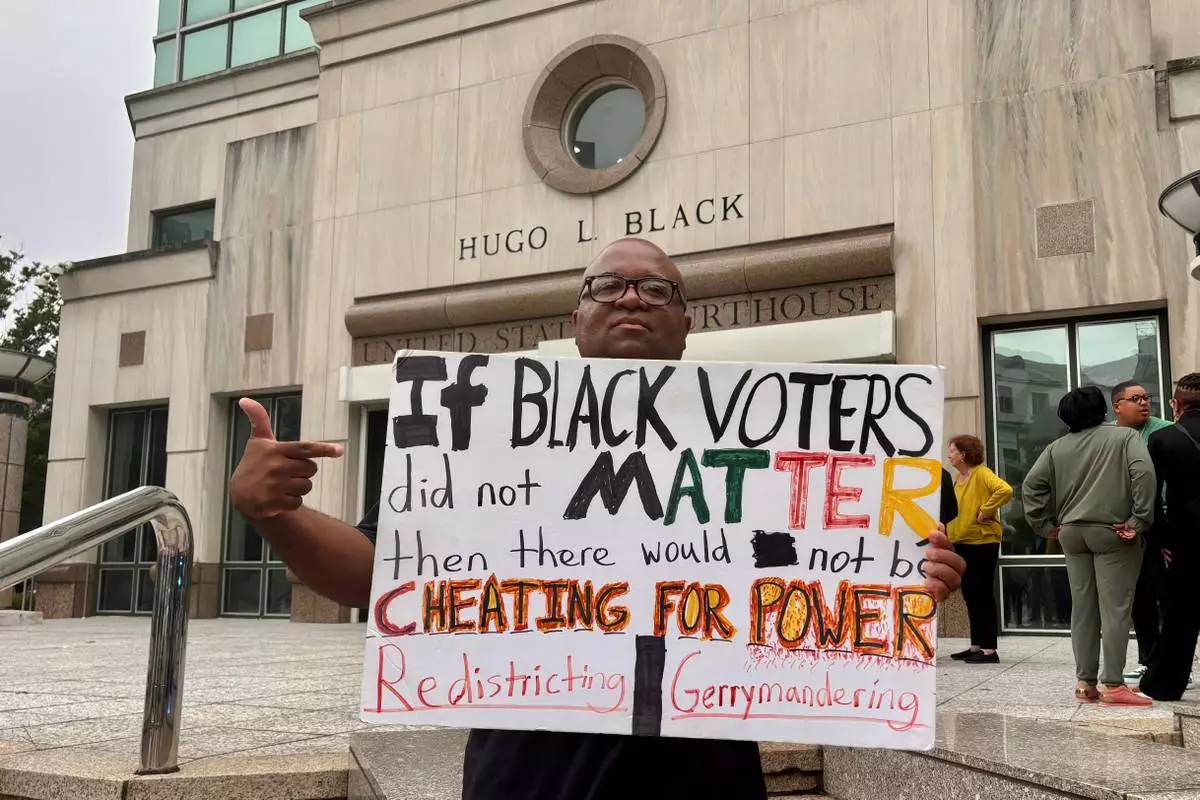
Travis Jackson stands outside the federal courthouse on Friday, May 22, 2026, in Birmingham, Ala. after a court hearing related to redistricting litigation. (AP Photo/Kim Chandler)


Travis Jackson stands outside the federal courthouse on Friday, May 22, 2026, in Birmingham, Ala. after a court hearing related to redistricting litigation. (AP Photo/Kim Chandler)
NEW YORK (AP) — The U.S. stock market is rising Tuesday as it catches up with others around the world that climbed the day before, when President Donald Trump said negotiations were “proceeding nicely” with Iran on ending their war.

The S&P 500 rose 0.8% after trading resumed following Monday’s holiday. The Dow Jones Industrial Average was down 25 points, or 0.1%, as of 10:50 a.m. Eastern time, and the Nasdaq composite was 1.3% higher. All three indexes are near all-time highs.

The gains came even though fighting continued in the region, and the U.S. military said it carried out “self-defense” strikes in southern Iran, including on missile launch sites and boats placing mines. Markets have rallied in the past on hopes for a coming end to the war with Iran, only to see the conflict drag on.

The price for a barrel of Brent crude, the international standard, rose 3.8% to $99.80, but that reclaimed only some of its 7.1% plunge from Monday. The price for a barrel of U.S crude oil, meanwhile, fell 3% to $93.74.

Oil prices have been at the center of the action for financial markets since the United States and Israel attacked Iran in late February. The ensuing war has closed the Strait of Hormuz to most oil tankers, keeping crude pent up in the Persian Gulf instead of flowing to customers worldwide. That in turn has driven up oil’s price and sent a wave of painful inflation around the world.

Hopes for a deal to improve the flow of oil helped lift stocks of companies with big fuel bills. United Airlines rose 6.6%, and cruise operator Carnival steamed 3.5% higher.

The lower oil prices also helped pull yields down in the U.S. bond market, which eased the pressure on Wall Street. The yield on the 10-year Treasury fell to 4.49% from 4.56% late Friday.

It’s a respite following recent gains for yields in bond markets worldwide, which threatened to slow economies and undercut prices for stocks and all kinds of other investments. High yields have already forced the average long-term U.S. mortgage rate to its most expensive level since last summer, and they could curtail companies’ borrowing to build the artificial-intelligence data centers that have supported the U.S. economy’s growth recently.

Big technology stocks also continued their big runs. Micron Technology leaped 17.7% to top $880 and was the strongest force lifting the S&P 500 after analysts at UBS led by Timothy Arcuri raised their 12-month price target for the stock to $1,625 from $535. They're forecasting continued strength in demand for computer memory, and Micron's stock has already tripled so far this year.

That helped offset a drop of 11.6% for AutoZone, which reported slightly weaker revenue for the latest quarter than analysts expected, though its profit topped expectations. CEO Phil Daniele said performance for the retailer’s stores in Brazil and Mexico was below its plan.

Most big U.S. companies have been reporting both profit and revenue for the start of 2026 above what analysts expected. The strong performances have helped vault U.S. stocks to records, even with all the uncertainty around oil prices and the war with Iran.

U.S. households have been feeling discouraged about the economy because of accelerating inflation, and a report on Tuesday said consumer confidence edged downward in May, though the number was not as bad as economists expected. It followed a report on Friday that said sentiment among U.S. consumers hit its lowest level on record.

In stock markets abroad, indexes were mixed. South Korea’s Kospi jumped 2.5% as it also caught up with other markets following a Monday closure for a holiday.

London’s FTSE 100 added 0.5% even though British petroleum giant BP fell 5.1% there. BP ousted its chairman over what it called serious concerns related to “important governance standards, oversight and conduct.”

Japan’s Nikkei 225 fell 0.2% from its all-time high set the day before.

AP Business Writer Elaine Kurtenbach contributed to this report.

Specialist Glenn Carell, left, and trader Robert Charmak work on the floor of the New York Stock Exchange, Friday, May 22, 2026. (AP Photo/Richard Drew)

Specialist Glenn Carell, left, and trader Robert Charmak work on the floor of the New York Stock Exchange, Friday, May 22, 2026. (AP Photo/Richard Drew)

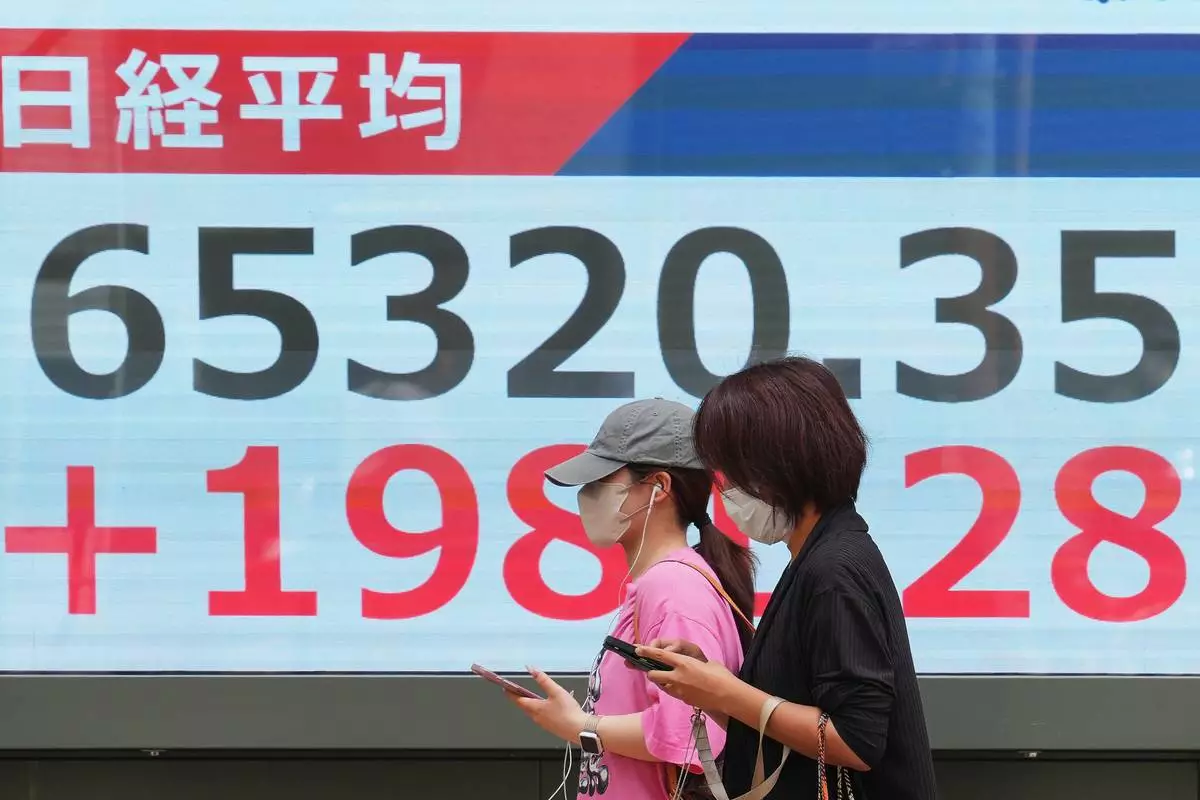
People walk in front of an electronic stock board showing Japan's Nikkei index at a securities firm Monday, May 25, 2026, in Tokyo. (AP Photo/Eugene Hoshiko)

People walk in front of an electronic stock board showing Japan's Nikkei index at a securities firm Monday, May 25, 2026, in Tokyo. (AP Photo/Eugene Hoshiko)

A currency trader talks on the phone near a screen showing the Korea Composite Stock Price Index (KOSPI) and the foreign exchange rate between U.S. dollar and South Korean won, left, at the foreign exchange dealing room of the Hana Bank headquarters in Seoul, South Korea, Wednesday, May 20, 2026. (AP Photo/Ahn Young-joon)

A currency trader talks on the phone near a screen showing the Korea Composite Stock Price Index (KOSPI) and the foreign exchange rate between U.S. dollar and South Korean won, left, at the foreign exchange dealing room of the Hana Bank headquarters in Seoul, South Korea, Wednesday, May 20, 2026. (AP Photo/Ahn Young-joon)

A person looks at an electronic stock board showing Japan's Nikkei index at a securities firm Monday, May 25, 2026, in Tokyo. (AP Photo/Eugene Hoshiko)

A person looks at an electronic stock board showing Japan's Nikkei index at a securities firm Monday, May 25, 2026, in Tokyo. (AP Photo/Eugene Hoshiko)

A person stands in front of an electronic stock board showing Japan's Nikkei index, seen through the glass wall of an office building Monday, May 25, 2026, in Tokyo. (AP Photo/Eugene Hoshiko)

A person stands in front of an electronic stock board showing Japan's Nikkei index, seen through the glass wall of an office building Monday, May 25, 2026, in Tokyo. (AP Photo/Eugene Hoshiko)

Recommended Articles