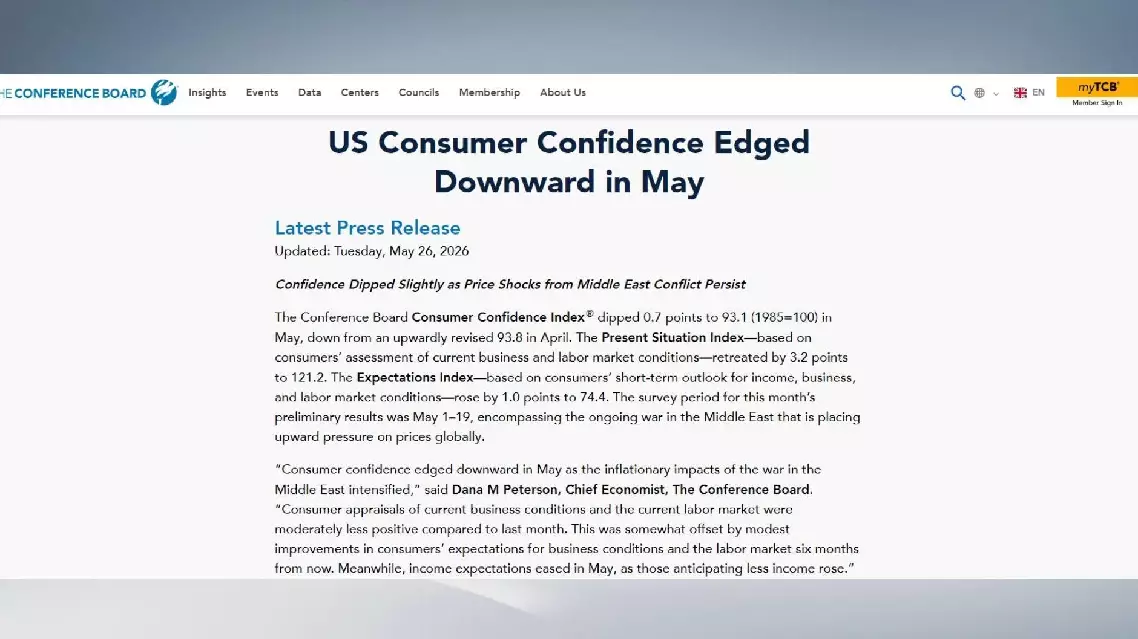
U.S. consumer confidence dropped slightly in May as persistently high gasoline prices and inflation continue to strain household budgets, according to the Conference Board Consumer Confidence Index, which dipped 0.7 points to 93.1 in May, down from an upwardly revised 93.8 in April.
The Present Situation Index, which is based on consumers' assessment of current business and labor market conditions, retreated by 3.2 points to 121.2.
Conversely, the Expectations Index, based on consumers' short-term outlook for income, business, and labor market conditions, rose by one point to 74.4.
The survey period for the month's preliminary results spanned May 1 to May 19, a timeframe heavily impacted by the ongoing conflict in the Middle East, which continues to place significant upward pressure on global prices.
"Consumer confidence edged downward in May as the inflationary impacts of the war in the Middle East intensified," said Dana M. Peterson, chief economist at The Conference Board.
"Consumer appraisals of current business conditions and the current labor market were moderately less positive compared to last month. This was somewhat offset by modest improvements in consumers' expectations for business conditions and the labor market six months from now. Meanwhile, income expectations eased in May, as those anticipating less income rose,” he said.
The decline in the Conference Board's metric aligns with a separate gauge of consumer sentiment compiled by the University of Michigan, which dropped to a record low this month.
Across the U.S. economy, spikes in gasoline prices and higher food costs have worsened overall inflation. This upward price pressure has outpaced the growth in average paychecks in recent months, effectively reducing the purchasing power of many Americans.
The oil price shock remains the primary driver of consumer anxiety, with average gasoline prices nationwide hovering around 4.50 U.S. dollars a gallon in May, a sharp increase from around 3 dollars at the end of February.
Inflation, high gas prices dent U.S. consumer confidence