WASHINGTON (AP) — When President Donald Trump's administration announced last week that it would require green card seekers to apply from their home countries instead of in the U.S., immigration attorney Flavia Santos Lloyd’s phone began ringing off the hook with clients worried about the implications for them.
Lloyd wasn't sure what to tell them, but she knew the confusing new policy would slow down applications.
“It has a chilling effect because we have some cases that we were going to proceed and I can tell already, we should wait and see what’s going on," she said.
U.S. Citizenship and Immigration Services announced Friday that foreigners in the U.S. who want a green card will need to leave and apply in their home country, barring some unspecified exceptions.
The announcement, which potentially affects hundreds of thousands of green card applicants a year, was the latest immigration policy unveiled by Trump's Republican administration to stun and confound lawyers, advocates and immigrants. It's also part of a pivot by the administration to target legal pathways to immigration, after focusing since last year mostly on migrants in the U.S. illegally.
“This is simply an attempt to try to limit and scare people away from the legal immigration process,” immigration attorney Charles Kuck said, adding that he expected legal action against the change. “This is a scare tactic.”
As worried immigrants and their employers flood immigration law offices with questions, it's unclear what the effect will be, what exceptions might be allowed and how the policy will play out on the ground.
Some green card seekers were already facing questions about why they should be allowed to apply from the U.S.
For more than half a century, foreign nationals with legal status have been able to apply for and complete the process for permanent residence in the United States — including people married to U.S. citizens, holders of work and student visas, and refugees and political asylum-seekers, among others.
That appeared to change suddenly on Friday, when USCIS announced the shift on its website.
“From now on, an alien who is in the U.S. temporarily and wants a Green Card must return to their home country to apply, except in extraordinary circumstances," the agency said.
USCIS also issued a more detailed policy memo designed as guidance for its staffers who decide these cases. Immigration experts who were trying to decipher the news said the memo was more nuanced, leading to confusion over what the change actually entailed.
In response to questions from The Associated Press, the Department of Homeland Security said Wednesday the shift wouldn't prevent anyone “who legitimately and properly” qualifies from obtaining a green card although it will result in some people having to apply overseas with the State Department. The department said the policy would have “no noticeable impact on highly qualified applicants and skilled professionals who have followed the law.”
One immigration law firm, Boundless Immigration, in a blog post on its website stating its interpretation of the policy, said officers were being instructed to “apply existing discretionary standards more rigorously” but surmised that the policy doesn't completely stop the adjustment of status process for “eligible applicants” depending on the category of visa they have.
The company cited previous policy memos about citizenship acquisition that had not prompted harsher steps in practice.
Shev Dalal-Dheini, senior director of government relations at the American Immigration Lawyers Association, said the guidance may be targeting people who overstayed their visas, such as the parent of a U.S. citizen who remained after a visa expired, an employee of a company who transferred to the U.S. or people in the country on visas specific to clergy and other religious workers.
“It seems like maybe who they’re targeting is potentially those whose period of stay lapsed while they were here,” she said.
Kevin Miner, a partner with the immigration law firm Fragomen, said he expected that people on employment-based visas, like H-1Bs, would be exempt. Known as dual-intent, these visas allow people on nonimmigrant visas in the U.S. to seek a green card. Those dual-intent visas were specifically mentioned in the memo as areas of possible exception.
“Those probably are cases that will continue to precede business as usual and that we won’t see a significant impact,” said Miner, who said the announcement Friday took people by surprise.
Matthew Soerens, the U.S. director of church mobilization for World Relief, an organization that helps resettle refugees in the U.S., said language in the memo referring to cases in which immigrants have to adjust their status in the U.S. gives the organization “hope” and “expectation” that the guidance doesn't apply to refugees.
Refugees are people who are fleeing their homeland who meet a specific set of criteria to be admitted to the U.S. after lengthy vetting. They are required to do that green card processing a year after arriving in the U.S. and can't go home because of the risks they'd face there, Soerens said.
Trump's administration has slashed the number of refugees admitted into the U.S. this year and limited them to white South Africans.
People who entered the country under humanitarian parole, which allows presidents to admit people for humanitarian reasons and which President Joe Biden's Democratic administration expanded dramatically, could also be impacted, Soerens said.
Many of those people might have already had family in the U.S. or they married a U.S. citizen — both of which potentially give them pathways to apply for a green card that could now be complicated.
All of these nuances make it difficult to provide general legal advice to people, said Dalal-Dheini.
“It’s going to be a very case by case specific thing," she said.
The American Immigration Lawyers Association said several people in green card interviews under the new guidance faced questions Tuesday that haven’t previously been asked of applicants.
One person who was applying to get a green card based off their marriage to a U.S. citizen was asked why they applied to adjust their status in the U.S. instead of going back to their home country and applying at the embassy there. They were asked if there were any factors that would prevent them from applying back at their home country and if they still had family there.
Another person was asked to file a form demonstrating why they should be allowed to apply from the U.S. and were told evidence should prove they wouldn't be a financial burden or a “public charge” on the U.S. and could include their 2025 tax return, a letter from an employer stating their salary and bank statements.
Lloyd, the immigration attorney, said she has sent emails to her corporate and noncorporate clients telling them that she is monitoring the situation and she will reach out to them as soon as she has more guidance and practical applications.
She said she thinks the policy will deter some companies from pursuing green cards for their clients.
“I don’t want everybody to panic,” she said. “My advice to them is wait and see.”
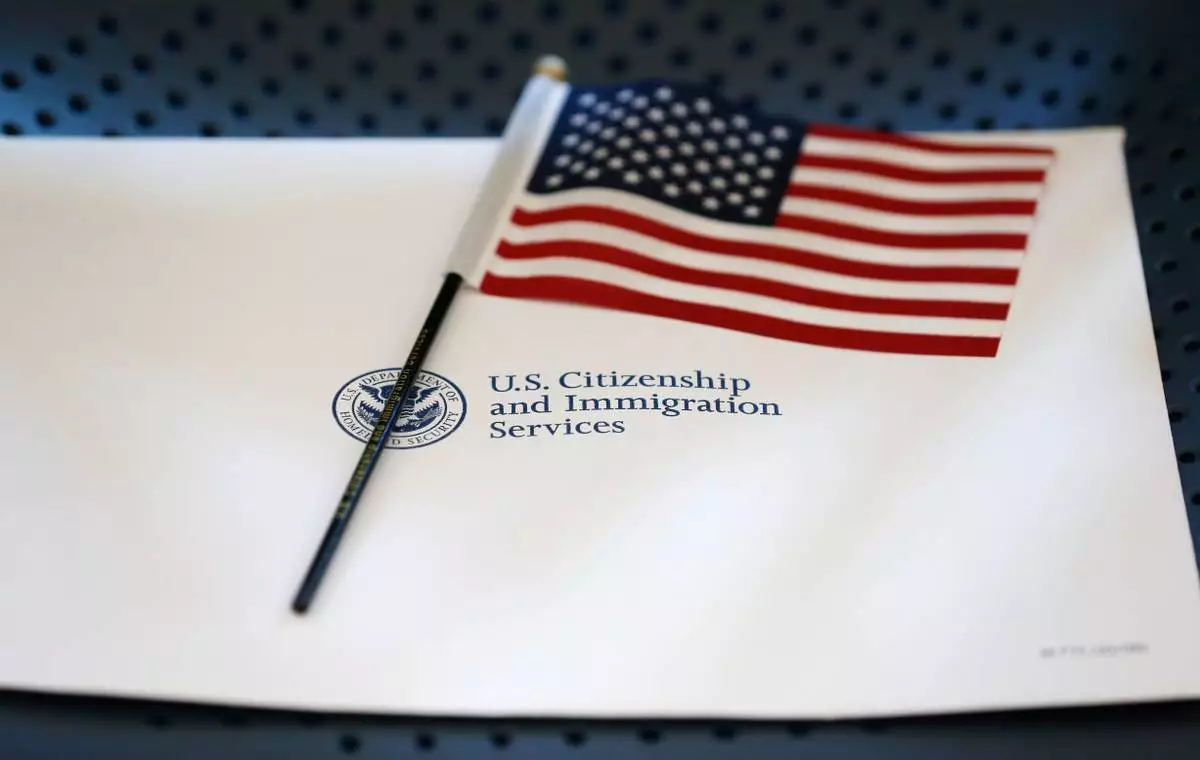
FILE - An information packet and an American flag are placed on a chair at the U.S. Citizenship and Immigration Services Miami Field Office on Aug. 17, 2018, in Miami. (AP Photo/Wilfredo Lee, File)