The New York Jets are signing kicker Younghoe Koo to compete at the position, a person with knowledge of the move told The Associated Press.
Koo will join Cade York and Lenny Krieg as kickers on the Jets’ roster. Nick Folk, New York’s kicker last season, signed with Atlanta as a free agent in March.
The person spoke to the AP on condition of anonymity Wednesday because the team didn’t announce the signing. SNY first reported that Koo would be joining the Jets.
The 31-year-old native of South Korea who went to high school in New Jersey kicked in five games last season for the Giants after one with Atlanta, where he played since 2019. Koo began his NFL career with the Chargers in 2017 after signing as an undrafted free agent out of Georgia Southern.
Koo made headlines last December in Week 13 when his foot missed the ball on a field-goal attempt for the Giants during a “Monday Night Football” game, a 33-15 loss to New England. Koo later said he saw the ball moving as he approached and aborted the kicking attempt.
In an odd twist, Mark Toothaker — a stallion season manager at Spendthrift Farm in Lexington, Kentucky — told the AP in April that the botched kick might have saved his life. He said he was watching the game and laughed so hard, he had a seizure. His wife Malory, a nurse, called 911, paramedics arrived and took Toothaker to a hospital — where a CT scan revealed a tennis-ball-sized tumor on the left side of his brain. The tumor was surgically removed and turned out to be benign.
Koo, who was selected to the Pro Bowl during the 2020 season, has made 185 of his 217 career field-goal attempts and 186 of 194 extra-point tries.
AP Sports Writer Stephen Whyno contributed to this report.
AP NFL: https://apnews.com/hub/nfl

FILE - Atlanta Falcons place kicker Younghoe Koo warms up during the second half of an NFL football game against the Tampa Bay Buccaneers, Sept. 7, 2025, in Atlanta. (AP Photo/Mike Stewart, File)
CAIRO (AP) — Iranians began to regain internet access on Wednesday after authorities ended a monthslong shutdown. But users said service was slow and spotty in some areas, with apps like YouTube and Instagram heavily restricted, as they were before the cutoff began during nationwide protests in January.
Authorities justified the outage as a military imperative after the United States and Israel attacked Iran on Feb. 28. Their decision to lift some restrictions this week came as negotiators appeared to be closing in on a more permanent truce. But many Iranians feared access could be cut off again at a moment's notice.
Internet tracking company Netblocks said Iran’s connectivity, which measures the ability of devices to connect to the internet, is at around 86% of capacity from before the cutoff. Internet analysis firm Kentik said internet traffic, which measures the amount of data transferred and is a good illustration of usage, was at around 40%.
Amir Rashidi, an Iranian cybersecurity analyst, said there were still widespread disruptions. “It's too early to say the shutdown is over,” he wrote on X.
Iran’s roughly 90 million people have been cut off from the internet for most of 2026, one of the world’s longest and strictest national shutdowns. Young people with online careers saw their incomes evaporate. Job losses and the closure of online businesses added to the war's steep economic costs.
The cutoff made it difficult for Iranian families to communicate through months of unrest and war. At some points, phone lines were also cut off, though they were later restored.
A woman living in Tehran said that for months she was barely able to speak to her sons living abroad. She couldn't believe authorities had restored access, saying she had assumed they would find some justification to prolong the outage.
A taxi driver said service was restored but weak. He expressed hope it would improve so he could use messaging apps with family and friends. Both spoke on condition of anonymity for security reasons.
Prices spiked during the shutdown, with residents in Tehran at times paying around $7.50 per gigabyte. Prices are back down to around $2.25 for 30 gigabytes, roughly where they were before the protests.
Even then, Iran tightly controlled access to popular social media sites, leading many to rely on virtual private networks, or VPNs. The cost of those workarounds soared during the shutdown, making them unaffordable for many as the economy was battered.
Businesses have started reappearing online, announcing their return with posts on sites like Instagram and Telegram.
A gamer and tech influencer in the central city of Isfahan said the shutdown had caused him to lose a lot of his audience on YouTube and Instagram, where he had spent years building up a large following.
“All my views and interactions are way down. I’ve been erased from the algorithm,” he said in a voice note sent by WhatsApp, adding that his internet connection was still slower than before the shutdown.
“The situation is such that many content producers have had their income reduced to zero, have moved on to other jobs, or have been forced to sell their equipment to survive,” he said. He spoke on condition of anonymity for fear of reprisal.
Iranian authorities first shut down the internet in January during mass anti-government protests that were eventually stamped out in a violent crackdown. Thousands of people were killed and tens of thousands detained.
That cutoff was just starting to ease when the government imposed a complete internet blackout after the start of the war, when U.S. and Israeli strikes killed Iran's supreme leader and other top officials.
The government faced criticism for the prolonged shutdown, which caused even more harm to an economy devastated by inflation, strikes on key industries and a U.S. blockade on Iranian ports.
The internet cutoff cost an estimated $30-40 million daily, with indirect losses likely twice that much, a member of Iran’s Chamber of Commerce, Afshin Kolahi, told a local newspaper last month. About 10 million people have jobs that depend on internet connectivity, according to Communications Minister Sattar Hashemi.
Iranians still had access to a national net, but that has a far narrower reach, and users complained of poor service and heavy censorship. Senior government officials are given SIM cards granting them access to the global internet. Under pressure, the government expanded access to the SIM cards to some professions during the shutdown.
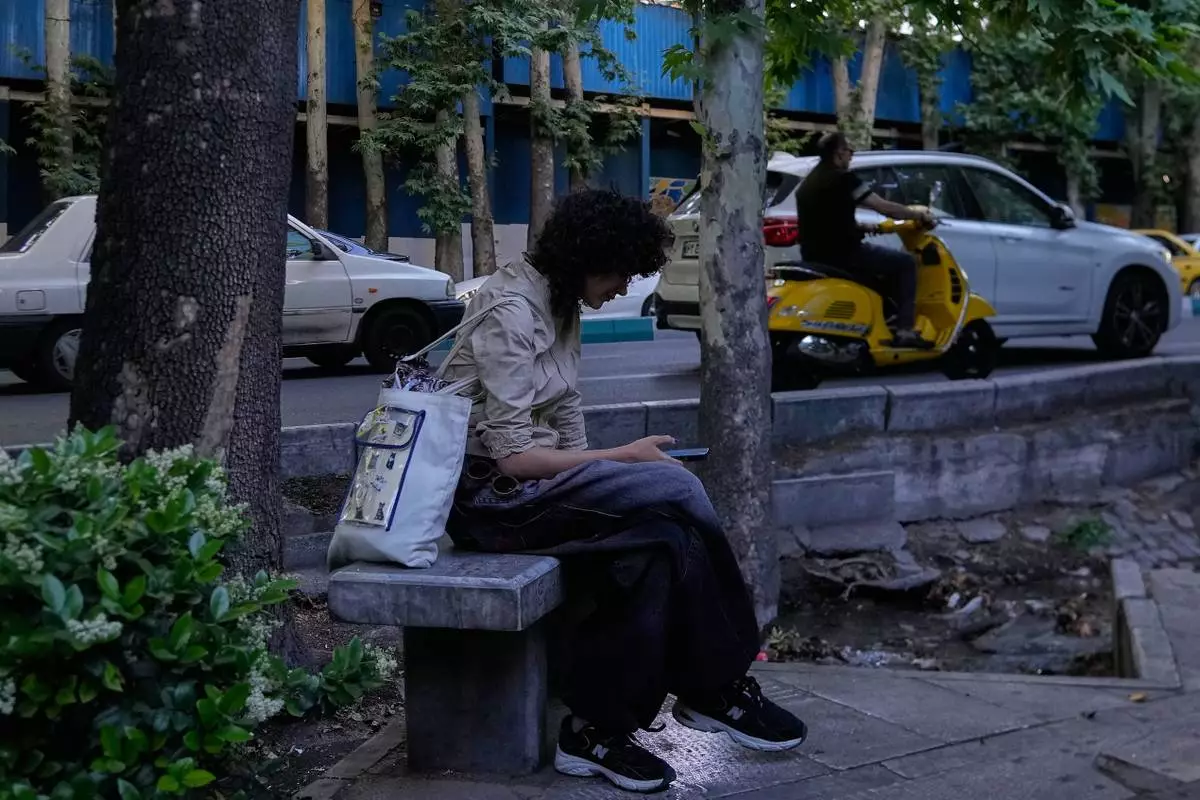
A woman checks her smartphone while sitting on a bench along a sidewalk in northern Tehran, Iran, Tuesday, May 26, 2026. (AP Photo/Vahid Salemi)