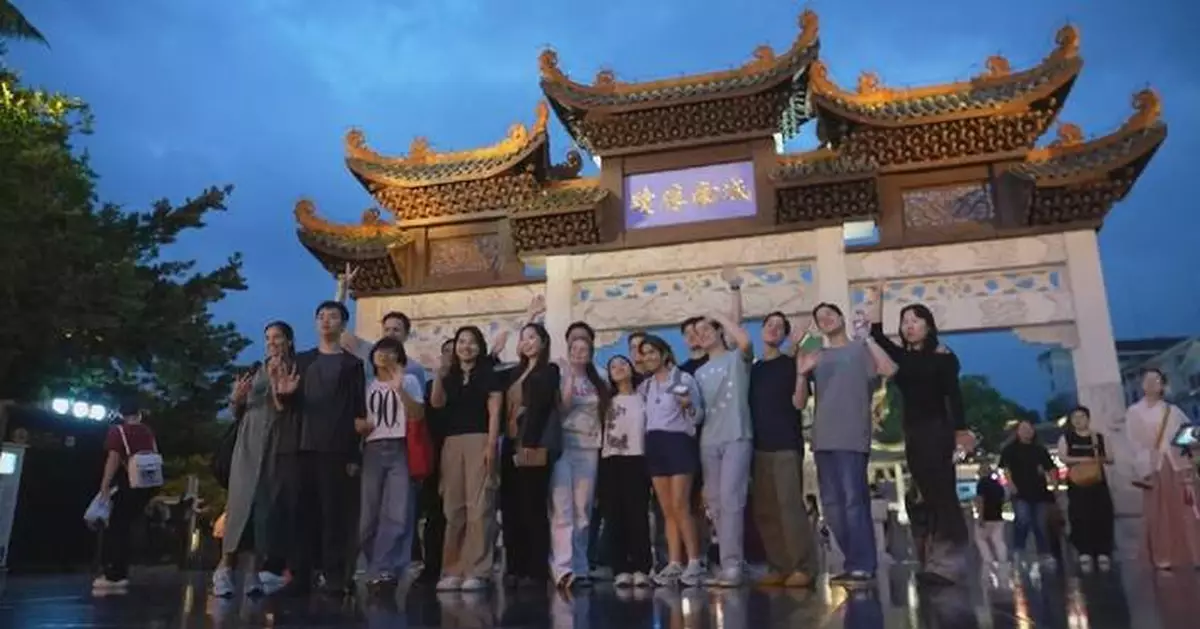
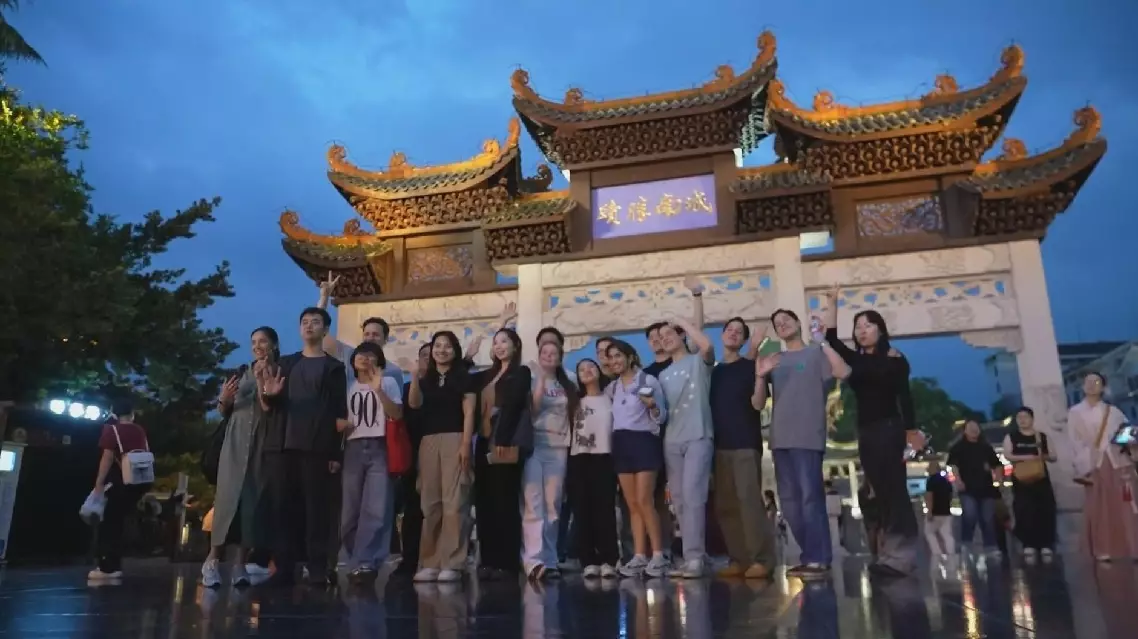
Students and professors from Harvard University are touring China this May, venturing beyond major cities to mountains in southwest China, where they are impressed by diverse local cultures and towering engineering projects.
An impressive moment came at the Huajiang Grand Canyon Bridge in Guizhou Province, a 2,890-meter-long steel-truss suspension bridge soaring 625 meters above the water, roughly the height of a 230-story building. Certified by Guinness World Records in April 2026 as the world's highest bridge, it has also been developed as a tourist site, with glass elevators, bungee platforms and night light displays illuminating the canyon walls.
Walking across the bridge, students from the United States marveled at the sheer scale of the structure and the purpose behind it: drastically transforming life for people living in the mountains.
"People should definitely come and see. I don't think many bridges have like these platforms where you can walk on. Learning about how much technology and innovation there is, this has been very eye-opening experience for me," said Akiyama Motoko from Harvard University.
The Chinese constructors explained that the bridge has compressed the journey between the two sides of the canyon from two hours to just two minutes, reshaping daily life for local residents.
"One thing is to see it on TV, another one is to be here. It's impressive. It's really incredible to see how far human can go. I mean, one cannot believe you can build something on top of this canyon and you have this bridge. It's amazing," said Jose Enrique Vera Ortega, a student from the Massachusetts Institute of Technology.
The Harvard cohort also stepped into local classrooms, but the experience went far beyond a standard campus visit. Together with Chinese students, they experienced the traditional art of Guizhou indigo dyeing, and established friendship across continents. Students eagerly swapped contact details, promising to meet again.
"Friendship goes beyond borders. I hope we can carry this friendship forward and keep sharing different cultures and customs of every country," said Chen Yuhan, a student from Guiyang No. 1 High School.
In addition to cultural exchanges, Carla Isabel Gamarra Martinez, a Harvard graduate student, said the visit reshaped her understanding of China's education system.
"I think I've always had a big respect for Chinese education because you see a lot of students at Harvard, Asian students. So, I knew before coming here that there has to be something very powerful about the education system. (But) you can never imagine someone's experience. You have to go. Go to the place and experience it yourself to have a better understanding," she said.
The visiting students and faculty expressed gratitude for the program that made their journey possible, which is a part of President Xi Jinping’s proposal to invite 50,000 young Americans to China on exchange and study programs over five years. The trip allowed them to see China with their own eyes and begin to understand it from a broader, more profound perspective, they said.
"Everyone is very impressed with the hospitality, with the level of work, with the innovation, with the respect for tradition. It's been already a wonderful trip. So, for many of us it's a first trip and it will not be the last," said Doris Sommer, a Harvard University professor on the trip.
US students, professors visit Guizhou