Shanghai's Renji Hospital has become China's first medical institution to acquire a DNV certification for blood purification care in early 2026, further bolstering the capacity of the city's international, high-end medical services.
For travelers managing uremia, a condition requiring regular blood purification, Shanghai has become a far more accessible destination. Renji's Blood Purification Center has earned the international certification that validates the center meets rigorous global standards for patient safety and care quality.
"This is my first time in Shanghai, China. It was such a straightforward and smooth booking. The doctors and the nurses have all been great. I felt at ease. I've had three treatments here. Coming to Shanghai has really shown me that I can really still live and experience the world," said a patient from London, the capital city of the United Kingdom.
Renji's doctors say they have invested years of efforts to obtain the DNV certification -- accreditation from Det Norske Veritas, a Norway-based international assurance organization that evaluates healthcare quality and patient safety standards globally.
"For 30 years, we saw a growing demand from international patients -- tourists, business travelers, even an engineer during the World Expo 2010. They needed hemodialysis but also required assurance that our quality met global norms. This drove us to pursue DNV certification. It was a multi-year process of fundamental upgrades, digitizing our entire system from handwritten records," said Gu Leyi, director of the Nephrology Department.
The DNV standard requires management protocols, traceable medical records, and standardized procedures to guarantee patient safety.
"Our DNV-certified process begins well before travel, with a thorough pre-assessment with the patient's home doctors and screening for infectious diseases. We arrange treatment frequency, allocate time slots, and prepare specific rooms based on the patient's prescription. Upon arrival, we re-test on-site. During each session, we provide multilingual communication support and full companionship. This system builds mutual trust with patients, and we're seeing many of them happy to return," said Lu Renhua, director of the Blood Purification Center.
Renji's blood purification center has three campuses across Shanghai and has the capacity to treat nearly 200 patients every day.
"Booking is through our international clinic website or by emails. DNV certification improves patients' access. Our goal is to replicate a patient's home treatment for a smooth transition. After each session, we provide a full report in English. The certification also facilitates direct payment from international insurance providers. Our weekend and evening shifts are able to fit into their travel itineraries, making Shanghai's international outreach more complete and multi-dimensional," Gu said.
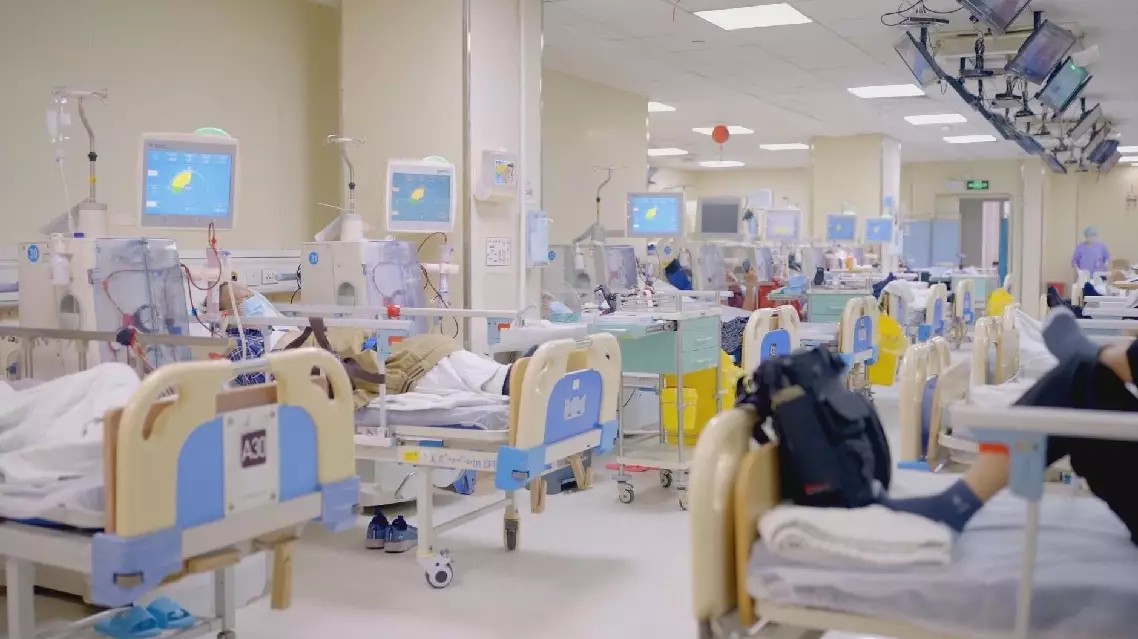
Shanghai's Renji Hospital earns China's first DNV certification for blood purification