With the rapid growth of artificial intelligence, the price of tin has jumped 40 percent to a record high of about 420,000 yuan (62,080 U.S. dollars) per ton from 300,000 yuan (44,340 U.S. dollars) per ton last November, reflecting the shifting global supply-and-demand landscape behind the surge.
Tin stands out in the world of metals for its good conductivity, low melting point and strong welding stability -- properties that make it a key material in advanced semiconductor packaging. The greater the computing power and the denser the chip stacking, the more tin is consumed, earning it the name "computing metal."
In response to surging global demand for tin, smelters in south China's Guangxi Zhuang Autonomous Region are running at full capacity while mines in southwest China's Yunnan Province are maintaining stable output, doing their part to help stabilize the domestic market.
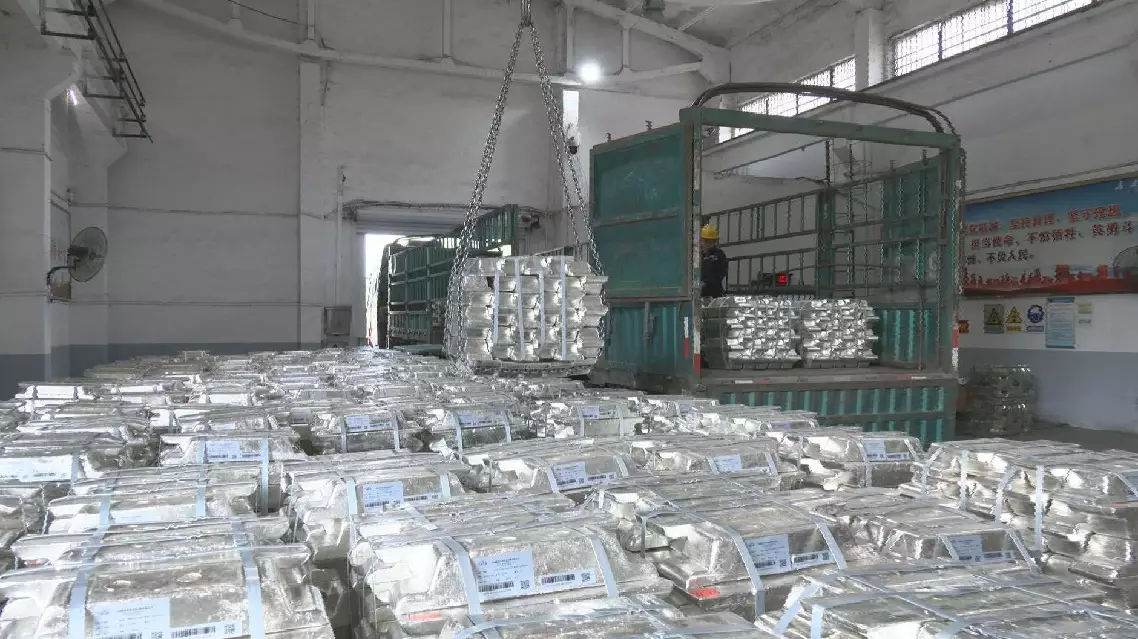
At the finished product warehouse of a tin smelter in Laibin, Guangxi, workers were seen loading one-ton bundles of finished tin ingots onto trucks. After inspection, the ingots would be sent to downstream enterprises.
"This truck carries 32 tons of tin ingots. And they're selling quite well, in pretty tight supply in the market," said Meng Bin, deputy general manager of Guangxi Laibin Huaxi Tin Smelting Co., Ltd.
Meng said that due to strong demand for tin from downstream enterprises, his company's production lines are now operating 24 hours a day without interruption.
"It may take two to three days to ship the tin ingots to various parts of the country after they come off our production lines. The turnover speed of the products is about one to two days faster than before," Meng said.
While the smelting sector is experiencing a boom in both production and sales, upstream miners cannot increase output quickly.
At the Datun tin mine in Yunnan, the mine manager said that tin mine capacity is subject to the hard constraints of mining systems and safety regulations, maintaining a balanced level of extraction year-round. Even with a surge in downstream demand, rapid expansion of output is not feasible.
"The mine's daily output is about 6,000 to 7,000 tons. We believe it is unrealistic to increase output from a primary ore mine. No matter how many application scenarios or how large the demand from downstream, the supply can only be this much," said Xu Peiliang, manager of Datun tin mine, who is also chairman of the Yunnan Tin Company Ltd.
China is the world's largest producer and consumer of refined tin. However, affected by declining ore grades in domestic tin mines, approximately two-thirds of the tin ore used in domestic smelting now relies on imports.
Since last year, major tin-producing countries such as Myanmar, Indonesia and the Democratic Republic of the Congo have experienced supply shortages due to export restrictions, geological disasters and other factors.
Industry insiders believe that rising tin prices will be a long-term trend over the next one to two years.
"Due to the inherent characteristics of global tin resources, supply elasticity is naturally insufficient. Tin has a very low abundance in the Earth's crust, and the global static reserves-to-production ratio has already fallen to below 20 years. Meanwhile, the grade of existing producing mines is declining, and mining costs are on an irreversible upward trend. As a result, the global supply gap is likely to continue widening year by year. In the short term, tin prices are expected to remain volatile at high levels, with a tendency to rise easily but fall reluctantly," said Han Shouli, general manager of Yunnan Tin Group (Holding) Company Ltd. An analyst said she believes that looking at the medium to long term, there are solid reasons for tin, the "computing metal," to keep the price high.
"New demand from areas like AI and optical modules is one of the key factors driving tin prices up over the long term. Overall, we expect the price level to stay at historically high levels," said He Qian, an analyst at Fubao Information.
Tin price hits record high as AI growth leads to surging demand