PHILADELPHIA--(BUSINESS WIRE)--Jun 2, 2026--
True, the premier global executive talent platform powered by data, AI, and deep sector expertise, announced today the launch of the True AI Capability Index℠, a proprietary framework that predicts executive performance in the AI-transformation age. While the broader market struggles to assess technical adaptability, True is providing the first reliable system to assess candidates with the winning combination of proven execution and AI fluency.
This press release features multimedia. View the full release here: https://www.businesswire.com/news/home/20260602934855/en/
The talent market is currently split between proven leaders who are failing to adapt their playbooks and high-potential candidates who lack the experience to manage large organizations. True’s AI Capability Index℠ gives clients a clearer view of which leaders will continue to create value as the rules evolve.
"We are entering a phase where relationship depth and judgment matter more than ever," said Brad Stadler, CEO & co-Founder of True Platform. "The cost of finding names is decreasing. True’s advantage lies in our ability to assess talent using these advanced frameworks. We’re modernizing executive hiring to ensure our clients have the leadership they need to outperform."
The True AI Capability Index℠ categorizes candidates using two primary metrics: execution pedigree and AI skill/will. This data-driven approach allows clients to commit to hiring profiles that offer both immediate results and long-term upside.
"Our clients are looking for leaders who can drive transformation with no historical precedent," said Evan Grossman, Managing Director and co-Head of the CEO & Board Practices. "The framework creates a shared language for these conversations. We help clients understand the trade-offs between expert operators and AI-focused innovators. This clarity narrows the candidate pool and leads to more realistic hiring decisions."
Leadership has not changed but how executives succeed has. The True AI Capability Index℠ assesses candidates on five dimensions of adaptive intelligence including model-updating speed and hybrid organization design. True looks for leaders who reason through ambiguity and design teams around human and AI collaboration. This focus on real capability reduces the risk of hiring leaders who might plateau as technology changes.
ABOUT TRUE
True is the most trusted executive talent management platform powered by unmatched data, technology, and global expertise. The True AI Capability Index℠ predicts executive performance in the AI-transformation age with precision and speed. Products and services include True Search for executive recruiting, TrueBridge for fractional and interim placements, and True Talent Labs to strengthen leadership teams through coaching and assessment. Thrive is our real-time Talent CRM and SearchEssentials brings tech-enabled tailoring to the hiring process.

True Launches the True AI Capability Index℠ to Redefine Executive Assessment
BIRAO, Central African Republic (AP) — The agony began for Maude Ahmad Fadala shortly after sunset.
Her baby was coming. She was in a refugee camp, weakened by typhoid. There were no camp facilities for what was about to happen, and she had no money to travel. She struggled to her feet and started walking.
She stopped every few minutes, gripped by pain from contractions, then could go no farther.
“I gave birth in the street," she said. "There was no doctor, no midwife, and no one holding my hand.”
This is part of a series on maternal mortality in sub-Saharan Africa, which has the world’s fastest-growing population and accounts for 70% of global maternal deaths. Around 180,000 pregnancy deaths are recorded every year across the continent, along with the deaths of about 1 million newborns.
Nearly two-thirds of maternal deaths worldwide occur in countries affected by conflict or “fragility,” the World Health Organization said this year. For women like Fadala, fleeing Sudan’s war to countries like Central African Republic, the danger doesn’t stop at the border.
Displacement can mean missed prenatal appointments, dangerous journeys and weakened health systems, often in remote settings.
Women in Central African Republic are 40 times more likely to die in pregnancy or childbirth than in the United States, the United Nations has said. For every 100,000 births in the country, one of the world's poorest, 829 women die.
Years of internal conflict have made Central African Republic and its health system fragile. Despite its vast reserves of gold, health services are scarce outside major cities. One in three people live on less than $2 a day.
The government, aware of its maternal mortality problem, announced a plan in 2024 to increase spending for resources such as skilled birth attendants. Officials did not respond to questions about how it's working.
Now, sweeping cuts in humanitarian aid funding by top donor the United States and other countries have made it even harder for women to find care.
In the remote town of Birao near the Sudan border, where Fadala shelters, four local midwives who had been supported by the U.N. Population Fund lost their jobs last year as the Trump administration cut every U.S. funding agreement with the U.N. sexual and reproductive health agency.
Opposite Fadala's tent is a former UNFPA-funded “safe space” providing transport for pregnant women to the district hospital. It was one of four such spaces in Birao serving nearly 50,000 women. Those have closed without U.S. funding, along with two U.S.-backed health facilities.
Now, "some women run the risk of dying in pregnancy situations that are not medically managed,” said UNFPA program officer Marie Justine Mamba Ibingui.
UNFPA's budget in Central African Republic has been halved in the past two years to $6.5 million, country director Victor Rakoto said. UNFPA was the only provider of reproductive health products in Birao.
“The risk of maternal death is going to increase if there is no solution,” Rakoto said.
Conflict-affected settings like Birao account for six in 10 maternal deaths globally, according to the U.N.
The district hospital, which Fadala had tried to reach, is a few kilometers (over a mile) away over dirt roads.
On a recent day, birthing assistant Delphine Zanabe moved between patients as dozens of women waited, sitting thigh-to-thigh on hard benches in the sweltering heat. Some had walked for hours to reach the hospital. Others had risked their pregnancy with motorbike journeys over rough ground.
From the border, adjoining a part of Sudan held by paramilitary forces fighting the Sudanese military, it’s a 65-kilometer (40-mile) journey to the refugee camp.
“They only come when they are about to give birth,” Zanabe said. “It’s a struggle and it’s either the baby or the mother who suffers.” According to WHO guidelines, pregnant women should attend at least eight prenatal consultations.
For refugees, living in survival mode in unfamiliar surroundings compounds the challenges of poverty and lack of education. Zanabe said those factors often put women at risk for pregnancy and childbirth complications.
In the maternity ward, eight beds were in a room so small they almost touched. They serve a population of about 70,000 people, along with 22,000 Sudanese refugees.
Doctors said 12 staffers have lost their jobs as a result of aid cuts. The majority were from the maternity department.
Amna Adam Hessen had arrived the day before, burning with fever from malaria. Her unborn child was found to be in a breech position, a discovery made late because she had missed prenatal appointments. Brought by motorbike from the refugee camp, she bled heavily during labor and lost her baby.
The next day, her mother, Salet, fanned her in the suffocating heat.
“Giving birth here is exhausting,” she said, describing the long and difficult night.
Amna writhed with fever on the bare foam mattress and cried out, “Mama, mama."
Zanabe is worried about future cuts in humanitarian assistance affecting mothers.
Over 40% of births in Central African Republic already occur away from medical facilities, the United Nations has estimated — a traditional approach that risks otherwise preventable complications.
Clara Abessendé was one of the four midwives who lost their jobs.
She had watched as the number of women arriving daily at the hospital tripled after Sudan's war began in early 2023, and as staffers ran out of supplies like antibiotics and malaria treatments.
“As a result, there were more cases of infant and maternal deaths," she said.
Abessendé said she feels heavy with the guilt of having to leave her job.
“The children born in my hands .. .I abandoned them like that," she said.
Katidje Idrisse Tahire is one of the women she's no longer there to help.
Tahire walked slowly through the refugee camp to fetch water, one child on her back and two others at her side. She was late in her ninth month, preparing to have another.
She said she fled Sudan four months ago on foot. At the border, armed men robbed her of everything. Her husband hasn’t been seen since they fled Darfur.
“My whole body aches,” she said. “I am very tired and unwell.”
She has no money and doesn't know if care will be available when her baby comes.
For more on Africa and development: https://apnews.com/hub/africa-pulse
The Associated Press receives financial support for global health and development coverage in Africa from the Gates Foundation. The AP is solely responsible for all content. Find AP’s standards for working with philanthropies, a list of supporters and funded coverage areas at AP.org.
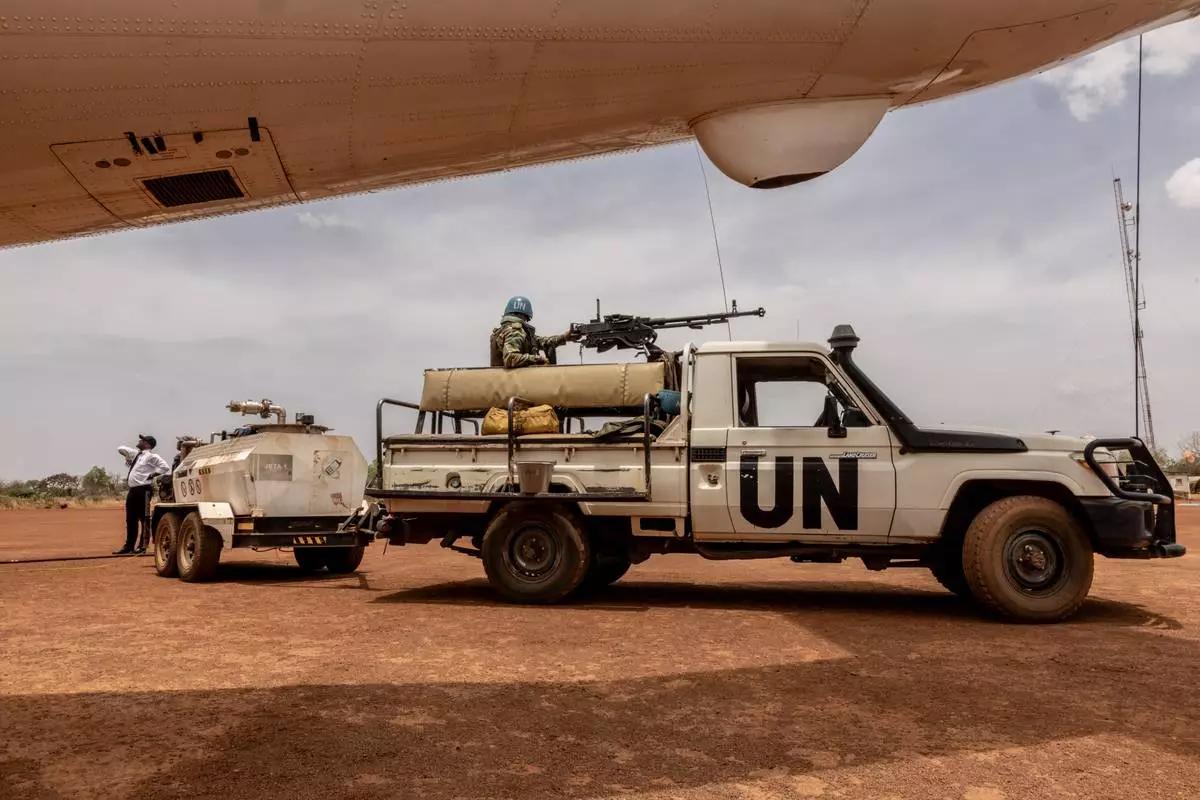
UN peacekeepers stand guard of a UN flight refuelling on the tarmac of the Birao Airport in Central African Republic, Wednesday, March 25, 2026. (AP Photo/Caitlin Kelly)
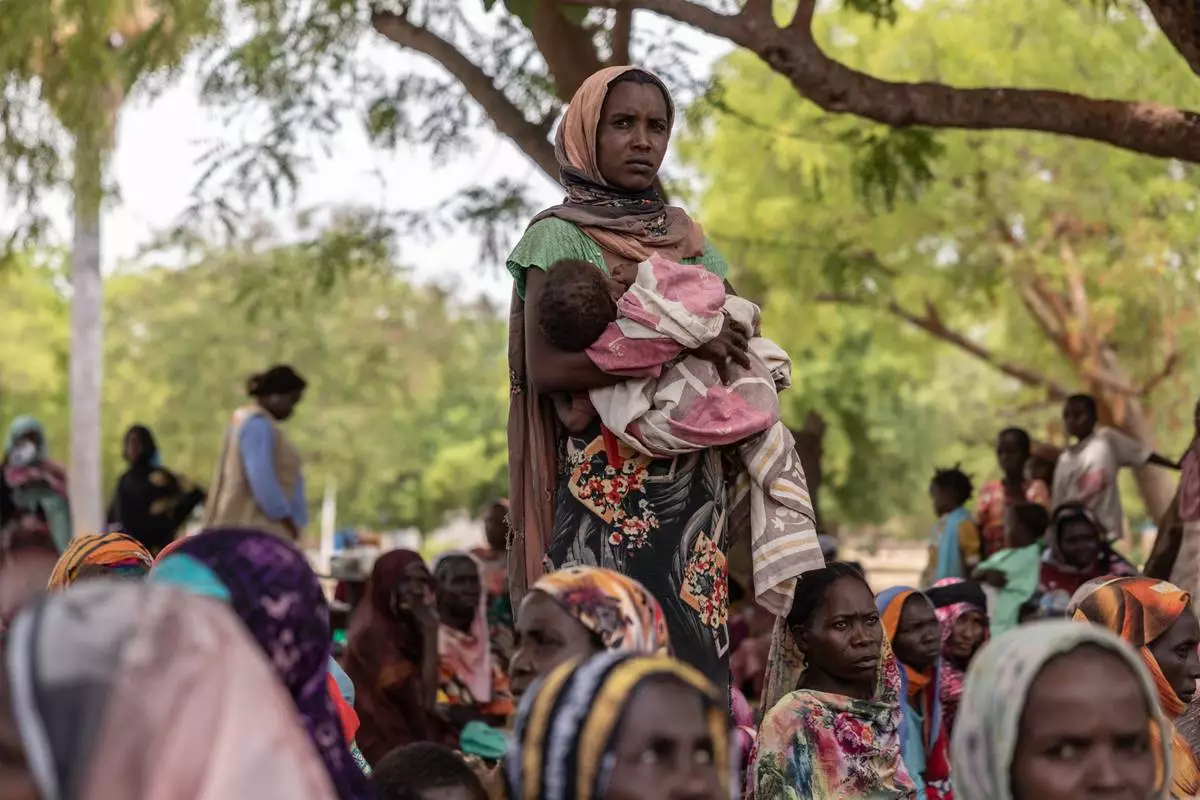
A woman holds her baby outside the registration center for new refugees on the outskirts of the Korsi Refugee Camp in Birao, Central African Republic, Thursday, March 26, 2026. (AP Photo/Caitlin Kelly)
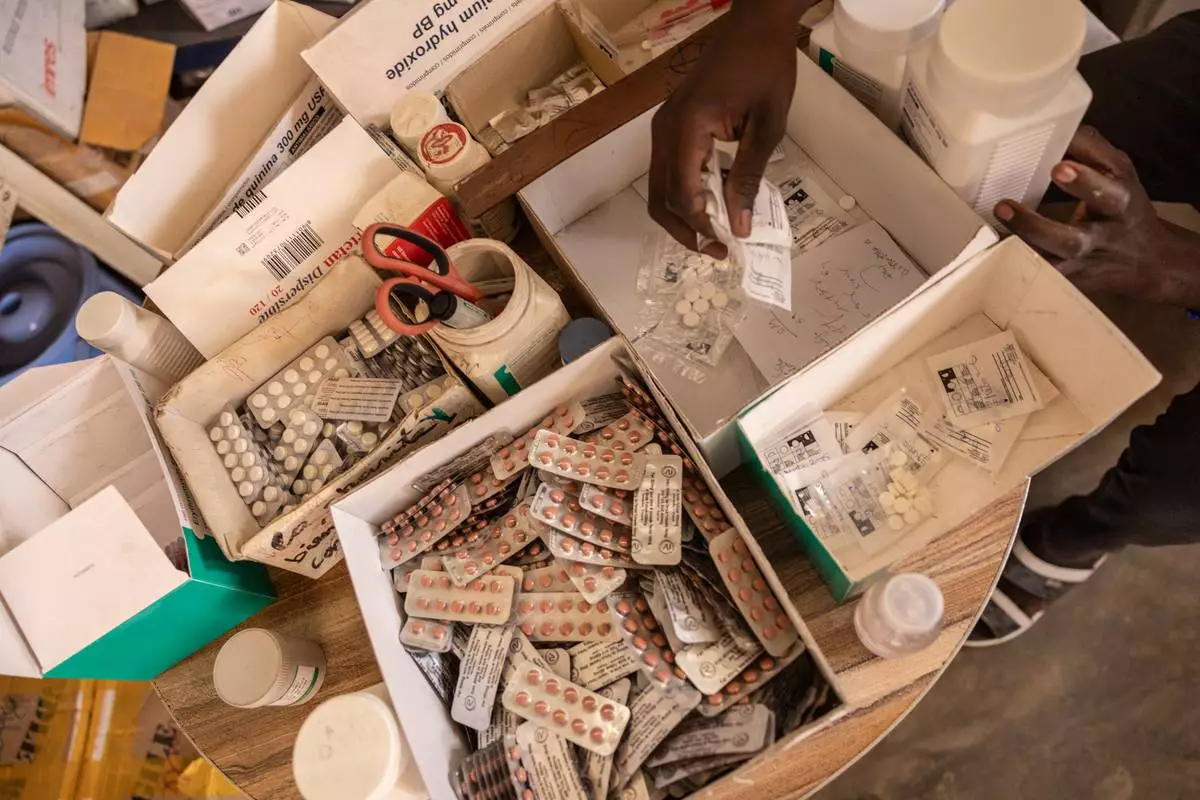
A pharmacist hands pregnant women painkillers from boxes at the pharmacy of the Birao District Hospital in the Central African Republic, Thursday, March 26, 2026. (AP Photo/Caitlin Kelly)
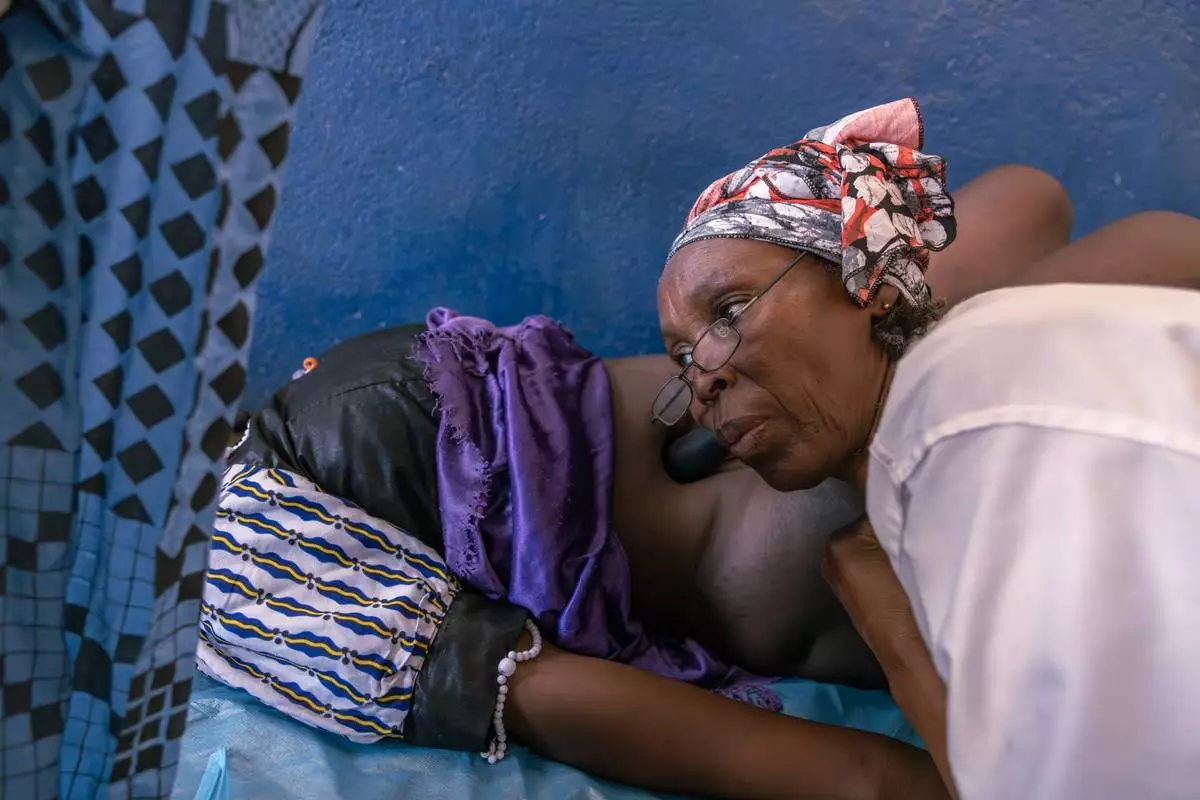
A woman has her first pre-natal consultation with nurse Delphine Zanabe at the Birao District Hospital in Central African Republic, Thursday, March 26, 2026. (AP Photo/Caitlin Kelly)
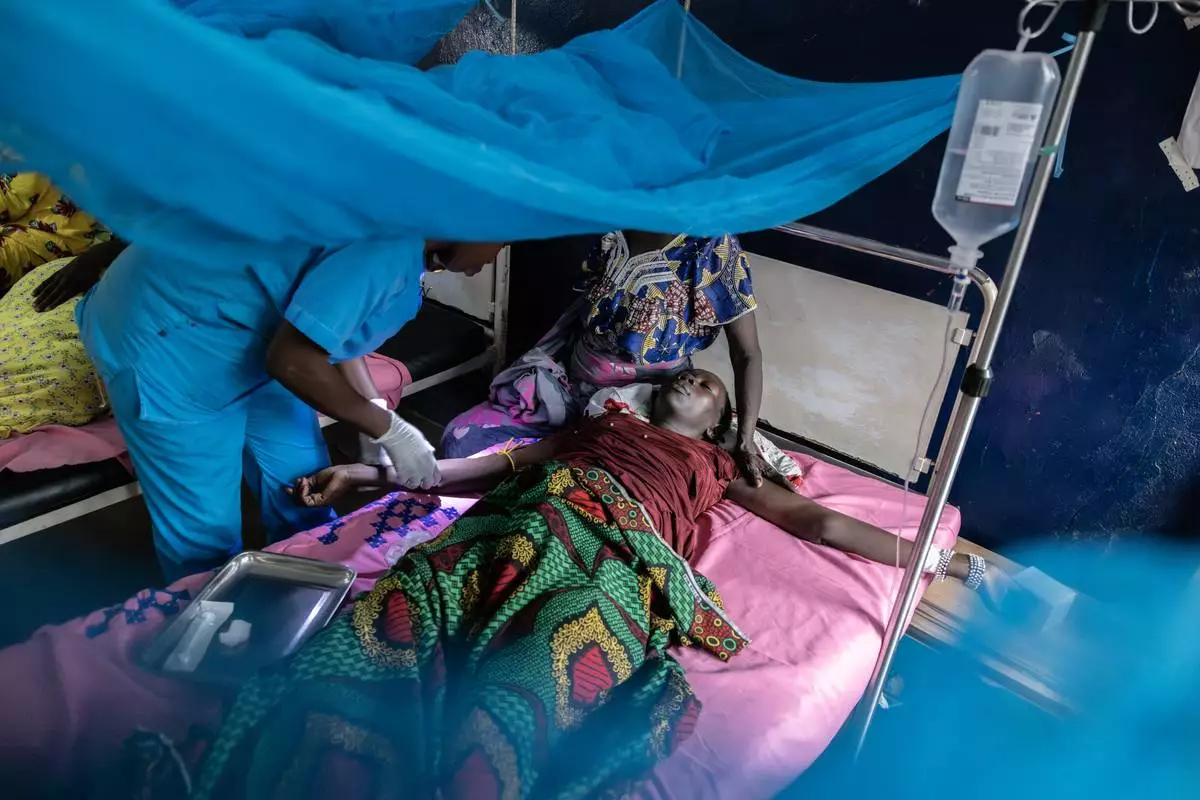
A nurse gives painkillers to patient Amna Adam Hessen, whose baby was delivered stillborn the previous day, at the Birao District Hospital in the Central African Republic, Wednesday, March 25, 2026. (AP Photo/Caitlin Kelly)