Findings of 2026 Pay Trend Survey
The following is issued on behalf of the Pay Trend Survey Committee:
The Pay Trend Survey Committee (PTSC) met today (June 3) to examine the findings of the 2026Pay Trend Survey (PTS).
The validated survey findings indicate that the following average pay adjustments were awarded by the surveyed companiesover the 12-month period from April2, 2025, to April1, 2026:
Salary bands in which surveyed employees are grouped
Basic Pay Indicator
Additional Pay Indicator
Gross Pay Trend Indicator
Lower Salary Band (below $26,590 per month):
2.73%
-0.40%
2.33%
Middle Salary Band ($26,590–$81,510 per month):
3.16%
0.51%
3.67%
Upper Salary Band ($81,511–$163,905 per month)
3.29%
1.87%
5.16%
The 2026 PTS was conducted by the Pay Survey and Research Unit of the Joint Secretariat for the Advisory Bodies on Civil Service and Judicial Salaries and Conditions of Service in accordance with the methodology approved by the Chief Executive in Council in March 2007.
The survey findings reflect the pay trend in 104 surveyed companies covering 154 887 employees over the 12-month period from April 2, 2025, to April 1, 2026. The survey takes into account adjustments to the basic salaries and additional payments awarded to employees of the surveyed companies attributable to factors in relation to the cost of living, general prosperity and company performance, general changes in market rates, merit and inscale increments, in accordance with the approved survey methodology.
A breakdown of the 104 companies by size is as follows:
Number of companies
Larger companies (employing 100 or more staff members)
80 (77%)
Smaller companies (employing between 50 and 99 staff members)
24 (23%)
Total : 104 (100%)
The distribution of the 154 887 employees by the three salary bands is as follows:
Salary bands in which surveyed employees are grouped
Number of employees
Lower Salary Band (below $26,590 per month)
63 493 (41%)
Middle Salary Band ($26,590–$81,510 per month)
77 516 (50%)
Upper Salary Band ($81,511–$163,905 per month)
13 878 (9%)
Total :
154 887 (100%)
The PTSC met today to examine and consider the 2026 PTS Report. Members present unanimously confirmed the survey findings. The PTSC will submit the 2026 PTS Committee Report to the Government after the meeting.
The PTSC is chaired by Mr Laurence Li, SC. The PTSC expressed its sincere appreciation to the companies for the full assistance that they rendered to the Pay Survey and Research Unit.

Photo source: reference image
Speech by CE at Nazarbayev University in Astana, Kazakhstan
Following is a speech by the Chief Executive, Mr John Lee, at Nazarbayev University in Astana, Kazakhstan, today (June 3):
President Professor Waqar Ahmad (President of Nazarbayev University), faculty members, students, distinguished guests, ladies and gentlemen,
Good morning. It is an honour to be here, with you today, at Nazarbayev University, a leading centre of education and innovation in the heart of Eurasia.
I was delighted to learn that your university, Central Asia's No.1, has been ranked among the top quartile of international research universities. And you achieved this just 16 years after your founding. This is an outstanding record.
Nazarbayev University has made news, and history, in many ways. One of them is the visit in 2013 by President Xi Jinping of my country, the People's Republic of China. Here, at this very university, President Xi delivered a landmark speech, publicly proposing, for the first time, the joint building of the Silk Road Economic Belt.
That historic moment marked the genesis of today's Belt and Road Initiative. It is a strategic blueprint for connectivity, shared development and common prosperity. And it has reshaped global co-operation.
Since its inception, the Belt and Road has developed a comprehensive framework for global partnership. It's anchored in policy co-ordination, infrastructure connectivity, free and unfettered trade, financial integration and, critically, people-to-people bonds.
More than a decade on, the foundations laid here are delivering rewarding results: new trade corridors, stronger financial flows, and a clearer recognition that shared prosperity is the most sustainable path forward.
Lasting prosperity requires shared knowledge, talent, and trust across borders - and that begins with education. Right here at Nazarbayev University, that vision is taking shape. One pioneering partnership is with the Hong Kong University of Science and Technology.
Last year, at the 10th Belt and Road Summit in Hong Kong, the two institutions signed a Memorandum of Understanding (MOU). The agreement includes the launch of a joint Bachelor of Business Administration programme in Eurasian business. The programme features a joint curriculum, with students spending two years at each institution.
This landmark initiative is the first of its kind in Asia. It demonstrates a shared commitment to advancing higher education co-operation under the Belt and Road Initiative. I am confident that the new degree programme will offer farreaching benefits for our students and our economies.
Today, we will take another encouraging step forward. After my speech, Nazarbayev University will reach MOUs with Hong Kong's Education University and Polytechnic University.
These agreements will deepen academic and research collaboration. They will strengthen peopletopeople ties between Hong Kong and Kazakhstan.
This growing network of institutional partnerships is precisely how we build enduring foundations for long-term co-operation and mutual rewards.
Now, why is Hong Kong the right partner? For many reasons. And I'll tell you a few of them now. Hong Kong, like Kazakhstan, is an active contributor and beneficiary of the Belt and Road Initiative. Under "one country, two systems", Hong Kong serves as a "super connector" and "super value-adder". We add value to everything we do - and to every economy, company and institution we partner with.
An international financial, trade and legal services hub, Hong Kong's prosperity is underpinned by the common law system, the free flow of capital, and a deep pool of talent. In fact, Hong Kong is the only city in the world with five of the top 100 universities. This talent environment is reinforced by our global standing: last year, Hong Kong ranked first in Asia, and fourth globally, in the World Talent Ranking.
We have long been committed to international co-operation, enabling our companies and professionals to seize opportunities worldwide. And that very much includes the Belt and Road Initiative, and the educational collaborations it enables.
These collaborations do more than grant degrees. Through academic exchanges and joint research, students gain an international mindset, adaptability, and communication and problem-solving skills. These skills help them manage uncertainty, and identify pathways to shared growth.
This year, more than 6,000 students from Belt and Road countries are studying in programmes funded by Hong Kong's University Grants Committee. I am pleased to note that some 500 of them are from Kazakhstan. That makes Kazakhstani students one of the largest groups of students among our Belt and Road student community.
The HKSAR (Hong Kong Special Administrative Region) Government's Belt and Road Scholarship scheme sets aside 150 scholarships annually for post-secondary students from Belt and Road countries. Together with the "Study in Hong Kong" initiative, internships, and youth exchange programmes, these efforts are building a shared Belt and Road talent pool.
These initiatives, let me add, go well beyond education. They foster the lasting friendships and mutual understanding that transcend borders. Every student who studies abroad becomes an ambassador for their home country and a bridge to their host community.
The Kazakh community in Hong Kong is growing. And I invite you to look to Hong Kong for your future, too, students here. We welcome talented youth and entrepreneurs with open arms. The opportunities are wide open, too.
Hong Kong is one of the world's leading financial centres, a rising innovation and technology hub, an arts and culture, sports and entertainment metropolis. And a whole lot more.
And, like you, we Chinese enjoy eating. Last night, I took the delegation for a classic Kazakh dinner - beshbarmak and baursak. We all enjoyed the boiled meat and the deep-fried dough balls. Let me add that Hong Kong has its first Central Asian restaurant opened just a few months ago. I always believe that food is a place's best ambassador. I look forward to Kazakh restaurants filling up the streets of Hong Kong, so that the over 500 Kazakh students can help introduce their culture in Hong Kong.
Ladies and gentlemen, the partnerships we celebrate today are just the beginning. Each agreement, each student exchange, each shared research project brings our universities and our youth closer together. That is how we turn a vision of shared prosperity into daily reality.
I wish Nazarbayev University every success ahead. I wish the students here bold dreams and bright futures. And I wish Hong Kong and Kazakhstan a partnership that grows stronger with every passing year. Thank you.
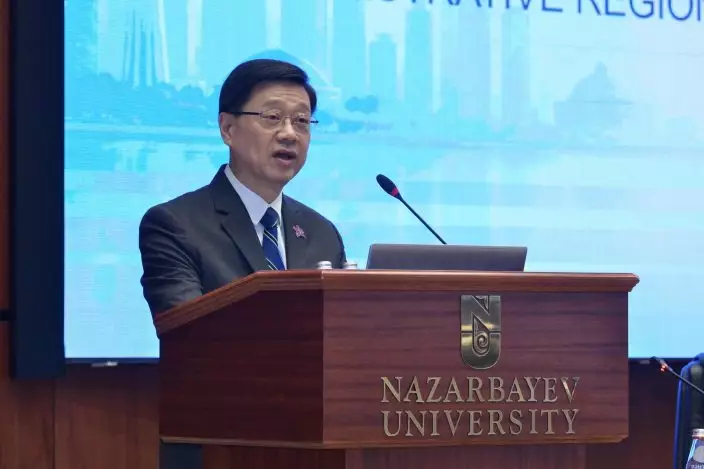
The Chief Executive, Mr John Lee, today (June 3), visited Nazarbayev University in Astana, Kazakhstan. Photo shows Mr Lee addressing the signing ceremony for Memoranda of Understanding between Nazarbayev University and Hong Kong higher education institutions. Source: HKSAR Government Press Releases