Job seekers in the United States are confronting an increasingly uncertain and competitive market where the rise of artificial intelligence (AI) is fundamentally reshaping the entry-level employment landscape.
Outside the Chase Center Arena in San Francisco, long lines of job hunters gathered at a paid career expo for the sports and entertainment industries, highlighting the intense competition in the current economic climate.
Many applicants feel they are not only competing against their peers but also against emerging AI technologies, which many fear is replacing traditional roles.
Among them is Layla Dessouki, who expressed concern over how AI is taking over too many entry-level jobs.
"It's tough out there. It is brutal. I've been looking for a job for I want to say maybe nine months now. I am worried about that (AI), especially as an entry-level candidate. I think we need to have those entry-level roles for people to be able to do the more senior roles," said Dessouki.
Data from the career site Huntr supports these anxieties, as many are now having to endure much longer searches to finally land a job.
Sam Wright, Huntr's head of Career Strategy, noted that over the past year, the average time for job seekers to go from starting their search to receiving their first offer has nearly doubled, increasing from 57 days to 108 days.
"You can be competing against maybe a mid-level person that has lost their job. And so now you have greater competition, and that competition is causing folks to need to do a little bit more than maybe what was expected in the past. Now, doing that more is also becoming easier because of the technology, which is why I do believe that it's so important for early career folks to get used to using AI tools," Wright said.
Despite the challenges, some job hopefuls say they are actively trying to keep up with these technological shifts.
Miles Hickey, a recent graduate, believes that adapting to new tools is essential for those looking to get ahead of the curve.
"I think trying to integrate yourself with the technology and making it accessible for others to learn and use, especially as the younger generation trying to carry on the advancement of technology -- 100 percent think it's helping," he said.
For Anousha Nejad, a student and sports journalism enthusiast, this means leveraging social media platforms like TikTok and Instagram to showcase her skills. While she acknowledges the undoubted capabilities of AI, she remains confident in the irreplaceable nature of certain creative roles.
"There's some jobs that like AI can do part of. I don't think there's a lot of jobs in the sports industry that AI can replace. Like media, I don't think the AI can replace that. Photography - that can't be replaced," she said.
The conversation around AI's impact on labor has even reached the highest levels of the tech industry.
Jensen Huang, CEO of American tech giant NVIDIA, recently made headlines by suggesting that the advent of the AI era represents a prime time for skilled tradespeople, such as electricians and plumbers.
However, some analysts including Wright have cautioned against viewing blue-collar work as a universal safety net.
"I think that there's a lot of tech folks that are kind of pontificating on this rise in the blue collar work and blue collar work is certainly valuable, but there's a finite number of those jobs as well. We don't need every single person in the economy to be a plumber," Wright said.
While job seekers navigate these ongoing changes, experts are observing a grand experiment regarding which skills can be automated. Wright noted that Huntr has not yet seen evidence in its analysis suggesting AI will lead to draconian cuts in unemployment. Instead, certain sectors like healthcare remain resilient due to demographic shifts.
"[When] we have an aging population, we see things like the medical industry, right, and medical care. So those jobs seem to be pretty consistent and seeing increases in opportunities that are available. So, I've actually personally met with several career changers that were [like:] 'hey, I was in a remote job in the software industry, that's feeling insecure. I'm actually going to go to back to school to become a nurse'," said Wright.
As the job market continues to evolve, many job seekers express frustration but acknowledge they have little choice but to embrace the new tech-driven economy and adapt in order to survive.
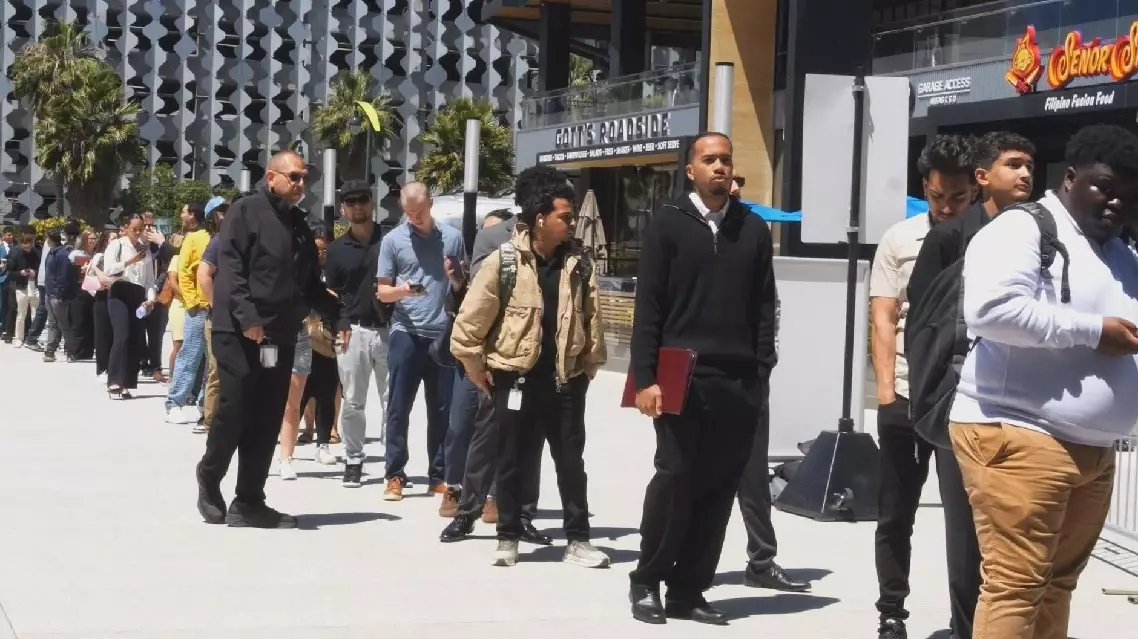
Entry-level job seekers face fierce competition as AI uncertainty hangs over US labor market