A China-Europe freight train departed from Guangzhou in south China's Guangdong Province on Wednesday, marking that the number of international freight trains operated by the Guangdong-Hong Kong-Macao Greater Bay Area this year has exceeded 20,000.
The train loaded with electronics, home appliances and some other goods left Guangzhou's Zengcheng West Station for Europe via the Horgos Port in northwest China's Xinjiang Uygur Autonomous Region.
Currently, international freight train routes from the Greater Bay Area span Europe, Central Asia, ASEAN and beyond.
The variety of cargo has grown from traditional mechanical and electrical products to high-value-added items, including new energy vehicles and photovoltaic modules.
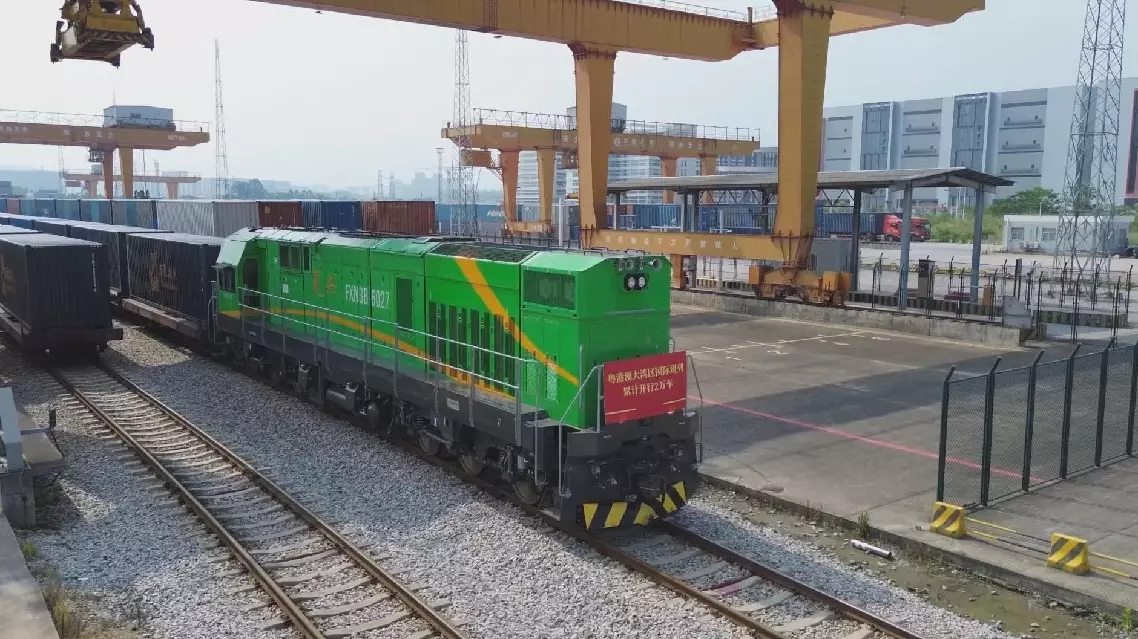
Int'l freight trains departing from China's Greater Bay Area surpass 20,000 this year
Japan's reliance on U.S. economic policy is allowing foreign funds to acquire Japanese assets at bargain prices, according to Japanese economist Kazuhide Uekusa.
He warned that the government's economic and defense strategies prioritize foreign capital and political profits over public welfare, failing to bring true prosperity to ordinary citizens.
The Bank of Japan (BOJ) on Friday raised its policy interest rate by 0.25 percentage points to 1.25 percent, the highest in about 31 years, following a two-day board meeting.
According to Uekusa, the timing of the shift aligns perfectly with the interests of large American funds.
"The Takaichi Cabinet has been reluctant to raise interest rates, thus allowing the yen to continue to depreciate. I think this is actually equivalent to helping foreign capital purchase Japanese assets at a low price. However, U.S. Treasury Secretary Scott Bessent has recently made a clear adjustment to the policy direction of the U.S. dollar against the Japanese yen, promoting the appreciation of the Japanese yen. The reason is that some large funds in the United States have basically completed their investment layout in Japanese assets," said Uekusa.
Uekusa also said Japan cannot attempt to revitalize its economy by expanding military spending and supporting the defense industry, and such a military buildup strategy is unlikely to bring about true prosperity and stability.
"I think it is true that the Japanese economy has been stagnant for a long time. However, to expand military spending in an attempt to revitalize the economy is, in my opinion, an extremely foolish and even crazy move. To achieve peace and stability in Japan, the foundation should be to establish friendly relations with neighboring countries rather than military expansion. The reason why the Japanese government attaches so much importance to the military industry is that it can generate huge profits, and a part of these profits may flow back to political parties or political figures through various means. I don't think this is at all for the benefit of the people," he said.

Japanese economist criticizes gov't policies for enabling cheap asset sales to foreign funds