UNITED NATIONS (AP) — Portugal and Austria defeated Germany for seats on the powerful but deeply divided U.N. Security Council on Wednesday in a hotly contested race after intense campaigning.
The 10 rotating seats on the 15-member Security Council are earmarked for different regions of the world. The assembly elects five countries by secret ballot every year to serve two-year terms alongside the council’s five permanent veto-wielding members — the United States, Russia, China, Britain and France.
In the other contested race, after four rounds of voting in the 193-member General Assembly, Kyrgyzstan defeated the Philippines by a vote of 143-49 and will join the council for the first time.
Zimbabwe, the African candidate, and Caribbean candidate Trinidad and Tobago had no opponents and both were elected with more than 180 votes.
The Security Council is mandated under the U.N. Charter with ensuring international peace and security, but it has failed in the three major current conflicts because of the veto power of Russia on Ukraine and of the United States, Israel’s closest ally, often on Gaza and on Iran.
There have been decades of efforts to reform the Security Council to reflect the geopolitical realities of the current world, not of the post-World War II era 80 years ago, when the United Nations was established. But they have all failed, though a new attempt is underway.
In the race for the two seats for the group of mainly Western nations, Portugal received 134 votes and Austria 131 votes, while Germany, Europe’s economic powerhouse which had served six previous terms on the council, received 104 votes.
“Obviously, the result is a real disappointment,” German Foreign Minister Johann Wadephul told reporters. He said Russia campaigned against Germany because of its strong support for Ukraine. “It also may have cost us votes that Germany must always assume a special responsibility for Israel with regard to the Middle East conflict," he said.
Austria’s foreign ministry said its election capped a 15-year campaign and is a “strong international sign of confidence” in the country.
Kyrgyzstan’s Foreign Minister Jeenbek Kulubayev told reporters “we understand now is a turbulent time” and said Kyrgyzstan will work together with other council members.
The five new members will take up their seats on Jan. 1. They will replace Denmark, Greece, Pakistan, Panama and Somalia.
Associated Press writer Stephanie Liechtenstein in Vienna, Austria contributed to this report.

FILE - The symbol of the United Nations is displayed outside the Secretariat Building, Feb. 28, 2022, at United Nations Headquarters. (AP Photo/John Minchillo, File)
NEW YORK (AP) — “This is ‘60 Minutes,’” Harry Reasoner announced on Sept. 24, 1968, introducing his new CBS News show alongside fellow correspondent Mike Wallace. “It’s kind of a magazine for television.”
He added: “We do think this is sort of a new approach.”
More than a half-century and 58 seasons later, that same term — “new approach” — is being deployed by CBS News leader Bari Weiss to explain her sweeping changes at the most renowned news program in TV history: firing the top producer and two correspondents, among others, and installing a new chief with no TV broadcast experience. Now, one of the show’s most famous faces, Scott Pelley, is gone too — fired after a tense confrontation with bosses.
“We realize, of course, that new approaches are not always instantly accepted,” Reasoner said on that night in 1968. And Weiss’ “new approach” has been greeted with biting criticism from some corners. Moreover, the turmoil has become a top news story in itself, with competing narratives flying — none of them flattering to CBS News.
The essential question percolating on Wednesday: Where does “60 Minutes” go from here? Can it stop being the story, get back to work and retain its reputation for probing journalism and its legendary success atop the news food chain? Or is its famous ticking timer, as some fear, literally running out?
To one prominent analyst of TV news, it seemed Wednesday that something had already evaporated — if only, perhaps, a long-held perception that “60 Minutes,” which manages to be both old-school and pugnacious, was something essentially untouchable.
“My first response is, it started in 1968 — not a bad run,” said Robert Thompson, director of Syracuse University’s Bleier Center for Television and Popular Culture. “Because it really does look like this is systematically deconstructing what (the show) was."
But, he quickly added: “I don’t think we’re writing the obituary of ‘60 Minutes.' I think there’s just too much value and voltage built into that brand.”
He felt, though, that there were concerning signs. The show is suddenly down four correspondents. Three have been dismissed, including Pelley, and Anderson Cooper is leaving of his own accord. There have also been unsettling accusations launched by Pelley. “New management has instructed me to inject falsehoods and bias into a politically sensitive story,” the correspondent and former evening news anchor contended in a statement Tuesday. “I’ve been told to include assertions that are unverified.”
CBS News denied the charge. “There is no political interference at CBS News, not from ownership, not from Bari Weiss," said a statement from a spokesperson Wednesday night. "The only ‘interference’ is the normal back and forth between editor and correspondent that happens in every newsroom.”
To Jeff Fager, former executive producer of “60 Minutes” and author of a book on the show, a major deficit will be the loss of Pelley himself.
“I can’t imagine running ‘60 Minutes’ without Scott,” said Fager, author of “Fifty Years of 60 Minutes: The Inside Story of Television’s Most Influential News Broadcast.”
“His is the most remarkable body of work in the history of the broadcast,” Fager said. “It’s hobbled without him.”
A dizzying week of public airing of dirty laundry continued Wednesday with remarks from Weiss to staff about Pelley’s firing — and Pelley's response to those remarks. In a transcript seen by The Associated Press, Weiss began a morning editorial call by saying she was “only interested in working in a newsroom that is built on trust and mutual respect."
“That foundation was broken on Monday, and despite our attempts to engage with Scott Pelley and to find a way back, unfortunately we weren’t able to do so, and so we had to part ways," Weiss said on the call. "We did not want that to happen, but that’s the path that he chose."
In short order, Pelley countered with his own lengthy description of their meeting. “Bari Weiss knows what she said is not true,” he said in a statement posted by New York Times media reporter Ben Mullin. “In the meeting on Tuesday, in which I was effectively fired, there was no effort to ‘find a way back.’”
Turmoil had been evident at “60 Minutes” for more than a year, after President Donald Trump sued the show over its editing of a 2024 interview with then-Democratic presidential candidate Kamala Harris. It became part of a broader upheaval at CBS News after Weiss was named to the new role of editor-in-chief by parent company Paramount late last year following David Ellison's arrival as the network's corporate leader.
Ellison's company, Skydance, merged with CBS parent company Paramount, which later settled the Trump lawsuit for $16 million, angering some at “60 Minutes" — and indirectly leading to the departure last month of popular CBS late-night host Stephen Colbert, who had called the settlement “a big fat bribe.”
Discord at the show burst into public view last Thursday, when Weiss and CBS News President Tom Cibrowski announced their changes aimed at “building a show that thrives in the 21st century.”
They installed Nick Bilton, a former technology columnist and documentarian, as executive producer, replacing Tanya Simon, a 30-year veteran of the show who’d been in the top job about a year. Also let go were correspondents Sharyn Alfonsi, whose segment about Trump administration deportees in a Salvadoran prison had been abruptly pulled by Weiss before running a month later, and Cecilia Vega.
Four days later, a Monday morning staff meeting exploded into acrimony when Pelley confronted Bilton, saying he had little relevant experience for the job. When Bilton told the meeting that “Bari loves this institution,” Pelley countered, according to accounts of recordings: “She’s murdering ‘60 Minutes.’ She does not love this place. She was brought in to kill it and she’s doing exactly that.”
That led to Weiss, Bilton and others calling Pelley in for the Tuesday meeting, after which he was fired. Weiss and Bilton did not answer interview requests Wednesday.
Reaction, though, pinballed across the media industry. “This is David Ellison's ‘60 Minutes’ now,” CNN media critic Brian Stelter wrote in his newsletter Wednesday.
So what does the future look like for the show? In her staff call Wednesday, Weiss praised some of Pelley’s work on recent “unforgettable stories” and promised Bilton would be delivering that kind of work “in season 59 with the amazing team that’s still there and hopefully from some new people that are going to be joining us.”
There was no word on those additions. A much larger question was whether the disarray at “60 Minutes” would prove, over time, to be more political in nature — Pelley and others have accused the new leaders of trying to gain favor with the Trump administration — or more of a generational debate. Weiss and Bilton have presented the changes as necessary to evolve with the times.
Fager, among others, worries about that narrative. The show, he said, has done a good job adapting.
“It hasn’t been running in place — that's such a misunderstanding of the broadcast,” he said. “We adapted on a regular basis. Every time there’s been a new leader, there has been significant evolution."
He acknowledged that some change and evolution is always necessary. But watching the past week's "new approach" unfold, he remains concerned about the show’s overall future.
”I worry about it,” he said. “I’ve always thought it’s fragile, and I don’t take it for granted.”
Jocelyn Noveck covers the intersection of media and entertainment for The Associated Press.
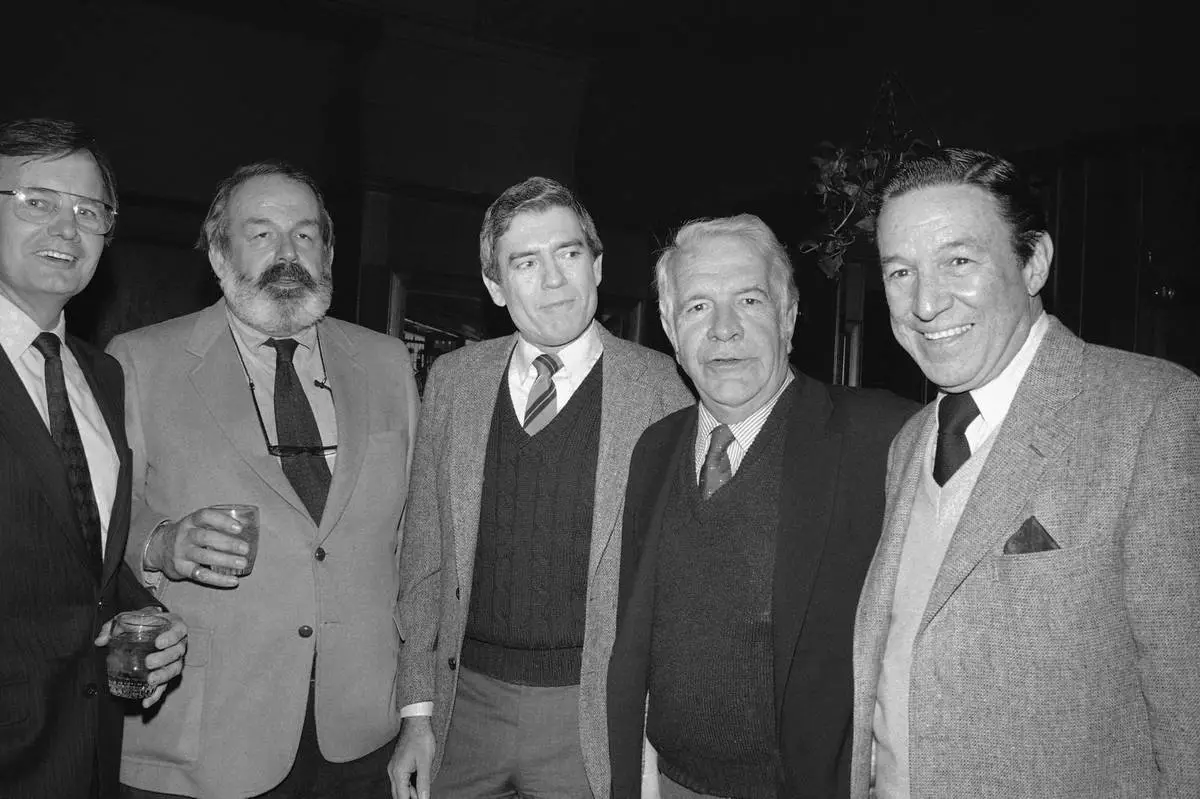
FILE - Dan Rather, center, joined by Harry Reasoner, second from right, and Mike Wallace, right, celebrates his first anniversary as anchorman and managing editor of the CBS Evening News, at a restaurant in New York, March 9, 1982. (AP Photo/Nancy Kaye, File)
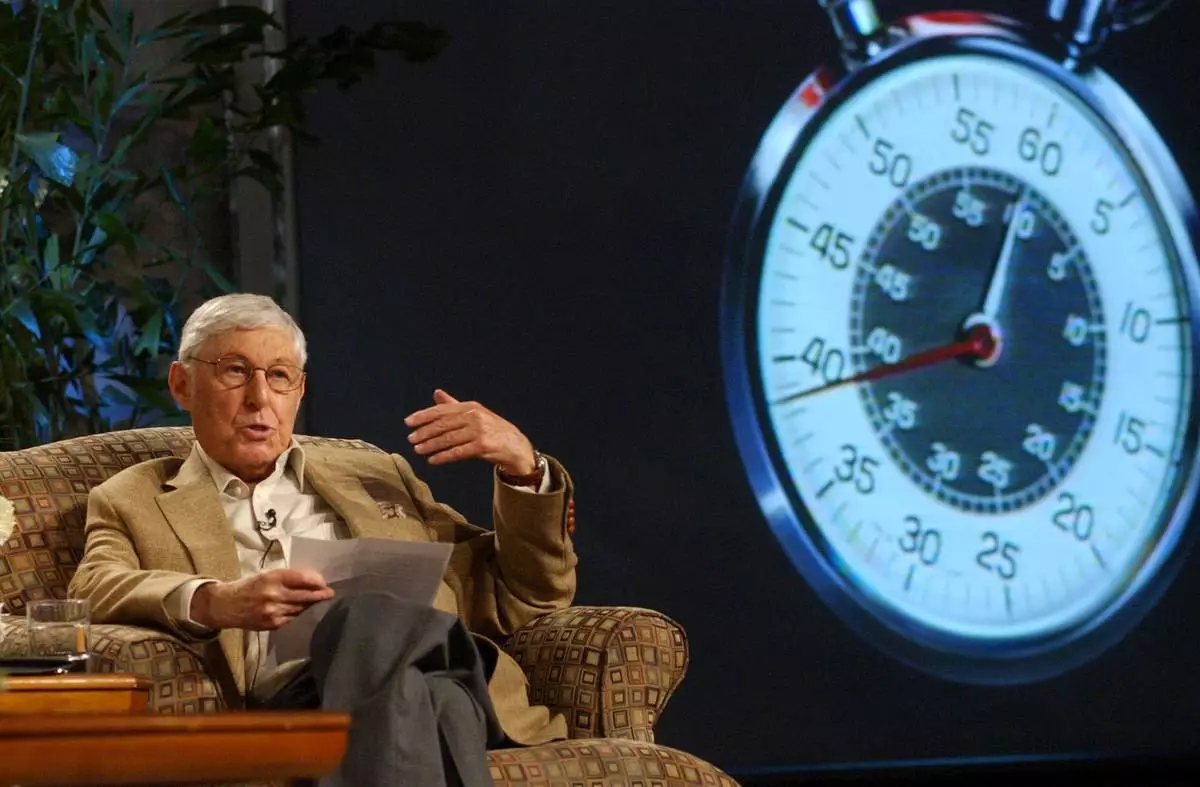
FILE - Against a backdrop of the famous "60 Minutes" stop watch, Don Hewitt, the program's creator and executive producer, reads prepared remarks to reporters during a session on "60 Minutes" during CBS' Winter Press Tour in the Hollywood section of Los Angeles, Jan. 17, 2004. (AP Photo/Rene Macura, File)
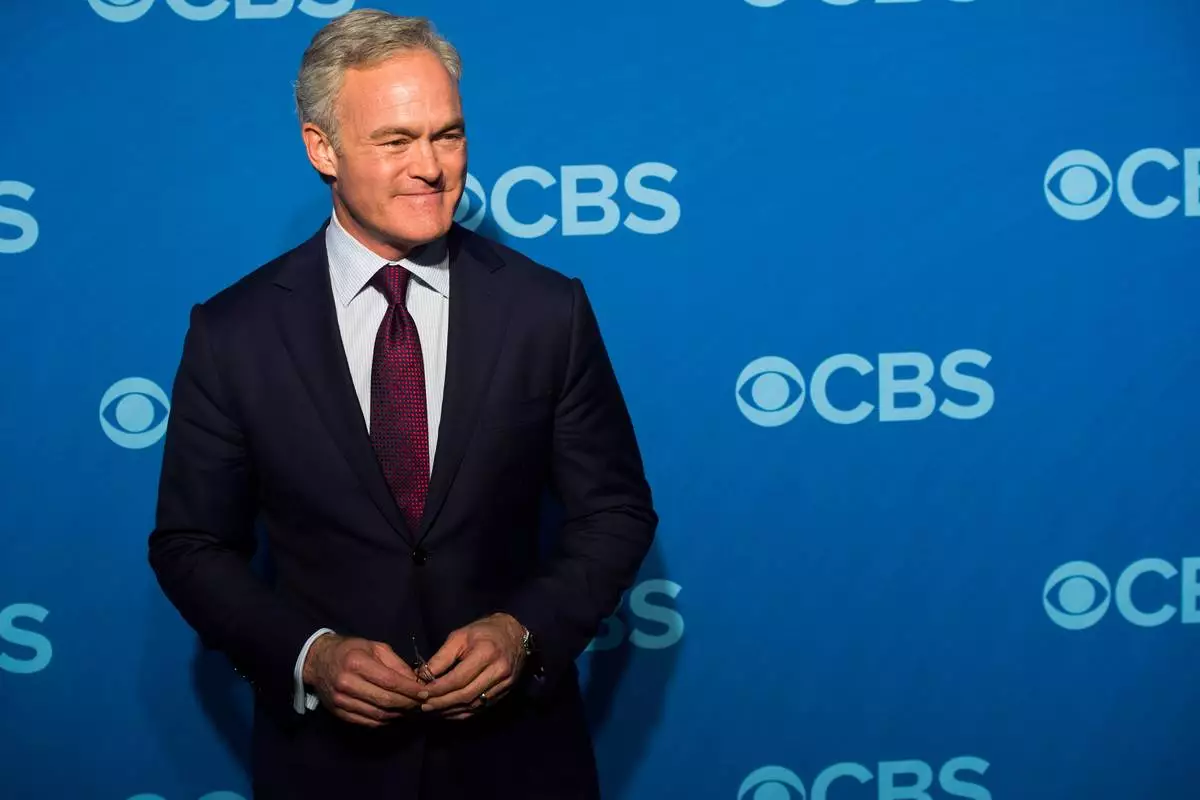
FILE - Scott Pelley, anchor of "CBS Evening News," at the CBS Upfront in New York, May 15, 2013. (Photo by Charles Sykes/Invision/AP, File)
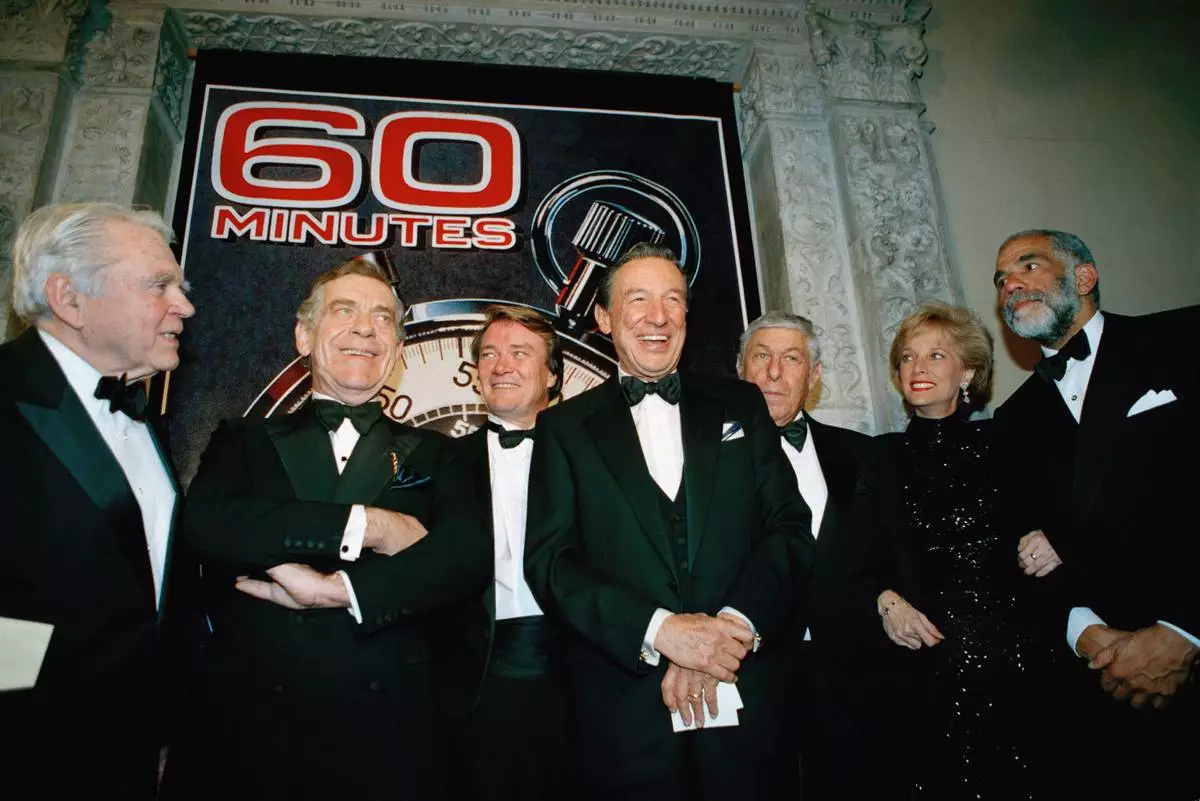
FILE - The "60 Minutes" team, from left, Andy Rooney, Morley Safer, Steve Kroft, Mike Wallace, executive producer Don Hewitt, Lesley Stahl, and Ed Bradley pose at the Metropolitan Museum of Art in New York celebrating their 25th anniversary, on Nov. 10, 1993. (AP Photo/Mark Lennihan, File)