Beijing is rolling out smart traffic systems under the city's "Dual Intelligence" program, using artificial intelligence (AI) to ease congestion and improve traffic management.
In Haidian District, the system is already optimizing traffic light timing at busy intersections in real time.
Thanks to the AI controls, signals have learned to "think." Instead of fixed schedules, green lights now adjust automatically to road conditions, extending by one to 15 seconds when congestion builds, and shortening when traffic clears. Traditional lights ran on preset cycles, forcing drivers to wait even when lanes were empty.
"It used to take me to wait for two or three green lights to pass through the Weigongcun intersection during the evening rush hour after work. But now, after the traffic light system is adjusted, I can pass it in one go, and I can also catch the green light at the next intersection. The traffic has become much smoother," said Zhou Shiguang, a driver.
At present, the system is in use at 19 intersections in Haidian District.
In the Sidaokou area, where 13 intersections have gone live, results are already visible, as average vehicle speed has risen by 21 percent, while the congestion index has dropped nearly 19 percent.
"By applying technologies such as 3D modeling, spatial intelligence, and digital twins, we digitally twin the traffic participants on the road surface, including vehicles and pedestrians. Then, road conditions are accurately captured in real time through AI cameras, and precise calculations are made with artificial intelligence algorithms. Finally, traffic lights are controlled by AI, achieving a transformation from vehicles observing lights to lights observing vehicles," said Zhao Tianmi, an official of management committee at Zhongguancun Science City.
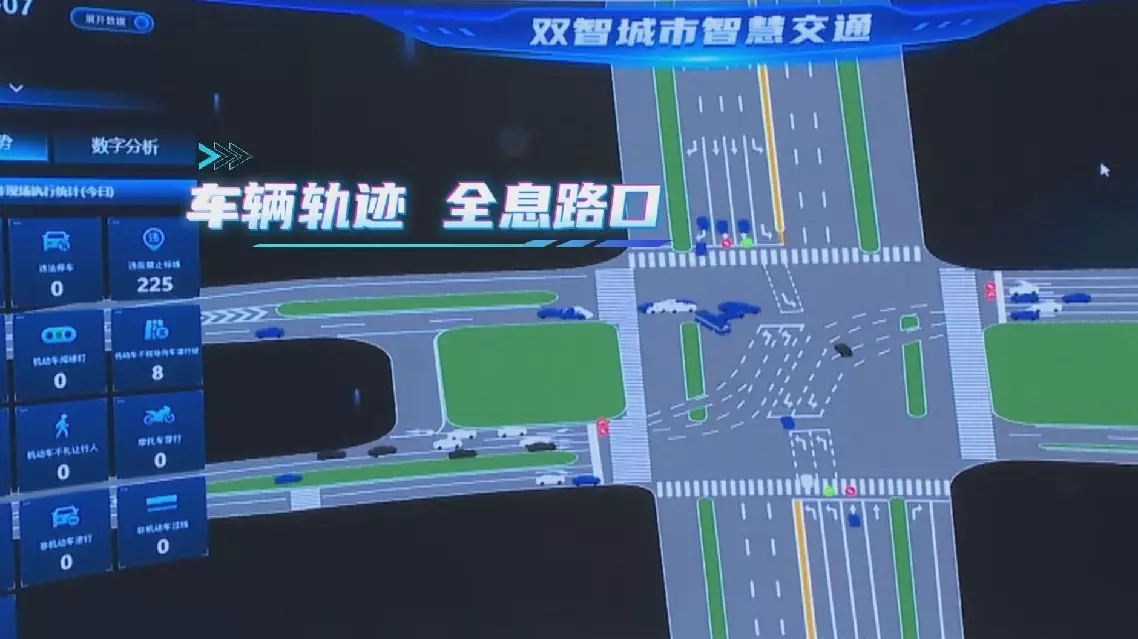
In addition to making traffic lights smarter, the system has also upgraded traffic law enforcement. Empowered by the intelligent transportation platform, the law enforcement mode has transformed from "single-point capture" to "full-domain automatic tracking".
For instance, when it comes to illegal U-turns, traditional single cameras are easily affected by light, distance or obstructions, thus failing to capture license plates clearly.
However, the current multi-camera splicing technology can lock onto the same vehicle based on its continuous trajectory, retrieve images across cameras to capture license plates, and preserve the entire illegal process from multiple perspectives.
The 3D trajectories generated by AI technology make the determination of illegal acts more efficient and accurate, and also significantly reduce the cost of law enforcement.
"Since the launch of the smart traffic control system, there has been a qualitative leap in the cyclical changes of traffic control. Through this non-site law enforcement of smart transportation, the input of police force can be effectively reduced and the control effect on the road traffic can be improved. Under the overall deployment, we will upgrade the system from four aspects: the localization and scale-up of the model, collaborative control of different lines and the intelligent control of later operation and maintenance," said Li Guang, deputy head of Haidian Traffic Management Detachment under Beijing Municipal Public Security Bureau Traffic Management Bureau.
Launched in December 2020, the "Dual Intelligence" program encourages the exploration of pathways for synergizing urban development and intelligent mobility.
As one of the first pilot cities, Beijing leads the country in areas such as the deployment of intelligent roadside infrastructure and the creation of application scenarios for smart technologies.
Beijing rolls out smart traffic system to ease congestion, cut delays