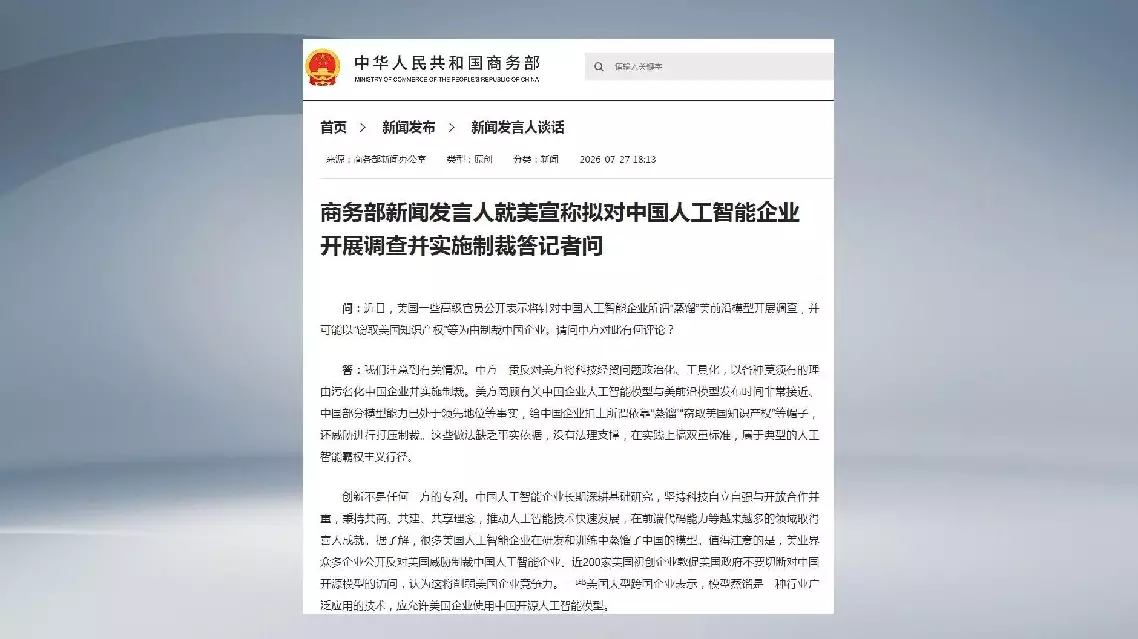
China on Monday urged the United States to stop smearing Chinese artificial intelligence (AI) companies and threatening them with sanctions, saying such actions lack factual and legal grounds and constitute a typical form of AI hegemony.
A spokesperson for China's Ministry of Commerce made the remarks in response to reports that some senior U.S. officials had publicly called for investigations into Chinese AI companies over their alleged "distillation" of advanced U.S. models and might impose sanctions on them on such grounds as the alleged "theft of U.S. intellectual property."
China has consistently opposed the U.S. practice of politicizing and instrumentalizing sci-tech, economic and trade issues, as well as the smearing and sanctioning of Chinese companies under all sorts of groundless pretexts, the spokesperson said.
The United States has disregarded such facts as the release dates of AI models developed by relevant Chinese companies being very close to those of U.S. models and some Chinese models having already achieved leading levels of capability, the spokesperson said.
Innovation is not the exclusive domain of any one party, the spokesperson noted.
Chinese AI companies have long been deeply engaged in basic research. They have attached equal importance to scientific and technological self-reliance and strength and to openness and cooperation, upheld the principle of extensive consultation, joint contribution and shared benefits, and promoted the rapid development of AI technologies. They have made progress in a growing number of fields, including front-end coding capabilities, the spokesperson said.
It is understood that many U.S. AI companies have used Chinese models for distillation in the course of research, development and training, the spokesperson said.
Notably, many companies in the U.S. business community have publicly opposed U.S. threats to sanction Chinese AI companies. Nearly 200 U.S. start-ups have urged the U.S. government not to cut off access to Chinese open-source models, arguing that doing so would weaken the competitiveness of U.S. companies. Some major U.S. multinational corporations have said that model distillation is a technique widely used across the industry and that U.S. companies should be allowed to use Chinese open-source AI models, according to the spokesperson.
China urges the United States to heed the objective and rational voices of the business communities in both countries, abandon its hegemonic mindset, and stop smearing Chinese companies and threatening them with sanctions, the spokesperson said.
China will take all necessary measures in response to any action that causes material harm to its interests and will resolutely safeguard its legitimate and lawful rights and interests, the spokesperson said. China hopes the United States will earnestly implement the consensus reached by the two heads of state, work with China in the same direction, strengthen dialogue and communication on AI, jointly promote AI for the positive and for good, and advance and improve AI governance for the benefit of both countries and the rest of the world, said the spokesperson.
China urges U.S. to stop threatening sanctions against Chinese AI firms