The summer wheat harvesting operations are in full swing in China's major wheat-producing regions, with over 11 million hectares of the crop has already been harvested so far.
By early June, the nationwide harvest progress has reached nearly 50 percent.
In Xinxiang City of central China's Henan Province, farmers are using combine harvesters to increase production efficiency.
Local authorities have established scores of agricultural machinery supply and maintenance outlets to ensure smooth mechanized harvesting operations.
"Current wheat harvesters, especially the combine harvesters purchased in the past two years, feature a large feeding capacity, high mechanized harvesting efficiency, and notably advanced smart functions," said Li Wenming, an official of Xinxiang Agricultural Machinery Technology Center.
To harvest more than 20 million hectares of wheat within 20-plus days, China plans to mobilize more than 800,000 combine harvesters, including over 200,000 participating in cross-regional operations, for this summer harvest season.
In Nanjing City of east China's Jiangsu Province, the grain depots in its Jiangbei New District have adopted intelligent procurement systems, which significantly improved the efficiency and accuracy of grain procurement.
"Our grain depot has completed preparatory work ahead of schedule, including warehouse disinfection, equipment maintenance, and site cleanup. We have also opened a green channel for summer grain procurement to provide farmers with one-stop grain sales services," said Wang Peidong, a grain storage keeper in Nanjing.

Nearly 50 pct of China's summer wheat harvest completed nationwide
A year after issuing its first ocean forecasting AI system, Chinese scientists on Saturday rolled out LangYa 2.0, a major upgrade that moves beyond basic sea variables to predict complex marine phenomena including typhoons, extreme rainfall and storm surges.
The new model was unveiled at the ongoing Fourth China Digital Earth Conference in Qingdao, a coastal city of east China's Shandong Province.
Developed by the Institute of Oceanology under the Chinese Academy of Sciences (IOCAS), LangYa 2.0 marks a leap from global ocean state forecasting to intelligent prediction of complex marine phenomena, making ocean forecasts perceptible, actionable, and decision-ready, according to Wang Fan, president of IOCAS.
It will provide intelligent support for marine disaster prevention, shipping safety, polar navigation, and climate response, he added.
The upgraded system now predicts six key marine phenomena -- typhoons, extreme rainfall, storm surges, internal solitary waves, mesoscale eddies, and sea ice.
It does so via six specialized vertical sub-models, each trained on unique datasets and physical mechanisms. Together, they form what the research team calls "a diagnostic AI," which delivers direct, actionable forecasts.
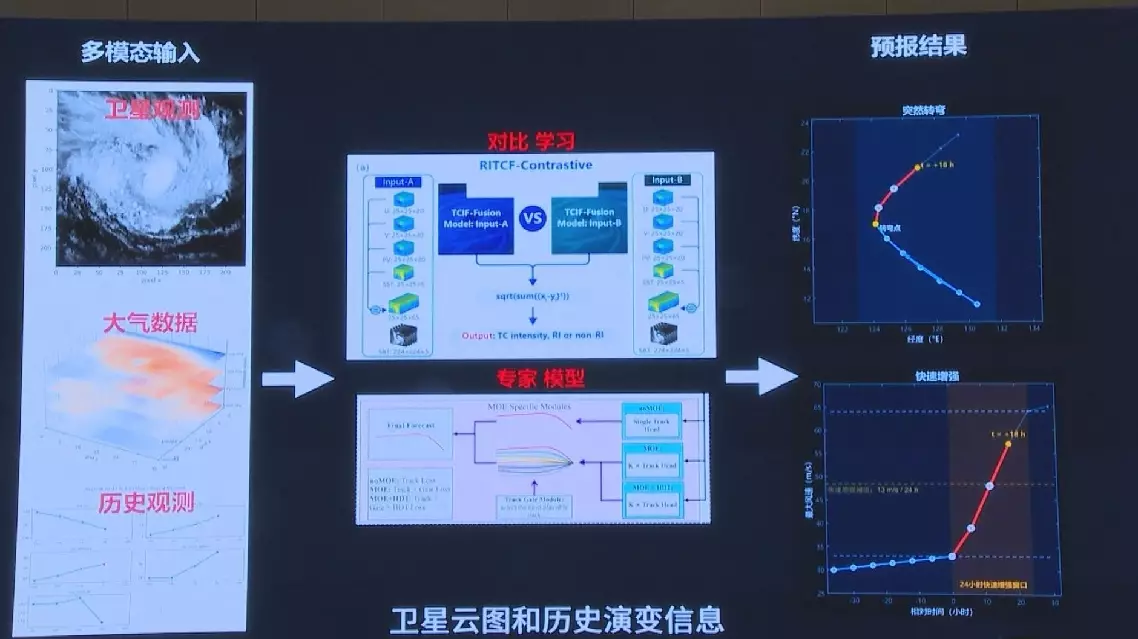
Take typhoons for example. The typhoon module fuses atmospheric and oceanic fields, satellite cloud imagery and historical typhoon tracks. It is specifically designed to handle two notoriously hard-to-predict behaviors: rapid intensification and sudden turning. For coastal communities, those few hours of extra warning can mean the difference between evacuation and disaster.
For offshore engineering, LangYa 2.0 can identify internal solitary waves -- the powerful, hidden currents that can damage oil platforms.
It forecasts their evolution over the following 30 days and allows users to query speed, amplitude and other key parameters for the coming week, according to the research team.
Even before its official release, version 2.0 has begun to prove its worth.
Independently validated by the Sea Ice Prediction Network, an international collaboration of scientists and research institutions dedicated to improving seasonal forecasts of Arctic sea ice, LangYa 2.0 ranked first among multiple global models in the 2025 seasonal forecast for September Arctic sea ice extent, which refers to the area of ocean covered by ice.
It delivers monthly-scale predictions at three-kilometer resolution, which is critical for Arctic shipping routes, climate research and polar navigation safety, the team noted.
China releases LangYa 2.0 AI model for full-blown marine phenomenon forecasting