CAIRO (AP) — Bahrain's government said Saturday that Iran fired ballistic missiles and drones toward it and Kuwait. The foreign ministry said they had been intercepted and called on Iran to immediately cease attacks on its Gulf neighbors.
Kuwait's foreign ministry called the attacks a “serious escalation” and a “flagrant violation of its sovereignty." It said on Saturday that it reserves the right to defend the country.
The statements came hours after the U.S. military said it shot down Iranian ballistic missiles and drones launched toward the Strait of Hormuz and Gulf Arab allies on Friday, while striking some of the Islamic Republic’s coastal surveillance radar sites in response, an exchange of fire that further frayed a shaky ceasefire with Tehran.
The exchange of strikes comes as the Trump administration ramps up pressure on Iran to make a deal to end the conflict.
U.S. Central Command said on social media Friday night that Iran fired seven ballistic missiles toward Kuwait and Bahrain, with U.S. forces intercepting six of the missiles and a seventh failing to reach its target. The military said there were no reports of harm to U.S. personnel.
The ballistic missiles were fired after the U.S. earlier in the day shot down four Iranian drones that were launched toward the Strait of Hormuz.
“The attack drones posed an immediate threat to regional maritime traffic,” U.S. Central Command said on social media.
Kuwait’s military said forces were intercepting missiles and drones attacking the country, while Bahrain activated air raid sirens and told residents to move to the nearest safe location and follow official instructions.
Iran’s Revolutionary Guard said it targeted the Ali Al Salem airbase, which hosts U.S. forces in Kuwait, and the U.S. Navy’s 5th Fleet in the tiny Gulf island nation of Bahrain, according to the state-run IRNA news agency.
The U.S. military is enforcing a blockade on Iranian ports in response to Tehran’s chokehold on the crucial corridor for global oil and natural gas shipments, which has sent energy prices spiking and posed political problems for President Donald Trump's Republican Party ahead of the midterm congressional elections.
U.S. Central Command said it hit the radar sites, including an island in the strait, “to defend against further attacks.”
It was the latest in back-and-forth attacks that have strained the tenuous ceasefire in the war and efforts to reach a deal to extend that truce. Earlier this week, Iranian drones heavily damaged a passenger terminal at Kuwait’s main airport, killing one person, wounding dozens and briefly closing the airfield.
Despite the attacks raising new concerns that the ceasefire could collapse, Trump told reporters Friday that “the situation with Iran seems to be going quite well.”
“We’re going to come out of Iran very quickly and it’s going to be very strong one way or the other, whether it’s a piece of paper or the very tough way,” Trump said at an event with farmers in Wisconsin. “The very tough way is maybe the easier way, but we’re going to come out, and your fertilizer prices are going to go way down, just like they were four months ago.”
Trump increasingly appears to be boxed in on a conflict that has settled into a holding pattern. U.S. and Iranian negotiators reached a tentative agreement a week ago to extend the ceasefire by 60 days and start a new round of talks on Iran’s nuclear program. But Trump has called for unspecified changes and Iranian officials have shown no public signs of signing off on the deal.
Asked on Friday why it was taking so long, Trump told NBC’s “Meet the Press” it was because “it’s a very hard thing for them.”
“There are things they never thought they’d be doing that they’re going to have to do. They’ve got no choice, and it takes a little while,” he said in the interview.
Trump said the Iranians still have 21% to 22% of their missiles.
His administration also has touted the latest ceasefire agreed to this week by the Lebanese government and Israel after U.S.-brokered talks in Washington. However, the Iranian-backed Hezbollah militant group has rejected the agreement and new attacks have put it at further risk.
The Israeli military on Friday struck multiple parts of southern Lebanon and issued evacuation warnings for nine villages, including one that has sheltered thousands of people displaced by the fighting. The strikes killed nine people in six locations in southern Lebanon, the state news agency reported.
The Israeli military said two soldiers were wounded, one severely, in an encounter Friday with militants in southern Lebanon.
The fighting in Lebanon, where Israeli forces have seized large swaths of the south, also threatens efforts to end the Iran war and reopen the Strait of Hormuz because Iran has demanded that any lasting truce extend to Lebanon.
Besides the drone interception in the Strait of Hormuz, the U.S. military said earlier Friday that its forces boarded a sanctioned oil tanker linked to Iran in the Indian Ocean as the United States seeks to prevent Iran from profiting off its oil and other goods.
The U.S. also targeted Iran’s energy sector with new sanctions on a group of people, firms and tankers.
Price reported from Bridgewater, NJ.
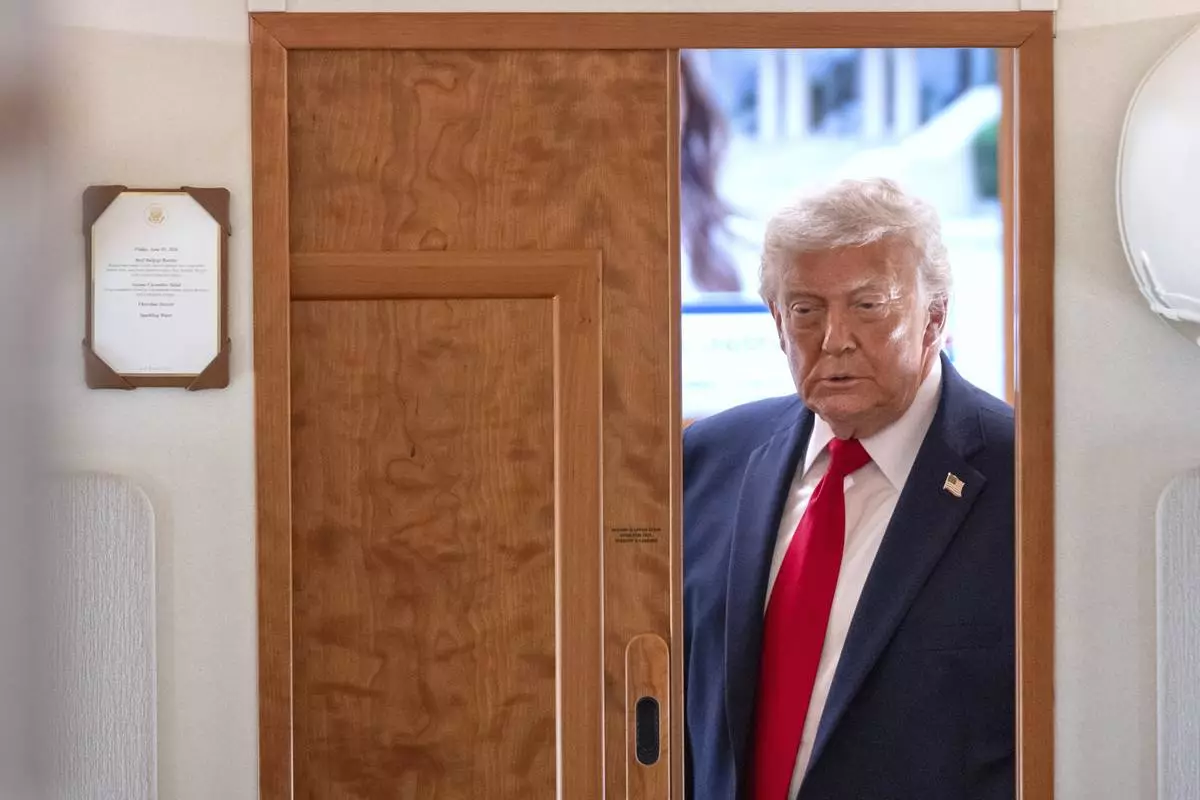
President Donald Trump arrives to speak to reporters aboard Air Force One en route from Joint Base Andrews, Md., to Eau Claire, Wis., Friday, June 5, 2026. (AP Photo/Mark Schiefelbein)

People gather on paddleboards in shallow water as cargo and service vessels are anchored in the Strait of Hormuz off Bandar Abbas, Iran, Monday, June 1, 2026. (Amirhosein Khorgooi/ISNA via AP)
Armenia's parliamentary elections Sunday will be a vote on its geopolitical future as incumbent Prime Minister Nikol Pashinyan seeks closer relations with the European Union and the United States despite longstanding ties with Russia that have been championed by his critics.
Many analysts favor Pashinyan's Civil Contract party to retain control of the parliament, but with many opposition parties running on pro-Russia platforms, the Caucasus nation's place on the international stage has been thrown into the spotlight.
In the months ahead of the election, Russian President Vladimir Putin and other Russian officials have warned Armenia that joining the EU could come at the expense of massive economic damage by disrupting Armenian trade ties with Moscow and its allies.
“These are the first elections in Armenia’s history where geopolitical orientation has become a decisive issue,” Mikayel Zolyan, an analyst and former member of the Armenian Parliament, told The Associated Press from Yerevan. “Until now, Armenia has remained within Russia’s sphere of influence, and this was taken for granted, but now, for the first time, this is being called into question.”
Relations between Moscow and Armenia soured in 2023 after Azerbaijan took control of the entire Karabakh region. The mountainous region had been controlled for decades by ethnic Armenian forces backed by Armenia, part of a long conflict between the neighboring countries.
Armenian authorities accused Russian peacekeepers deployed to the region of failing to stop Azerbaijan’s onslaught. Moscow, busy with the conflict in Ukraine, has rejected the accusations, arguing its troops didn’t have a mandate to intervene.
“It turned out that Russia’s image as a guarantor of Armenian security was not based in reality, and it all collapsed after the Karabakh war,” said Alexander Iskandaryan, director of the Caucasus Institute in Yerevan.
Pashinyan has begun cautiously weakening ties with Moscow, joining the International Criminal Court in 2023 and suspending its participation in the Moscow-dominated Collective Security Treaty Organization in 2024.
Armenia also officially declared its aspirations to join the EU and hosted the European Political Community summit in Yerevan in early May.
A convincing win in the parliamentary vote would give Pashinyan a mandate to continue the trend and finalize a deal with Azerbaijan.
Western nations have sought to show some of the advantages that closer ties could bring.
In August, U.S. President Donald Trump hosted Pashinyan and Azerbaijan’s President Ilham Aliyev to sign an agreement declaring an end to their decades-long hostilities and including provisions for the creation of a new transit corridor between Azerbaijan to its exclave of Nakhchivan. An agreement in February could pave the way for a U.S. company to build a new nuclear reactor in Armenia.
European Commission President Ursula von der Leyen also has said that Europe is ready to invest in Armenia's energy industry and its “booming digital scene.”
Trump has endorsed Pashinyan and called him a “great friend” and a leader who is making his country “strong, wealthy, and very secure!”
Much of Armenia’s opposition is still dominated by pro-Russia groups and many are also against normalizing relations with Azerbaijan. Key opposition figures have called for Pashinyan to stand down over the loss of Karabakh.
Nineteen political forces, including two blocs and 17 parties, are taking part in the elections.
Pashinyan’s main rival is the Strong Armenia Party, which wants closer business ties with Russia and accuses Pashinyan of attempting to spark a war with Moscow. The party is led by Armenian-Russian billionaire Samvel Karapetyan, who is on trial for calling for the overthrow of Armenia’s government. He denies the charges.
Other potential contenders include former President Robert Kocharyan, who leads the Hayastan bloc and has accused Pashinyan of “seriously undermining” relations with Russia.
Russia, which has a military base in Armenia, has warned that Yerevan’s Western turn could have dire political and economic consequences.
Putin has compared Armenia’s course to that of Ukraine in thinly veiled threats and has suggested Russia's conflict with Ukraine started with its attempts to join the EU.
In recent weeks, Russian has introduced new restrictions on Armenian produce after citing sanitation violations, banning Armenian flowers, certain types of cognac and wine, eggplants, potatoes, dried fruits, fish and more.
Armenia’s membership in the Eurasian Economic Union, a Russian-led customs union, was placed under formal review during a members’ meeting in Kazakhstan in May, with threats to suspend it completely it by December.
During the Kazakhstan summit, the governments of Russia, Belarus, Kazakhstan and Kyrgyzstan also demanded Armenia hold a referendum on whether it would remain in their group or seek EU membership. Pashinyan has rejected the need for such a vote.
Armenian government statistics show 38% of Armenia’s exports went to countries within the Eurasian Economic Union in 2025, the vast majority heading to Russia. In comparison, just 8% of trade went to the EU.
The Russian measures prompted von der Leyen to announce Thursday that the 27-nation bloc would send 50 million euros ($58 million) to support Armenia. In a statement, she said Russia is “weaponizing” economic relations and its ban on imports was “nothing short of economic coercion.”
Russia could exert further pressure on Armenia because it controls a significant portion of the country’s energy and infrastructure and supplies cheap gas.
“It’s completely unrealistic to say that Armenia can somehow overcome Russian influence in a short period of time,” analyst Zolyan said.
Armenia’s civil society also isconcerned by what they have described as Russian-backed disinformation campaigns ahead of the vote. Moscow denies any interference.
Daniel Ionnisyan, head of the Union of Informed Citizens, an independent election watchdog, told the AP that his organization has documented instances of Russian interference through social media campaigns, cyberattacks, vote buying and bribery of journalists.
That echoes findings of a delegation from the Parliamentary Assembly of the Council of Europe, which visited Yerevan in May and said foreign interference included illicit political financing, cyberattacks, economic coercion and direct attempts to manipulate the electoral process.
“These hybrid tactics aim not only to sway public opinion but to secure long-term geopolitical leverage over Armenia,” the delegation said.
Sam McNeil in Brussels contributed to this report.
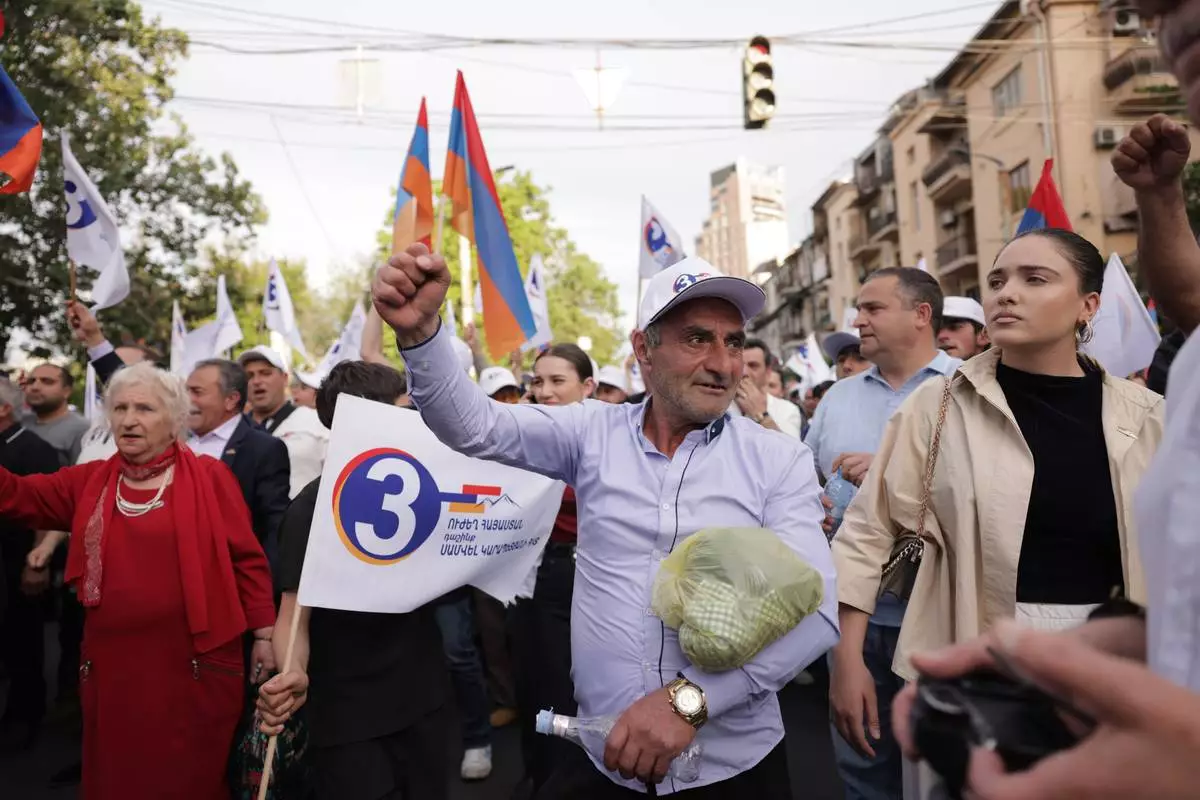
A man gestures as he and other supporters of Russian-Armenian tycoon Samvel Karapetyan, who heads Strong Armenia party, has faced criminal charges that he rejected as politically driven and campaigned from under house arrest, rally toward Republic Square against incumbent Prime Minister Nikol Pashinyan in Yerevan, Armenia, Wednesday, June 3, 2026. (AP Photo/Anthony Pizzoferrato)
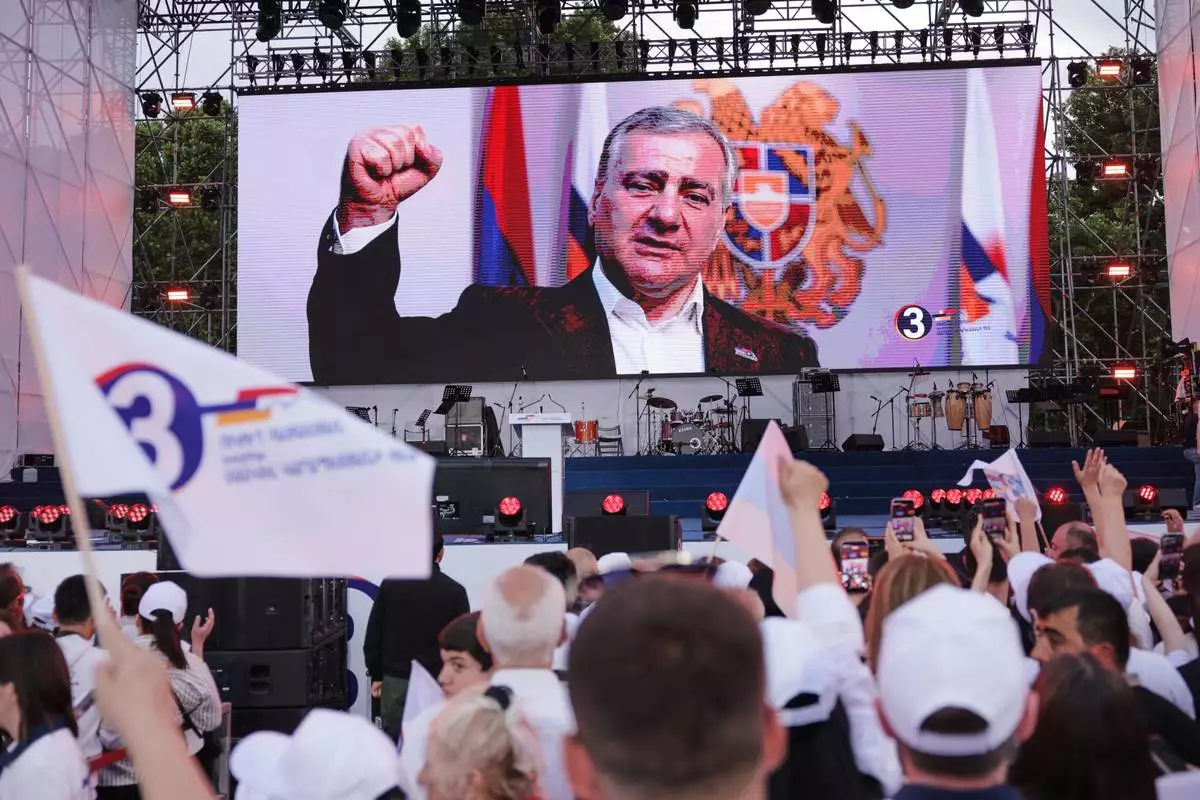
Supporters of Russian-Armenian tycoon Samvel Karapetyan, on screen, attend a rally against incumbent Prime Minister Nikol Pashinyan at Republic Square in Yerevan, Armenia, Wednesday, June 3, 2026. (AP Photo/Anthony Pizzoferrato)

Supporters of Russian-Armenian tycoon Samvel Karapetyan, on screen, attend a rally with Armenian national flags against incumbent Prime Minister Nikol Pashinyan at Republic Square in Yerevan, Armenia, Wednesday, June 3, 2026, as Karapetyan, who heads the Strong Armenia party, has faced criminal charges that he rejected as politically driven and campaigned from under house arrest. (AP Photo/Anthony Pizzoferrato)
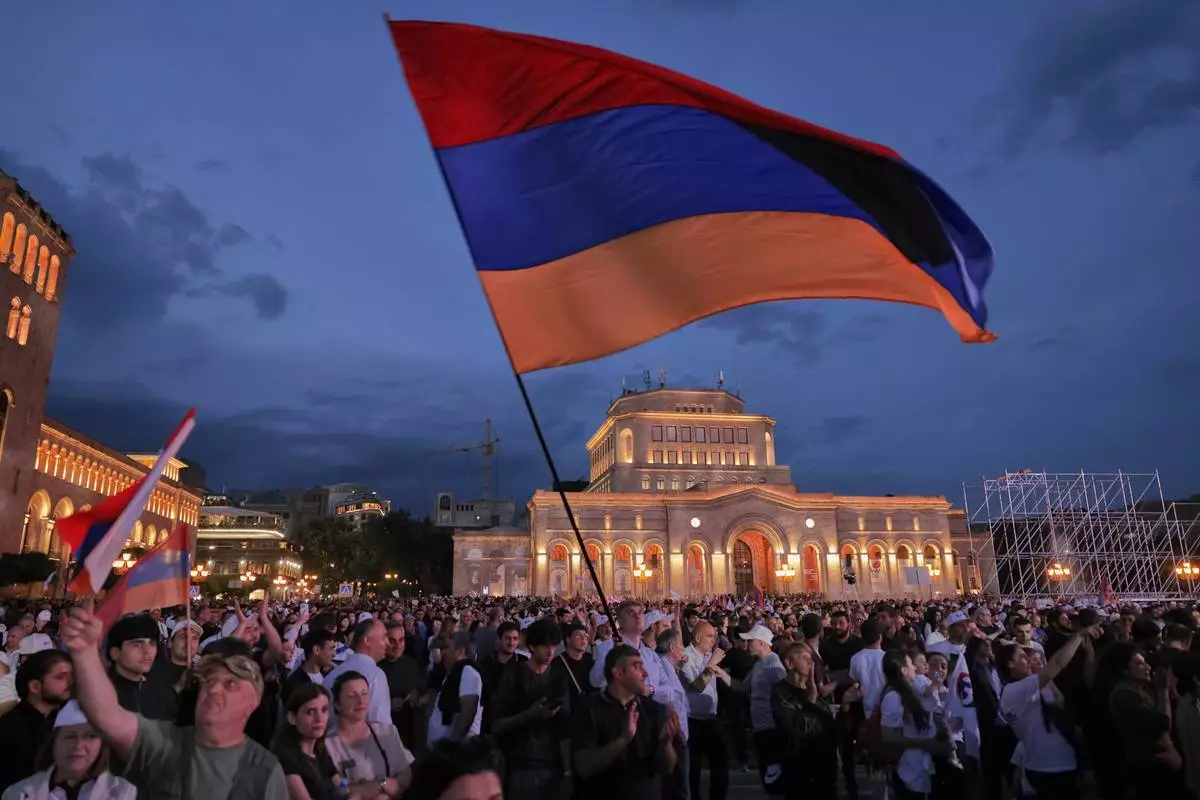
Supporters of Russian-Armenian tycoon Samvel Karapetyan, wave a Armenian national flag during a rally against incumbent Prime Minister Nikol Pashinyan at Republic Square in Yerevan, Armenia, Wednesday, June 3, 2026, as Karapetyan, who heads the Strong Armenia party, has faced criminal charges that he rejected as politically driven and campaigned from under house arrest. (AP Photo/Anthony Pizzoferrato)