Hubei Province in central China has been leveraging its strengths in fiber optics and semiconductor storage to drive explosive twelvefold growth in electronics sector profits year over year, spurred by surging global demand for AI hardware.
The Optics Valley, an emerging high-tech cluster in the provincial capital Wuhan, hosts the country's largest manufacturing base for optoelectronic devices and its largest research and development hub for optical communication technology.
It has become a globally recognized center for optoelectronics, with high-speed optical modules standing out as its most significant achievement.
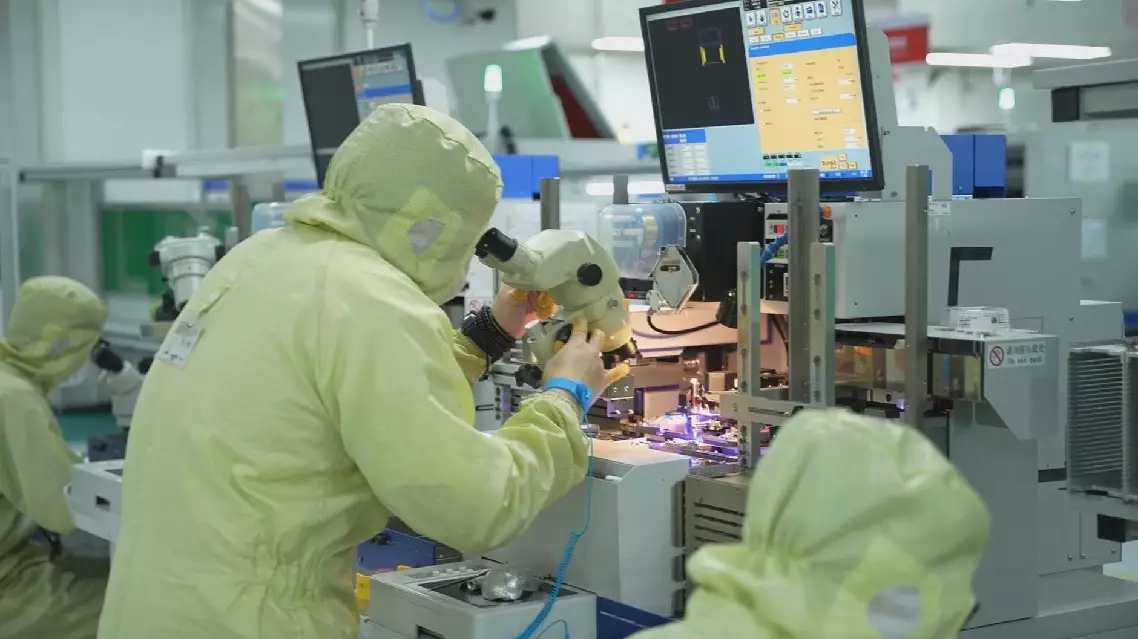
In a lab at Huagong Tech, one of the optical module manufacturers based in the Optics Valley, researchers are racing to develop next-generation optical modules with even higher data transmission rates.
Luo Chuanneng, head of the lab's research and development team and chief technology officer of optical interconnect business at Huagong Tech, said the core competitiveness of these optical modules lies in their transmission speed. He noted that their proprietary silicon photonics technology is their edge in seizing a larger share of the global high-speed optical module market.
Development of this technology began eight years ago. At the time, most optical modules in widespread use supported data transmission rates of only tens of gigabits per second. Silicon photonics, in contrast, was designed to achieve rates of hundreds or even thousands of gigabits per second. Back then, it was unclear where such ultra-fast modules would be used, and market prospects were entirely unknown.
After years of effort, the team achieved a breakthrough with a 400G optical module. Just around that time, the global build-out of AI data centers began to pick up steam, making market demand increasingly clear. Luo’s team had caught the wave.
The team raced ahead, building on its silicon photonics to successfully develop 800G and then 1.6T optical modules. Now, amid intensifying global competition in AI and surging hardware demand, these ultra-high-performance modules are poised to help China take a leading position in the global market for AI computing power centers.
Luo believes these successes are rooted in the team’s ability to stay committed to basic research and development, even when practical applications remained uncertain.
"In the past, optical modules typically evolved at a pace of one generation per decade. But with the explosion of AI, the iteration cycle has now shrunk to about a year -- or even half a year. Only by staying patient and dedicated to our research and development -- being willing to sit on a cold bench, as we say -- can we seize the opportunity when the moment finally arrives," he said.
China's "Optics Valley" seizes future of global optoelectronics industry