Gambian Vice President Muhammad B.S. Jallow commended north China's Tianjin Port for its zero-carbon, fully automated terminal as a model of how economic growth can align with environmental protection, saying the experience offers lessons for The Gambia. Tianjin Port, located on the coast of the Bohai Sea, is a major shipping point in north China. Linking over 500 ports in more than 180 countries and regions, it is one of the world top 10 ports, and it is also home to the world's first fully automated, zero-carbon terminal -- proof that economic growth and environmental protection aren't at odds.
During a recent visit to Tianjin Port, Jallow told China Global Television Network (CGTN) he was struck by its automation and zero-carbon achievements, describing the development model as uniquely impressive. "The level of automation, that is the thing that impressed me most, particularly, I mean as we are realizing that this is the first zero-emission port. We know that climate change is a big problem for all countries, particularly a country like The Gambia, which is just about one meter above sea level. So any little rise of the seas, in fact our capital city will be flooded, will be lost. So I think something like this is something that we can learn from. You cannot separate economic development from environmental protection, because environment protection actually enhances economic development. So that's why I say, I think zero carbon actually improves economic development," he said.
On May 1, China introduced zero-tariff treatment for 53 African countries with which it maintains diplomatic ties, becoming the first major economy to take such a step. The policy opens China's vast market wider to African goods and creates new opportunities for the continent.
The zero-tariff policy has opened new prospects for African exports, and Jallow pointed to The Gambia's groundnuts as a key beneficiary, thanking China for granting them access to its market.
"For us, our main export crop is actually groundnuts. And in fact I'll take this opportunity to thank the government of China for allowing our groundnuts to come after a lot of work that will enhance our income of the country. And we hope that, as time goes on, more groundnuts will be exported and cashew nuts, in fact for that matter, will be exported to China," he said.
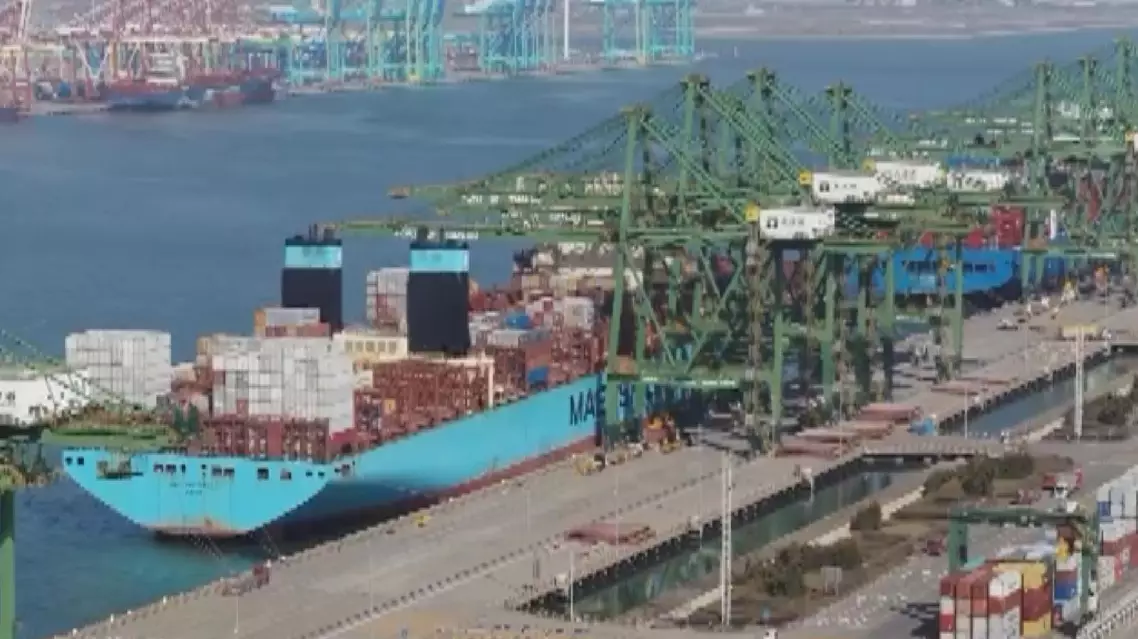
Gambian VP commends Tianjin Port’s zero-carbon model
Global financial and consulting firms have expressed confidence in China's manufacturing transformation, saying the country's push toward smarter, greener and more integrated advanced manufacturing is injecting strong momentum for global growth.
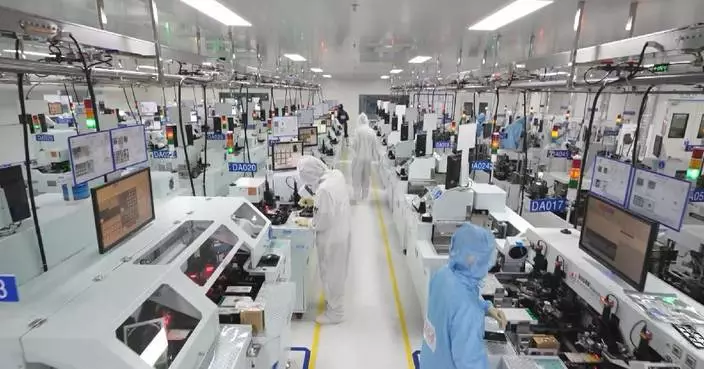
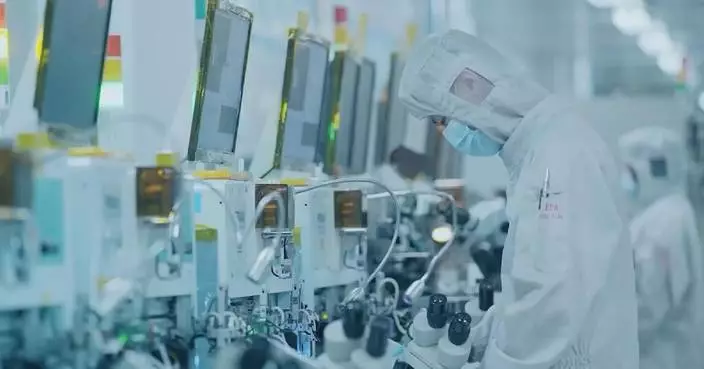
For the smart manufacturing sector, China has accelerated its adoption of digital and artificial intelligence (AI) technologies across the manufacturing industry.
Data from the Ministry of Industry and Information Technology showed that the scale of China's core AI industry exceeded 1.2 trillion yuan (about 167 billion U.S. dollars) in 2025, with the industrial internet covering all 41 major industrial categories, and over 500 excellence-level smart factories cultivated nationwide.
According to a report of Goldman Sachs, Chinese companies' overseas expansion has entered a 3.0 version in which exporters have increasingly sold AI-driven industrial capabilities, as frontier areas, such as embodied intelligence and humanoid robots, has been moving toward commercialization.
"After we visited many domestic humanoid-robot companies, one could find that on the components side, 80 percent to 90 percent have been already supplied by domestically made parts rather than relying on foreign-funded components. As a result, this industry achieved domestic substitution in many areas at a very early stage. That kind of full industrial-chain capability is uncommon. Leveraging these unique competitive advantages, Chinese companies are playing an increasingly important role on the global stage," said Du Qian, head of China Industrial Technology Research at Goldman Sachs.
In green transition, China has sped up its shift toward low-carbon manufacturing. China's new energy vehicle (NEV) output and sales have ranked first globally for 11 consecutive years, while the country has built more than 8,000 national-level green factories. Energy and water use per unit of industrial value-added companies have continued to decline, as the country has placed greater emphasis on green and low-carbon development.
"In China, we do buy into the structural growth story that is China, and China has really marked itself out as a tech innovator, a tech adopter. So, in terms of the green energy transition, EV, manufacturing processes, that is a strong structural growth driver. So, as a long-term investor, that earns a place in the global asset allocation from our perspective," said John O'Toole, global head of Solutions and chief investment officer for Asia at French asset management company Amundi.
On the industrial integration, China's manufacturing upgrade is deep cross-sector integration and brand elevation. Data from National Bureau of Statistics, in 2025, equipment manufacturing and high-tech manufacturing accounted for 36.8 percent and 17.1 percent of value-added industrial output, respectively.
The label of "Made in China" has been actively transitioning from low cost toward high-tech and high-premium brand identity.
"China is gradually transitioning from a manufacturing powerhouse to a technology and brand powerhouse. This process will bring massive growth opportunities. We have every reason to believe that in the next decade and beyond, more and more global brands will be born in China," said Zhang Yun, CEO of the U.S. consulting agency of Ries Global and chairman of Ries China.

Global institutions voice confidence in China’s manufacturing upgrades