Skip to Content Facebook Feature Image

EAC Releases Proposed Guidelines for Election Committee Subsector Elections, Open for Public Consultation Until July 10

HK

EAC Releases Proposed Guidelines for Election Committee Subsector Elections, Open for Public Consultation Until July 10
HK

HK

EAC Releases Proposed Guidelines for Election Committee Subsector Elections, Open for Public Consultation Until July 10

2026-06-11 15:00 Last Updated At:15:38

Public consultation on Election Committee Subsector Elections proposed guidelines commences

The following is issued on behalf of the Electoral Affairs Commission:

The Electoral Affairs Commission (EAC) today (June 11) released the proposed guidelines on election-related activities in respect of the Election Committee Subsector (ECSS) Elections for public consultation. The consultation will last until July 10.

The 2026 ECSS Ordinary Elections will be held at the end of this year. Before each ECSS Ordinary Elections, the EAC will review and update the guidelines on election-related activities.

The Chairman of the EAC, Mr Justice David Lok, said that these guidelines aim to explain in simple language the subsisting electoral law to remind candidates and other stakeholders of the provisions and requirements under the electoral law; and to promulgate a code of conduct based on the principles of fairness and equality with regard to the election-related activities not stipulated by the law. The EAC has always made its best endeavours to ensure that all public elections are held in an open, honest and fair manner, and formulating electoral guidelines plays an important role in the conduct of elections. The EAC wishes members of the public to actively participate.

The proposed guidelines are prepared on the basis of the existing guidelines for the ECSS elections (July 2021 edition) and the supplementary information compiled in July 2025 for the ECSS By-elections held last year, with appropriate amendments which are mainly composed of four categories: (1) to reflect the latest electoral legislation, such as updating the arrangements regarding the preparation of the ballot paper account and ballot counting; (2) to reflect new or enhanced election-related arrangements, for instance, voters/authorised representatives can check their latest registration particulars and access the Online Voter Information Enquiry System (www.voterinfo.gov.hk) to check information such as their allocated polling stations via "iAM Smart"; (3) to further elaborate the contents of the guidelines to enable candidates and relevant persons to more easily grasp the areas which they should pay attention to; and (4) to reorganise where appropriate the structure and content of the proposed guidelines by, for example, explaining the relevant electoral arrangements in the form of lists and flowcharts, consolidating the contents of the chapters, etc, with a view to making the proposed guidelines more concise and easier to comprehend.

The proposed guidelines can be downloaded from the EAC website (www.eac.hk), or viewed at the designated offices of the Registration and Electoral Office, the Home Affairs Enquiry Centres of all district offices and the major and district public libraries.

Members of the public could submit written representations on the proposed guidelines to the EAC Secretariat by email (eacenq@eac.hk), post (8/F, Treasury Building, 3 Tonkin Street West, Cheung Sha Wan, Kowloon) or fax (2511 1682) on or before July 10. For written representations submitted by post, the postmark date will be taken as the submission date. Late submissions will not be considered.

For enquiries, please call 2891 1001.
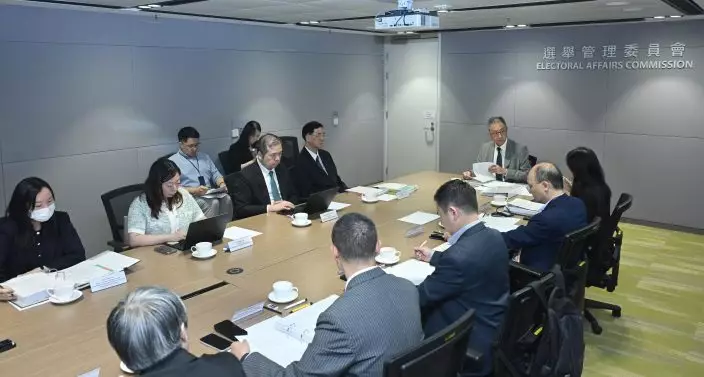
The Chairman of the Electoral Affairs Commission (EAC), Mr Justice David Lok (seventh left), chaired an EAC meeting earlier to discuss the proposed guidelines on election-related activities in respect of the Election Committee Subsector Elections. Also attending the meeting were EAC members Professor Daniel Shek (sixth left) and Mr Bernard Man, SC (fifth left), and the Chief Electoral Officer of the Registration and Electoral Office, Mr Herman Tse (second right). Source: HKSAR Government Press Releases
The Chairman of the Electoral Affairs Commission (EAC), Mr Justice David Lok (seventh left), chaired an EAC meeting earlier to discuss the proposed guidelines on election-related activities in respect of the Election Committee Subsector Elections. Also attending the meeting were EAC members Professor Daniel Shek (sixth left) and Mr Bernard Man, SC (fifth left), and the Chief Electoral Officer of the Registration and Electoral Office, Mr Herman Tse (second right). Source: HKSAR Government Press Releases

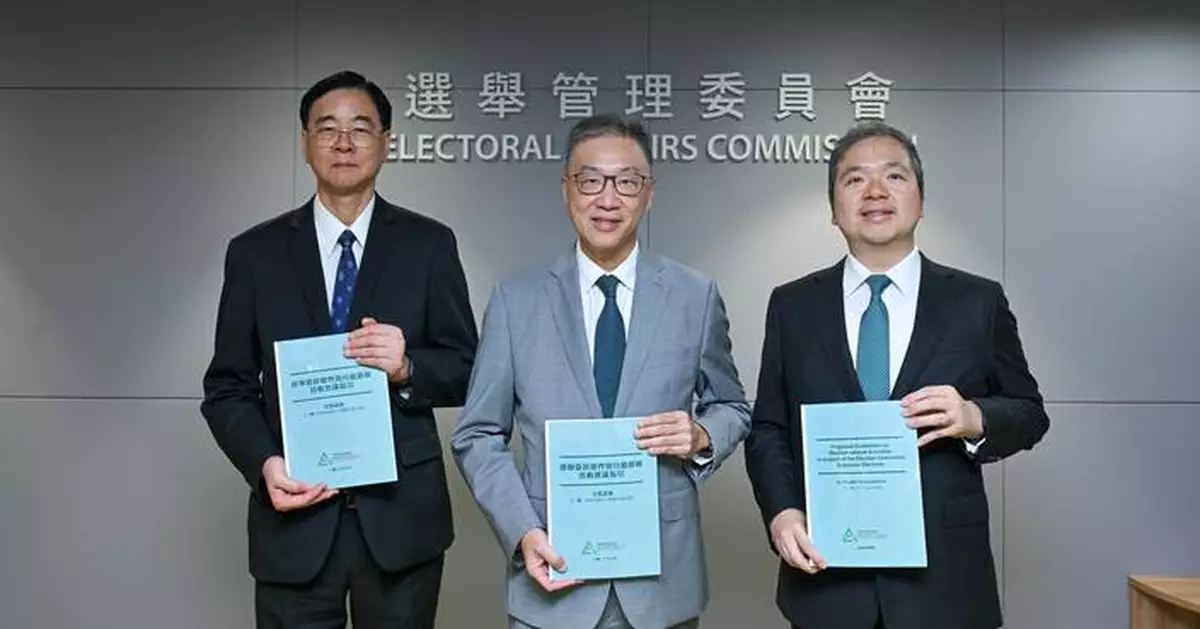
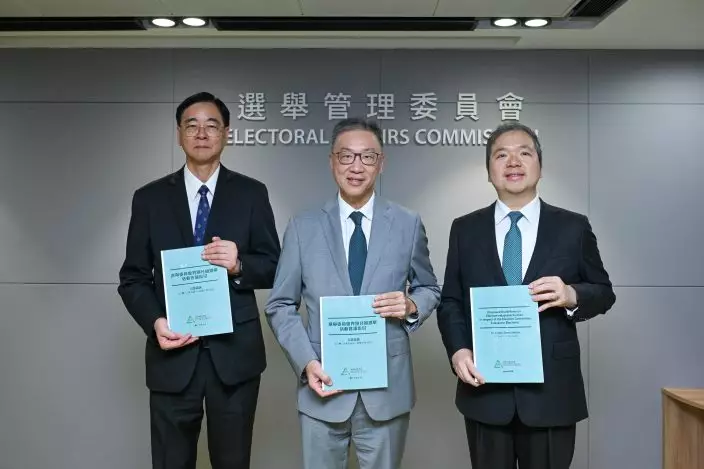
The Electoral Affairs Commission (EAC) today (June 11) released the proposed guidelines on election-related activities in respect of the Election Committee Subsector Elections for public consultation. The Chairman of the EAC, Mr Justice David Lok (centre), and EAC members Professor Daniel Shek (left) and Mr Bernard Man, SC (right), welcome views from members of the publ Source: HKSAR Government Press Releases
The Electoral Affairs Commission (EAC) today (June 11) released the proposed guidelines on election-related activities in respect of the Election Committee Subsector Elections for public consultation. The Chairman of the EAC, Mr Justice David Lok (centre), and EAC members Professor Daniel Shek (left) and Mr Bernard Man, SC (right), welcome views from members of the publ Source: HKSAR Government Press Releases

DH investigates case of severe paediatric influenza A infection

The Centre for Health Protection (CHP) of the Department of Health is today (July 26) investigating a severe paediatric influenza A infection case. The CHP urged the public to maintain good personal and environmental hygiene at all times to prevent influenza and other respiratory illnesses.

The case involves a 6-year-old girl with good past health who presented with a cough since July 20. She developed a fever, runny nose, sore throat and tiredness on July 23 and was brought to seek medical attention at a private clinic. As her symptoms persisted, she was taken to the Accident and Emergency Department of Prince of Wales Hospital on July 24, and was admitted to the paediatric intensive care unit for treatment. Her respiratory specimen collected by the hospital on July 24 tested positive for influenza A (H1) virus. Her clinical diagnosis was influenza A infection complicated with shock. The patient remains hospitalised in stable condition and is transferred to a general ward.

The CHP's preliminary investigation revealed that the girl had received the 2025/26 seasonal influenza vaccination. As the patient travelled to Japan during the incubation period (July 16 to 19), the CHP classified the case as an imported case. The CHP will continue to investigate the case. One of the girl's household contacts developed mild upper respiratory symptoms and tested negative for influenza virus. The CHP will continue to investigate the case.

Since Hong Kong entered the influenza season in late June, the influenza activity has continued to increase. Based on historical surveillance data, the CHP expects the influenza activity to rise steadily for some time after the start of the influenza season before reaching its peak and is expected to remain high in the coming weeks.

The CHP reminded members of the public, especially children, the elderly and those with underlying illnesses, to seek medical advice promptly for early treatment if they present with fever and respiratory symptoms. As the health condition of children with influenza can deteriorate rapidly, parents must pay close attention to their condition, and visit an accident and emergency department immediately if the child's condition deteriorates with symptoms such as shortness of breath, wheezing, blue lips, chest pain, confusion, a persistent fever or convulsions.

In addition, the public should maintain good personal and environmental hygiene at all times to prevent contracting influenza and other respiratory illnesses. Given that Hong Kong is currently in the influenza season and the COVID-19 activity has significantly increased, high-risk individuals should wear surgical masks when staying in crowded places; the general public is also advised to wear a surgical mask when taking public transport or staying in crowded places. People with respiratory symptoms, even if mild, should wear a surgical mask and seek medical advice promptly. They should also consider whether to attend work or school. If symptomatic individuals live with high-risk or immunocompromised persons, they should also wear a surgical mask at home to minimise the risk of cross-infection. They should also ensure proper ventilation indoors and enhance the cleaning and disinfection of the household environment.

Members of the public may refer to the CHP'sCOVID-19 & Flu Express,Seasonal Influenza Webpage,COVID-19 Vaccination Programme Webpage, andVaccination Schemes Webpage, for the latest information.

Source: AI-found images

Source: AI-found images

Recommended Articles