Skip to Content Facebook Feature Image

From Moved to Fooled — Who Wants Their Children to End Up on the Wrong Side of the Law?

Blog

From Moved to Fooled — Who Wants Their Children to End Up on the Wrong Side of the Law?
Blog

Blog

From Moved to Fooled — Who Wants Their Children to End Up on the Wrong Side of the Law?

2026-06-11 23:14 Last Updated At:23:14

In this world, winners become kings and losers outlaws. No parents, anywhere, want to see their children end up behind bars.

A video circulating on social media — timed to the June 4th anniversary — shows footage from the 2014 Occupy Central movement. In it, a girl of six or seven sings the revolutionary anthem Who Has Not Yet Awakened in a sweet, childlike voice. Forty years ago, that might have been moving. Forty years on, all it inspires is dread — a gut-level warning: watch out, don't get played.
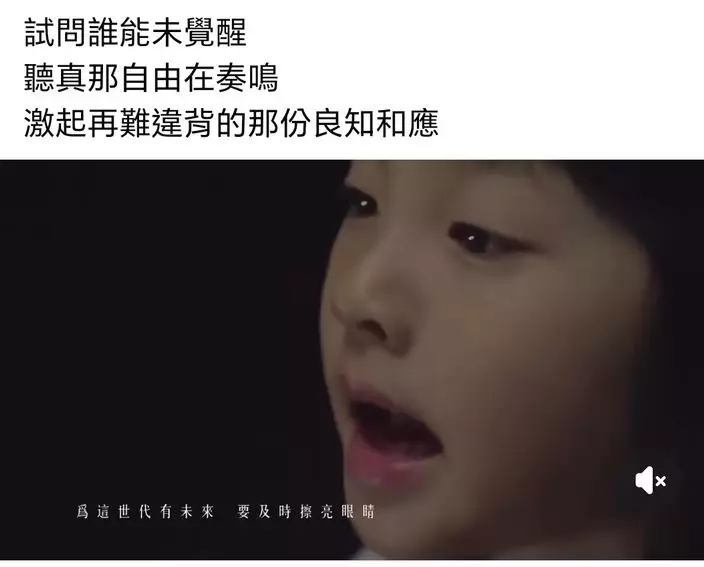
Feeding a child with political singing. What does early political exposure do to a young mind?

Feeding a child with political singing. What does early political exposure do to a young mind?

That video calls two recent news stories to mind.  

Law Student Convicted of Riot on Retrial

A first-year law student at a British university returned to Hong Kong in 2019 and joined a riot in Wan Chai on August 30. She was acquitted of riot charges in 2021. The Department of Justice appealed successfully, and the Court of Appeal overturned the acquittal and ordered a retrial before the original magistrate. On June 9, Judge Lee Chun-man convicted Tang Ka-yan — who was 21 at the time of the offense — of riot. 

Tang had argued there was no direct evidence of her participation — that she had simply been passing by. Judge Lee disagreed. He considered the location where she was stopped, along with her attire and equipment: black top, black trousers, gas mask, umbrella, and hiking pole. The cumulative weight of the circumstantial evidence, as the Court of Appeal had found, was overwhelming. It ruled out any possibility she was an innocent bystander. She was convicted of riot.

Now 28, Tang wept in the dock after the verdict. Her mother broke down in tears. Given the charge is riot, a substantial sentence is expected.  

A law student committing a riot is knowing breach of the law. Her legal education abroad evidently taught her nothing about respecting it.

Construction Worker Convicted of Sedition

A construction worker committed a series of seditious acts between 2024 and 2025. On October 2, 2024 — the day after National Day — he wrote seditious messages on pieces of paper and threw them from the window of his flat in On Tat Estate, Kwun Tong. On December 5, 2025, two days before the Legislative Council election, he threw another batch of seditious leaflets from the same flat. Police arrested him on April 21 this year.

Under caution, the defendant admitted throwing the papers. He stated he had done so to express his discontent with the SAR government, including calls for the public to boycott the vote. He also said he harbored resentment toward Mainland residents, blaming them for taking jobs from local workers — which was why he had written phrases such as "Kill mainlanders" on the papers.

In mitigation, the defense noted that the defendant had a low level of education and had worked in construction throughout his life. The events of 2019 and the pandemic hit him hard — his work shifted from full-time to casual, and his income dropped sharply. Those grievances, the defense argued, led to the offending.

Chief Magistrate So Wai-tak was unsparing. He found the defendant had acted with premeditation — deliberately choosing significant dates to throw targeted messages from his flat. The sentence: 10 months' imprisonment.

Some may feel 10 months for throwing a few pieces of paper is steep. But consider the defendant's record: 23 prior criminal convictions spanning dishonesty, violence, drugs, and public order offenses — including illegal protests — with a previous sentence of four years. He is a serial offender, and the court treated him accordingly.

No Escaping the Consequences

The two cases, taken together, send a clear message. Whether a female university student or a male construction worker, using unlawful means to protest or riot ultimately triggers legal consequences. If only they had thought twice before acting.

For those with deeply entrenched anti-government views, asking them to be patriotic — or even supportive of the government — is, of course, expecting the impossible. But rational adults must understand this: if you choose to confront the government through extreme and unlawful means, you must be prepared to pay the price. The mitigation pleas in both cases suggest that neither defendant had truly reckoned with the possibility of arrest and imprisonment.

Most parents dream of their children achieving great things. Few could imagine them ending up as convicts. For those who filmed their young children speaking out against the SAR government — did they ever stop to think? Such actions plant anti-government ideas in those children's minds from an early age. Those ideas can one day lead them to break the law and face the consequences. Did those parents consider that such footage could lead other people's children astray — pushing them toward failed attempts at subversion, a life on the wrong side of the law, and a ruined future? 

If you want to ruin yourself, that is your business. Don't drag others down with you.

Lo Wing-hung


Bastille Commentary

** 博客文章文責自負,不代表本公司立場 **

History holds a mirror to the rise and fall of civilizations. I recently finished watching a Chinese Mainland historical drama called Swords Into Plowshares (太平年), and it left a deep impression on me.

Swords Into Plowshares covers 53 years of history across the Five Dynasties and Ten Kingdoms period that followed the Tang Dynasty. The story opens during the Later Jin Dynasty under Shi Jingtang, when a warlord named Zhang Yanze — facing a shortage of military rations — ordered his men to treat civilians as "two-legged sheep," grinding them in stone mortars to be consumed as flesh and blood. His adopted son stepped forward to plead for mercy, unable to bear the horror. Zhang Yanze slit the boy's throat on the spot and had him thrown into a cooking pot. In an age of chaos, cannibalism was simply a matter of course. The opening scene of Swords Into Plowshares is nothing short of harrowing.

The series vividly portrays the unrelenting warfare and mass starvation of the Five Dynasties era. Among its rulers were ruthless opportunists who seized power by force — but also a handful of idealistic sovereigns who genuinely wished to accomplish something meaningful. They wanted to offer their people the promise of a peaceful year and an end to the age of human carnage. 

Having watched the full series, I was left with an overwhelming sense of gratitude for living in peaceful times. It is almost impossible to imagine that not only did such horrors exist in the past, but that even today, in some corners of the world, conditions remain more chaotic than anything seen during the Five Dynasties.

That reflection brought to mind the events surrounding the recent June Fourth anniversary.

The Performance in Causeway Bay

Around the June Fourth anniversary, a number of people took to Causeway Bay to stage various forms of "performance art" and "covert protests." Some carried balloons; others stretched red threads across the street — all in the name of symbolic commemoration, urging people to "never forget June Fourth." If we were truly to remember June Fourth, we must not overlook similar protest movements over the past 37 years — both in Hong Kong and abroad — that ended in disaster. Those lessons are indeed worth remembering.

The Same Old Story

These political struggles, dressed up as social movements, tend to follow an identical playbook. 

Step one begins with subtle art or satire. When the government moves to stop it, organizers accuse the authorities of being petty. Step two escalates into open, fierce criticism. When the government intervenes, they cry that free speech is under attack. Step three becomes mass assemblies — lawful or otherwise. When authorities step in, they charge that democracy is being strangled. Step four is violence. Peaceful gatherings alone cannot bring down a government, so organizers inject force into the mix, spreading disruption in all directions and paralyzing normal economic and social life. When the government acts, it is condemned as unjust. Step five — the final move — is an outright attempt to topple the regime.

Let us be honest: were those who led the chants of "end one-party rule" not trying to overthrow the Chinese Communist Party? Were they not hoping China would experience something like the collapse of the Iron Curtain in Eastern Europe in 1991, or the Arab Spring of 2011? Has any such movement ever known when to stop?

Cast your mind back to 1989, when Wu'er Kaixi showed up in his pyjamas to meet Premier Li Peng. Are we really to believe he had no time to change into decent clothing — no opportunity for a peaceful exit? Then in 2016, during discussions on Hong Kong's political reform, Zhang Dejiang — the Politburo Standing Committee member responsible for Hong Kong affairs — made a special visit to the city for a historic meeting with the pan-democratic camp, hoping they would accept the central government's compromise proposal. Instead, they berated him for two hours. Was there truly no room for them to win concessions toward universal suffrage? In the 2019 Black Riots, the SAR government announced as early as June that it would suspend the Extradition Bill. Was there no space for the opposition to make a graceful exit?

In movement after movement, regardless of the slogans raised or the democracy and freedom invoked, the real driving force was simply to oppose for opposition's sake. The ultimate and most fundamental goal was always the same: to bring down the CCP. Those involved had every opportunity to stop while they were ahead — but they never did, because they had other agendas. This story repeats itself endlessly. 

What Happens After the Overthrow?

Both the Tiananmen Square incident of 1989 and Hong Kong's Black Riots of 2019 were ultimately brought to an end by firm action from Beijing. The opposition never succeeded in toppling the CCP. Yet the hidden hands of the West achieved decisive victories elsewhere — dismantling the Soviet Communist Party in 1991, and toppling numerous Middle Eastern regimes in 2011. 

The post-Soviet states fared somewhat better. Even as the USSR fractured into 14 countries, Russia emerged as the dominant successor state. Because Russia retained its nuclear arsenal, even as a weakened power, the United States could do little to further constrain it. 

The fate of smaller nations was far more tragic. Take Libya as an example. Under the strongman rule of Muammar Gaddafi, Libya had quietly reconciled with the United States and agreed to abandon its nuclear weapons program. Then the Arab Spring erupted in 2011. Driven by foreign interference, Gaddafi's regime was overthrown, and he died in a roadside ditch. Fifteen years on, has Libya become a democracy — free, prosperous, and happy?

Libya's collapse has gone largely unreported in Western media. Today, Libya is mired in a situation far more wretched than China's Five Dynasties period. Two rival factions — the Libyan National Army and the Government of National Unity — face off against each other, each controlling vast swathes of territory. 

Beyond these two blocs, more than 300 armed militias compete for turf across the country. Factional strife is rampant. The entire nation has plunged into a terrifying maelstrom of ethnic, tribal, and foreign-power conflict. Most ironically, even the capital Tripoli has been carved up into controlled zones — just last May, two militia groups fought fierce battles in the heart of the city, sending civilians fleeing in all directions.

Had the forces backed by the West succeeded in toppling the CCP in China, China would almost certainly not have become another Russia. It would far more likely have become another Libya.

Over the past 37 years, China has risen as a great power, joined the ranks of the world's strongest nations, and stands as an equal to the United States. Ordinary people live in peace. Today, China faces a once-in-a-century transformation. Its economy is on the verge of surpassing America's in total output. Washington has responded with fierce resolve to contain China across every front. China's national leadership is steering this great ship forward through a raging sea.

Those who stretch red threads across Causeway Bay — what do they understand of how empires rise and fall, how great powers win and lose? Can they offer the Chinese people a "Swords Into Plowshares" moment of true peace? As the Chinese saying goes: you cannot speak of ice to a summer insect.


Lo Wing-hung

Recommended Articles