WASHINGTON (AP) — Independents have grown increasingly unhappy with President Donald Trump during his second term, a new AP-NORC polling analysis finds, particularly those without a college degree.
The analysis from researchers at The Associated Press-NORC Center for Public Affairs Research shows that while about half of independents without a college education had a positive view of Trump around the 2024 election, his approval with that group fell to about one-quarter this spring. That shift has erased the large education gap that existed among independents in the months before Trump took office for his second term, with independents now holding similarly negative views of the president regardless of their level of education.
The analysis was conducted by aggregating nearly two dozen AP-NORC polls conducted between July 2024 and April 2026, allowing for a deeper look at how support for Trump changed during several distinct periods, including the last six months of 2024, the first 100 days of Trump's presidency, the summer of 2025 when the Big Beautiful Bill passed, last fall's government shutdown and the beginning of the Iran war.
The compiled polling shows a steady decline among independents throughout Trump’s second term. His standing has also dropped among several small but important groups that moved toward him in the 2024 presidential election, including Black and Hispanic independents.
More Americans than ever consider themselves independents, and they are among the groups that shifted toward Trump in the 2024 presidential election. Any erosion in that support could signal trouble for Trump and Republicans headed into the midterm elections, which are often seen as reflection of how voters feel about their governing party.
Tafari Torres, a senior research associate at NORC who co-authored the analysis, noted that while Democrats' and Republicans' views of Trump have held largely steady in his second term, independents' opinions are still moving. “Independents are, broadly, the people who are reacting to the events and dropping in their support,” he said.
Trump's return to the White House was fueled, in part, by independent voters who saw him as the stronger candidate on key issues like the economy. The new analysis, which looks at Trump's favorability and presidential approval ratings, shows that once he took the helm, their views soured quickly.
Independents without a college degree had a much more positive view of Trump than college-educated independents did during and just after the 2024 election, but that shifted in the first few months of his term. Positive views of Trump among independents without a college degree fell from 48% in the months before he returned to office to 31% in polling conducted during Trump’s first 100 days back in office. Those warm views declined even further, to about one-quarter, during the government shutdown and the early months of 2026.
Only about 3 in 10 college-educated independents, by contrast, had a positive view of Trump before he returned to office, making their drop to about one-quarter much less dramatic.
“The decline among no-college independents was steeper and it was greater than the slight decline in college independents," said Sean Collins, a research associate at NORC who co-authored the analysis. "That was surprising, especially given, when you think of Trump's coalitions, those without college degrees is usually one of the ones that that stands out.”
Americans without a college degree have long been a key part of Trump's coalition. But Trump also won in 2024 by making gains among groups that tend to support Democrats, including Hispanic adults.
About 4 in 10 independent voters — 42% — voted for Trump in 2024, up from 37% in the 2020 presidential election. Independent voters without a college degree were a little more likely to back Trump over former Vice President Kamala Harris in the last election, according to AP VoteCast, and Hispanic independents were about evenly split between the two.
The picture looks much bleaker for the president now.
Nearly half of Hispanic independents — 46% — saw Trump favorably in the polling conducted around the presidential election. His approval among these adults dropped quickly in his second term, falling as low as 15% during last fall's government shutdown before landing around one-quarter in the spring.
Younger independents also became less supportive of the president, while independents age 60 and older remained mostly stable. Other AP-NORC polling has pointed to Trump losing ground among younger Republicans over inflation concerns and Hispanic Americans growing increasingly discontented.
“The gains Trump appeared to make during the election, I don’t know if they’re sticking around. He’s experienced some significant shifts among those people,” Torres said. ”From our research, they don’t appear to be permanent gains.”
Polling suggests that the economy as at the root of many Americans' frustrations with Trump, including independents.
About half of independents who supported Trump in 2024 said inflation was the single most important factor for their vote, AP VoteCast found, and most expressed high levels of concern about the cost of food and gas.
More than a year into Trump's second term, inflation remains high, fueled by gas prices that remain elevated as the Iran war continues. An AP-NORC poll conducted in April found that about 3 in 10 independents were “extremely” or “very” concerned about being able to afford groceries in the last few months, and a similar share were worried about being able to afford gas.
The analysis found that Americans' views of the U.S. economy tend to align with their view of the president. Those with negative views of the country's economy tended to have negative views of Trump, and about 8 in 10 independents described the U.S. economy this spring as poor.
The latest AP-NORC polling from May found that only about 3 in 10 independents approve of how Trump is handling the economy, in line with the roughly 3 in 10 who said that at the beginning of his second term. The April poll found only about 1 in 10 independents — 12% — approved of how Trump was handling the cost of living.
——
This AP-NORC analysis of 4,836 independents was conducted over 21 AP-NORC surveys, blocked into five time periods before and during President Donald Trump's second term. Independents are classified as panelists who do not select that they identify with or lean toward either the Democratic or Republican Party.
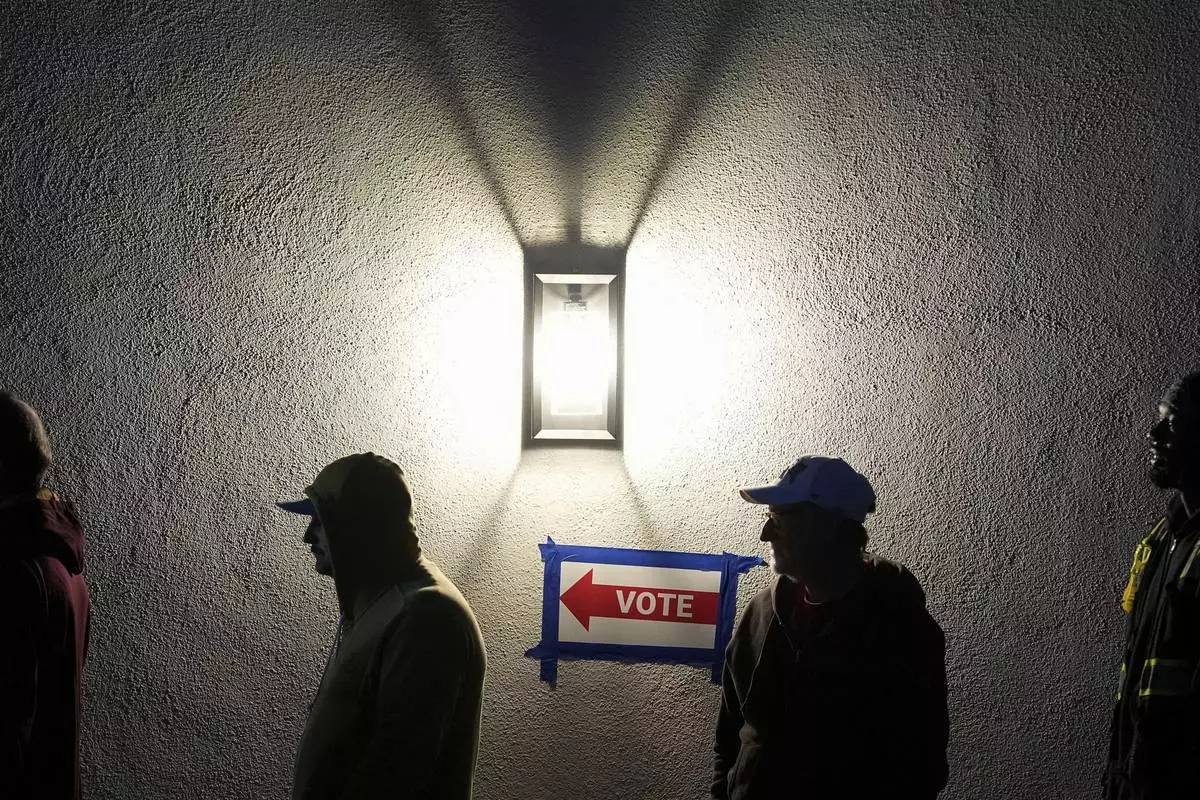
FILE - Voters stand in line outside a polling place at Madison Church, Nov. 5, 2024, in Phoenix, Ariz. (AP Photo/Matt York)
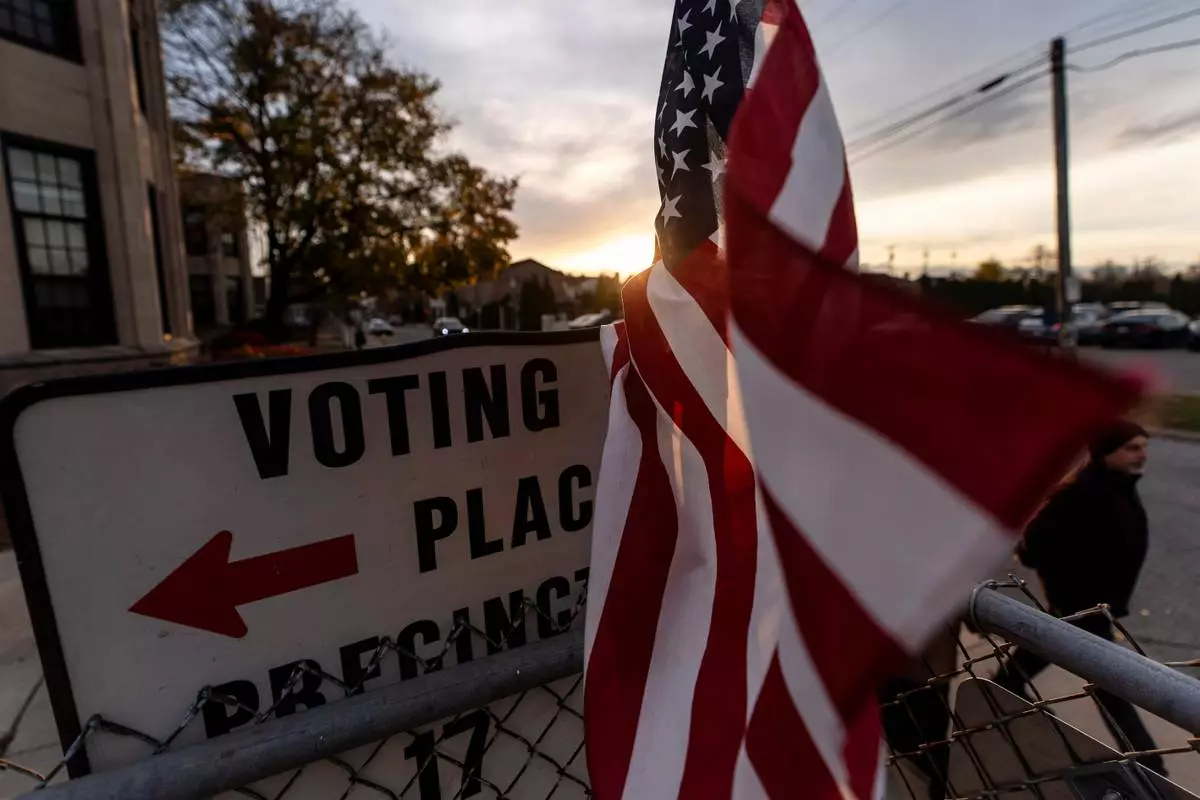
FILE - An American flag flies in the wind as a voter leaves a polling site after casting a ballot on Election Day, Nov. 5, 2024, in Dearborn, Mich. (AP Photo/David Goldman, file)
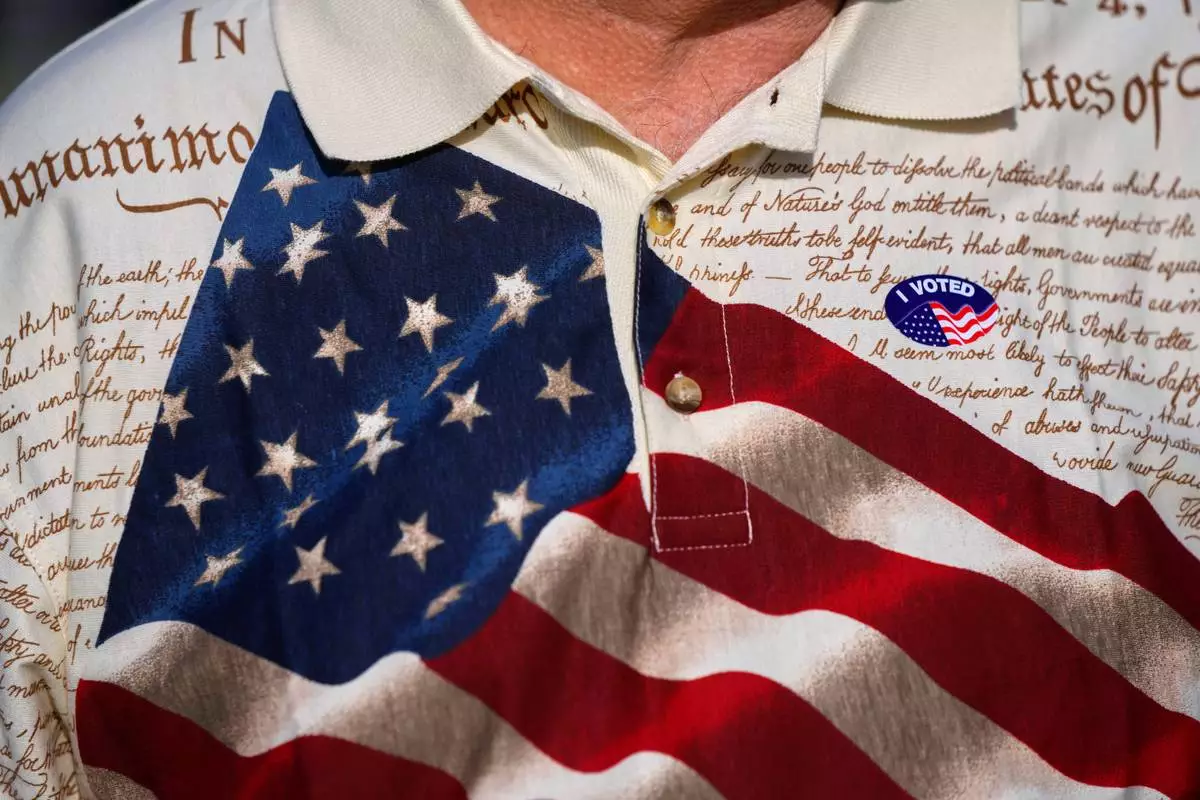
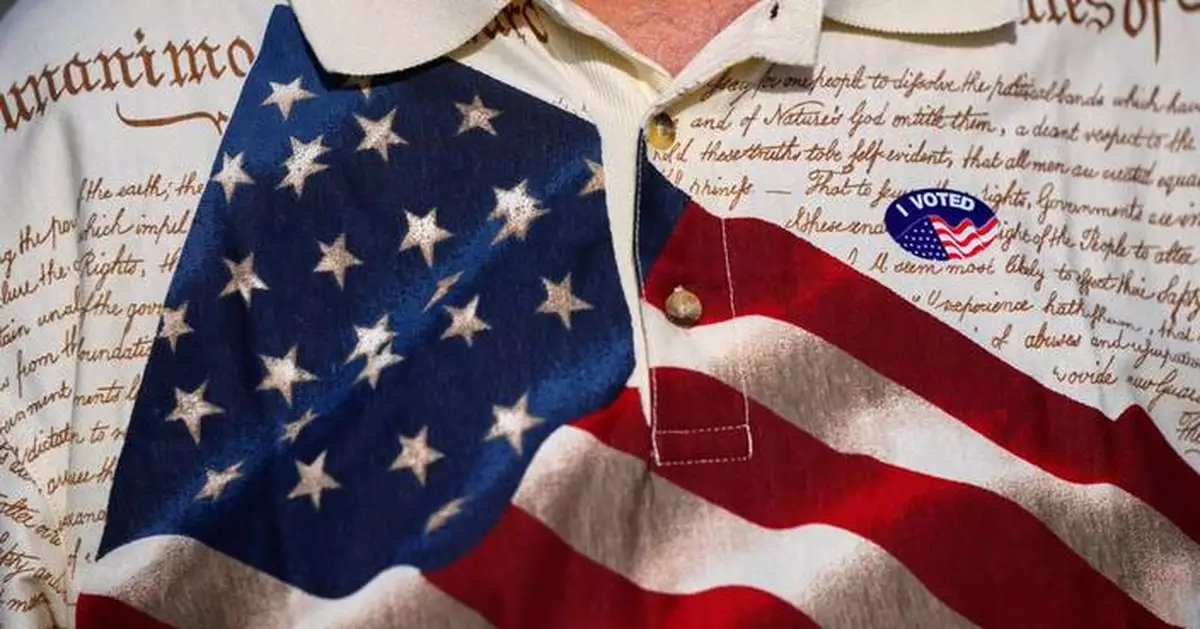
FILE - A man wears an "I voted" sticker on his shirt, printed with the American flag and the U.S. constitution, after voting at Wa-Ke Hatchee Recreation Center in Fort Myers, Fla, on Election Day, Nov. 8, 2022. (AP Photo/Rebecca Blackwell, File)
LONDON (AP) — David Hockney, a treasured British artist whose paintings of shimmering pools and colorful iPad drawings became icons of contemporary art, has died, his publicist said Friday. He was 88.
Over a seven-decade career, Hockney explored and reimagined classical portraiture, landscape painting and pop art, working in painting, collage, photography and digital drawing.
Hockney was born in the north of England but lived much of his life in Southern California, making its sun-drenched suburban views a major motif.
Later in life he returned to Europe, finding renewed inspiration in the wooded hills of his native county of Yorkshire and the fields and trees of France’s Normandy region. One of the most popular and critically lauded British artists of his generation, his works sold for record prices at auction.
Historian Simon Schama said it's no mystery why his work is so enduringly appealing.
“His work is admired — loved is not too strong a word — by the millions who, worldwide, flock to see it because it presupposes an expectation of pleasure,” Schama wrote in an essay accompanying a 2025 Hockney exhibition in Paris.
Hockney’s publicist, Erica Bolton, said he died at his home in London on Thursday, less than a month short of his 89th birthday. She did not give a cause of death.
He is survived by his longtime partner Jean-Pierre Gonçalves de Lima; his great-nephew and studio assistant, Richard Hockney; his brothers Philip and John; and numerous nieces, nephews, great-nieces and great-nephews.
With his trademark round glasses and bleached-blond hair, Hockney was a well-known figure in the swinging British and American art scenes of the 1960s, even before he reached the age of 30. His paintings were just as distinctive, many of them creating a dreamlike world of patterned light bouncing off water and windows, and human forms rendered in flattened, simplified shapes in matte acrylic paint.
“I’m excited every day,” he told the Los Angeles Times in 1979. “London has lots of dreary parts but I never find anything dreary in Los Angeles.”
Hockney was born July 9, 1937, in Bradford, a large industrial city whose chief export was woolen textiles. He spent his first two decades there before going to London’s Royal College of Art. He made an impact even before his graduation, and art dealer John Kasmin took him into his stable of artists in 1961.
His artistic influences ranged widely, including Renaissance portraitists, 18th-century English artist William Hogarth's satirical drawings, 19th-century English painter J.M.W. Turner’s landscapes, Pablo Picasso’s experiments in Cubism and 20th-century American pop art.
He shared with other pop artists an interest in the polished surface of modern life. And, like Andy Warhol with his Brillo boxes and Campbell’s soup cans, Hockney occasionally incorporated advertising labels, such as a British Typhoo Tea box used in his 1961 “Tea Painting in an Illusionistic Style.”
He told The New York Times in 1964 that he enjoyed the burgeoning pop art scene in New York but wasn’t sure he was part of it.
“I’m just an ordinary artist,” he said. “I do admire American pop — in fact it seems that everything fresh-looking and vital in England these days has been coming from the U.S.”
Nonetheless, he said in 1995 that he still considered himself “very much an artist in the English tradition.”
Even his move to California in 1964 had a historic precedent, he noted, since earlier generations of English artists had sought out the brilliant light of Italy.
Hockney, who was out as a gay man long before it was common, explored erotic themes, giving youthful male bodies the same tender scrutiny that artists had been giving the female nude for centuries.
Early works like “We Two Boys Together Clinging” and “Two Men in a Shower” celebrated gay relationships when homosexuality was still illegal in Britain.
Early in his career, two of his drawings were bought for the Museum of Modern Art in New York.
“The moment I first sold pictures to earn a living, I felt rich. I’ve been rich ever since,” he told The Associated Press in 1995. “I didn’t have much money but I did what I wanted. ... You are a rich man if you do the things you want to do.”
In 2018, his 1972 painting “Portrait of an Artist (Pool with Two Figures)” sold at a Christie’s auction for $90.3 million, at the time a record for a living artist.
While many of his best-known paintings had American scenes, he also tackled British subjects. He immortalized his parents in several portraits. “Mr. and Mrs. Clark and Percy,” a 1971 dual portrait of two of his English friends and their cat, was ranked No. 5 in a 2005 BBC Radio-National Gallery (London) online poll of the greatest paintings in Britain. It was the only work by a living painter in the top 10.
Like many traditional artists, he considering drawing a fundamental skill and lamented that it wasn’t taught as rigorously as it used to be.
“Human beings are the most interesting things we see, so they’re the hardest to draw,” he said in a 1996 AP interview.
He didn’t limit himself to drawing and painting, though. He contributed costume and set designs for the theater and opera, including a celebrated production of “Tristan und Isolde” first staged in 1987 at the Los Angeles Opera.
Hockney also embraced printmaking, photo collage and video.
When he took up photography, he fused genres, assembling individual photos into elaborate collages like “Pearblossom Highway, 11-18th April, 1986,” built up of individual views of a desert highway intersection.
“My photographer friends said it was a painting,” Hockney told the AP in 2001. “I said it’s a photograph; I used a camera.”
The insight he gained from his photo work led him to research and write a 2001 book, “Secret Knowledge: Rediscovering the Lost Techniques of the Old Masters.” He argued that through the centuries, artists used lenses and other optical devices to aid them in drawing much more often than most historians believe.
Later he began to draw on iPads, which became his favorite tool.
In the early 2000s, he looked afresh at the fields and forests of Yorkshire in a series of landscape paintings that combined bold color with minute attention to the texture of snow on a hillside or a blossom on a hawthorn hedge. They featured in a 2017 exhibition at Tate Britain in London that was visited by half a million people and moved to the Pompidou Center in Paris and the Metropolitan Museum in New York.
Hockney used the English landscape for inspiration in his design for a stained-glass window installed at Westminster Abbey in 2018 to celebrate the long reign of Queen Elizabeth II.
In 2019, he moved to Normandy, where during the 2020 coronavirus lockdown he produced joyous iPad drawings of springtime for his friends. His message — “Do remember they can’t cancel the spring” — was emblazoned in neon across the Fondation Louis Vuitton in Paris when it hosted a huge Hockney exhibition that opened in April 2025.
Art curator Norman Rosenthal, who helped put together the exhibition, called Hockney “the Picasso of our times.”
“When I say that, people laugh at me, as Picasso was the archetypal artist of the 20th century,” Rosenthal told the Independent newspaper. “But David Hockney is also an incredibly popular artist whose work changes how we see things.”
An unrepentant cigarette smoker who railed against government anti-smoking rules, Hockney complained when a poster for the 2025 exhibition was banned from the Paris Metro because it showed him holding a cigarette.
The announcement of his death from his publicist noted that Hockney was “a committed life-long and defiant smoker, expressing the pleasure in life it brought him. ... He smoked up to the end.”
Hockney had a minor stroke in 2012 and was increasingly deaf in later years — something he said improved his visual perception.
“If you lose one sense, you gain other senses, and I feel I could see space clearer,” he told the AP in 2017.
He never stopped working.
“It’s my work that keeps me young,” Hockney told the Sun newspaper in 2017. “I’ve been a professional painter for 60 years. Sixty years of getting up every day and doing exactly what I want to do.”
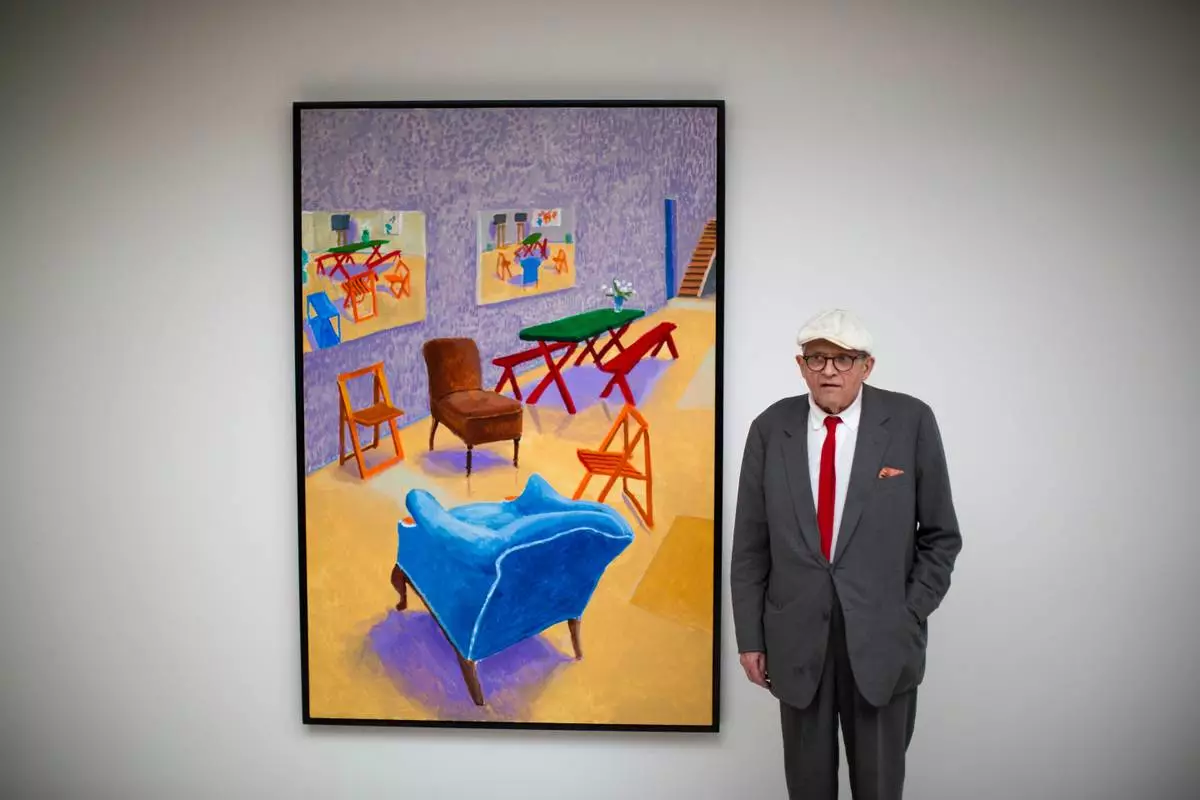
FILE - British artist David Hockney poses for photographers in front of his acrylic on canvas "Studio Interior #4" which features as part of the "David Hockney Painting and Photography" exhibition at the Annely Juda Fine Art gallery in London, Thursday, May 14, 2015. (AP Photo/Matt Dunham, File)
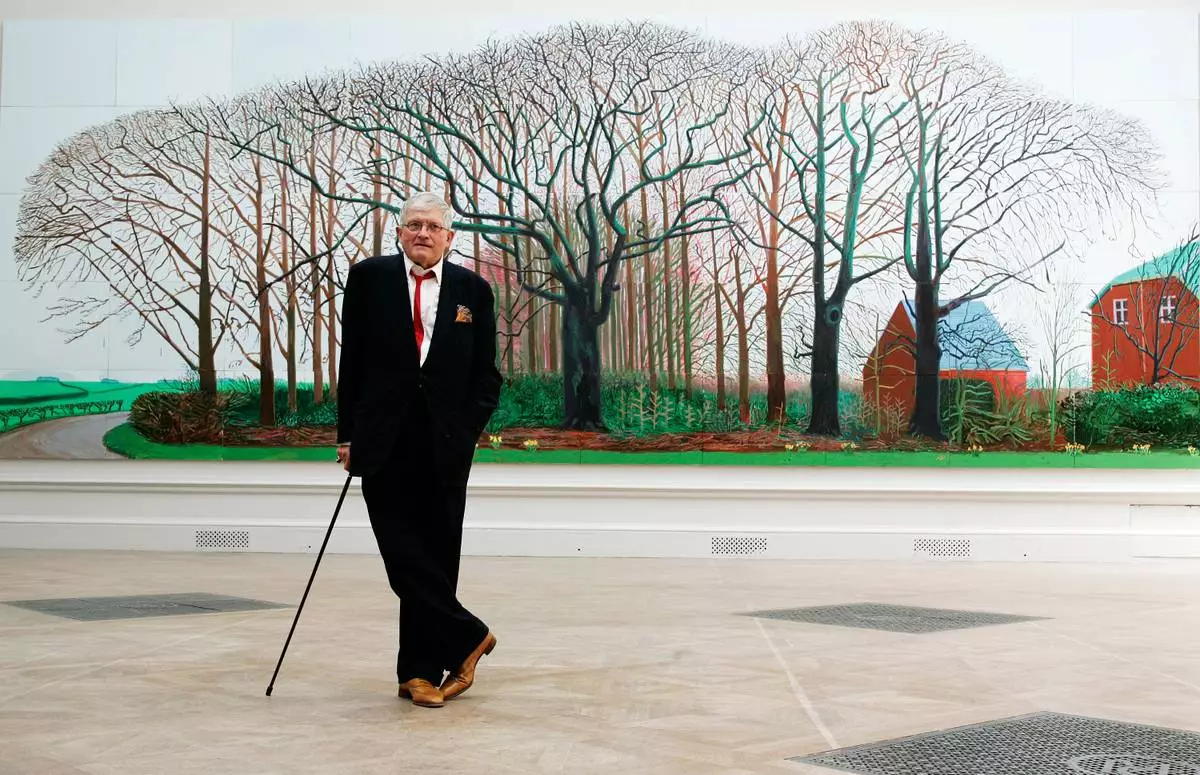
FILE - British artist David Hockney poses as he unveils his painting 'Bigger Trees Near Water', the largest painting ever shown at the Royal Academy's Summer Exhibition, London, Friday, May 25, 2007. (AP Photo/Sang Tan, File)
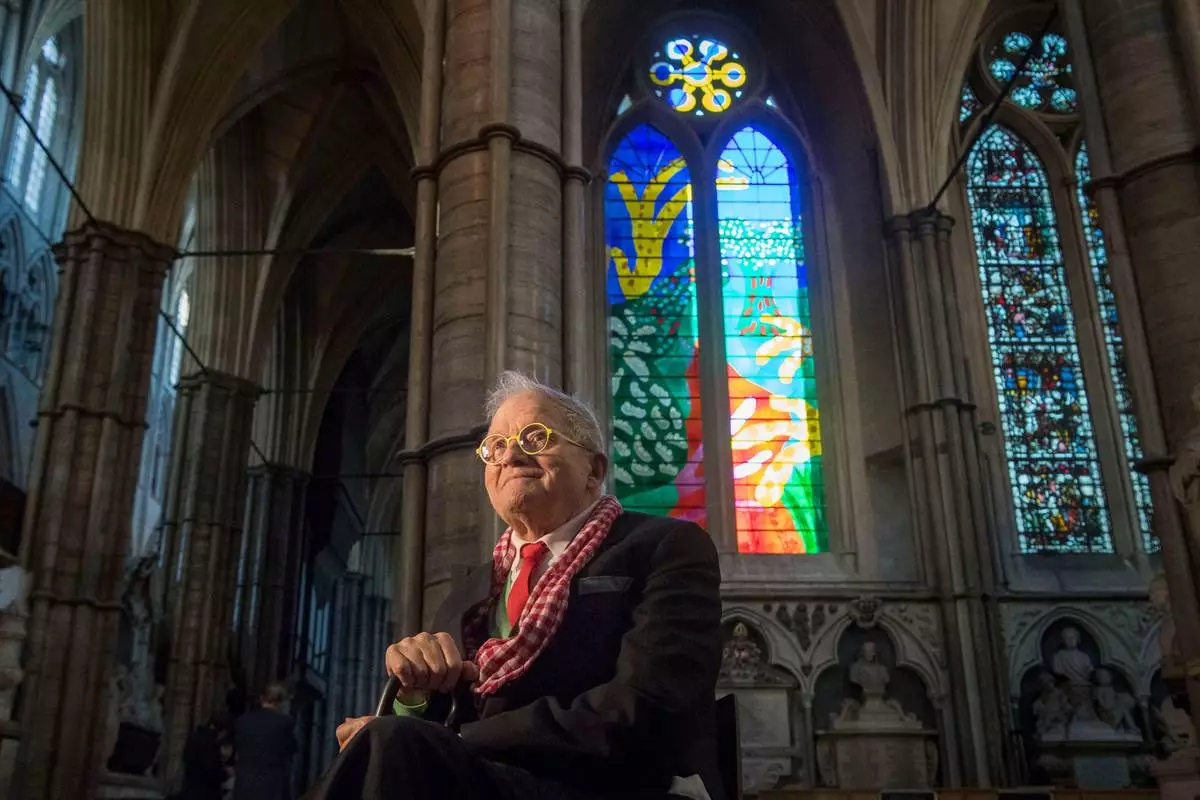
FILE - British artist David Hockney sits in front of The Queen's Window, a new stained glass window at Westminster Abbey, London, designed by David Hockney and revealed for the first time on Wednesday Sept. 26, 2018. (Victoria Jones/Pool via AP, File)
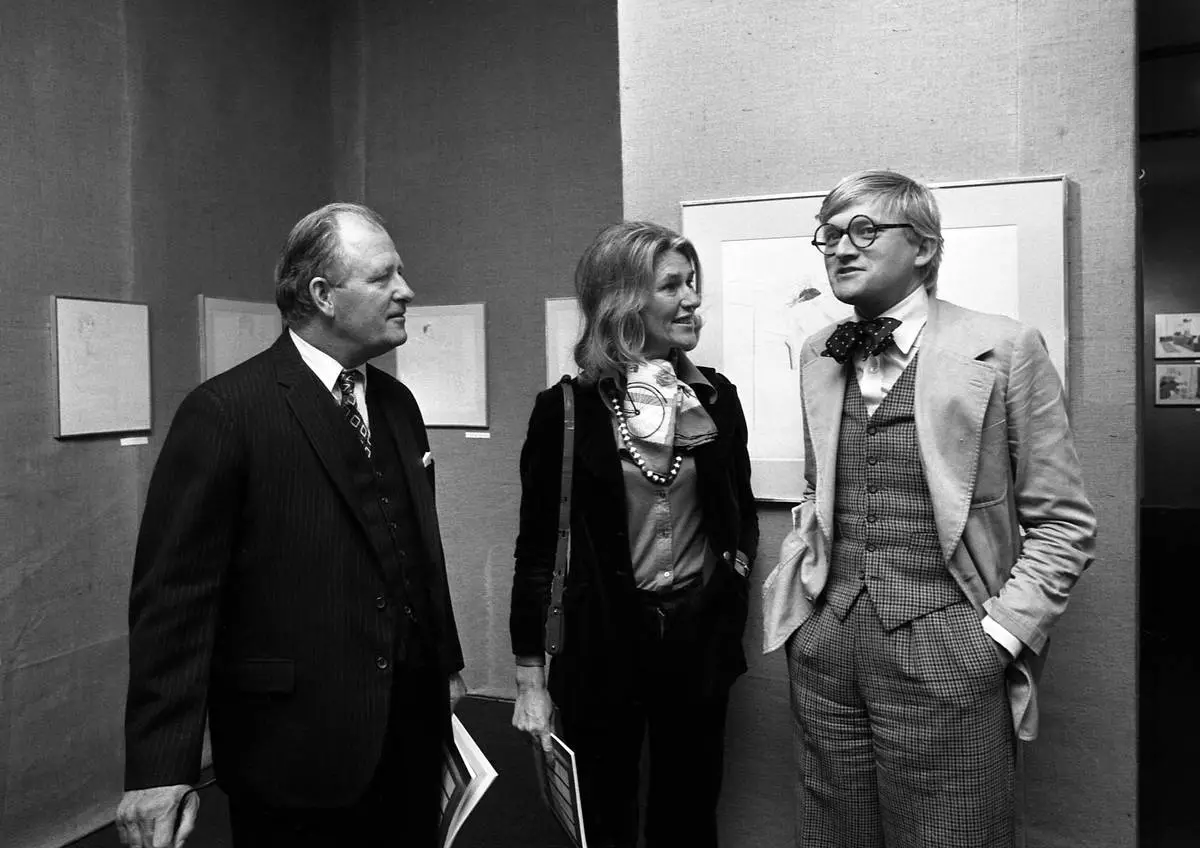
FILE - Painter David Hockney, right, with British Ambassador Edward Tomkins, left, at the opening of his exhibition at Musee des Arts Decoratifs on Oct. 10, 1974 in Paris. (AP Photo/Michel Lipchitz, File)
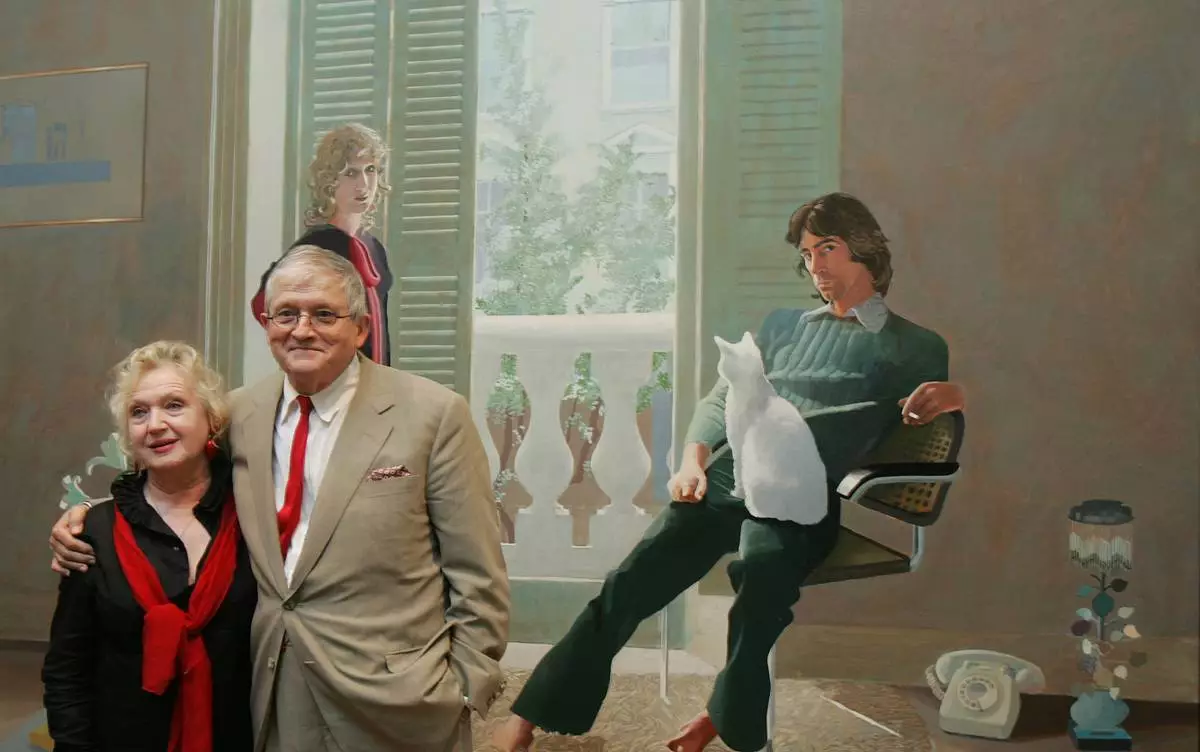
FILE - British artist David Hockney, stands next to his friend and model Celia Birtwell, in front of one of his most famous works ' Mr and Mrs Clark and Percy' at the National Portrait Gallery in London, Wednesday Oct. 11, 2006. (AP Photo/Alastair Grant, File)
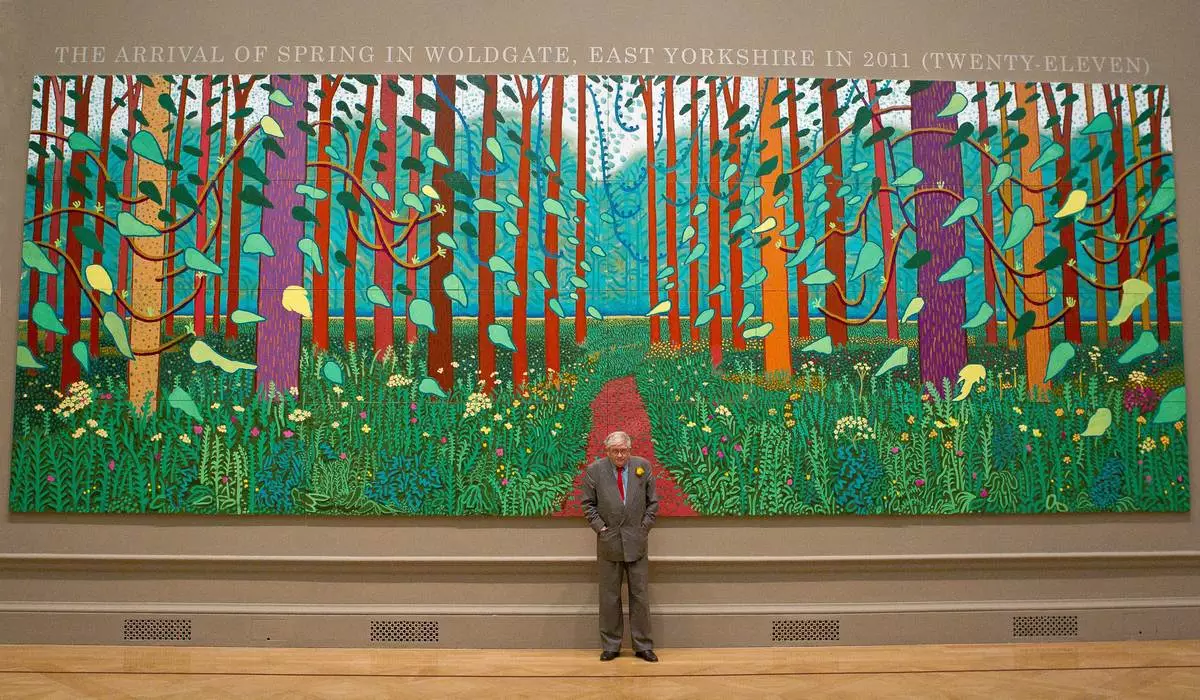
FILE - British artist David Hockney stands before one of his paintings of the East Yorkshire landscape at The Royal Academy of Arts in Piccadilly, London, Monday, Jan. 16, 2012, ahead of his exhibition called 'A Bigger Picture'. (AP Photo/Joel Ryan)
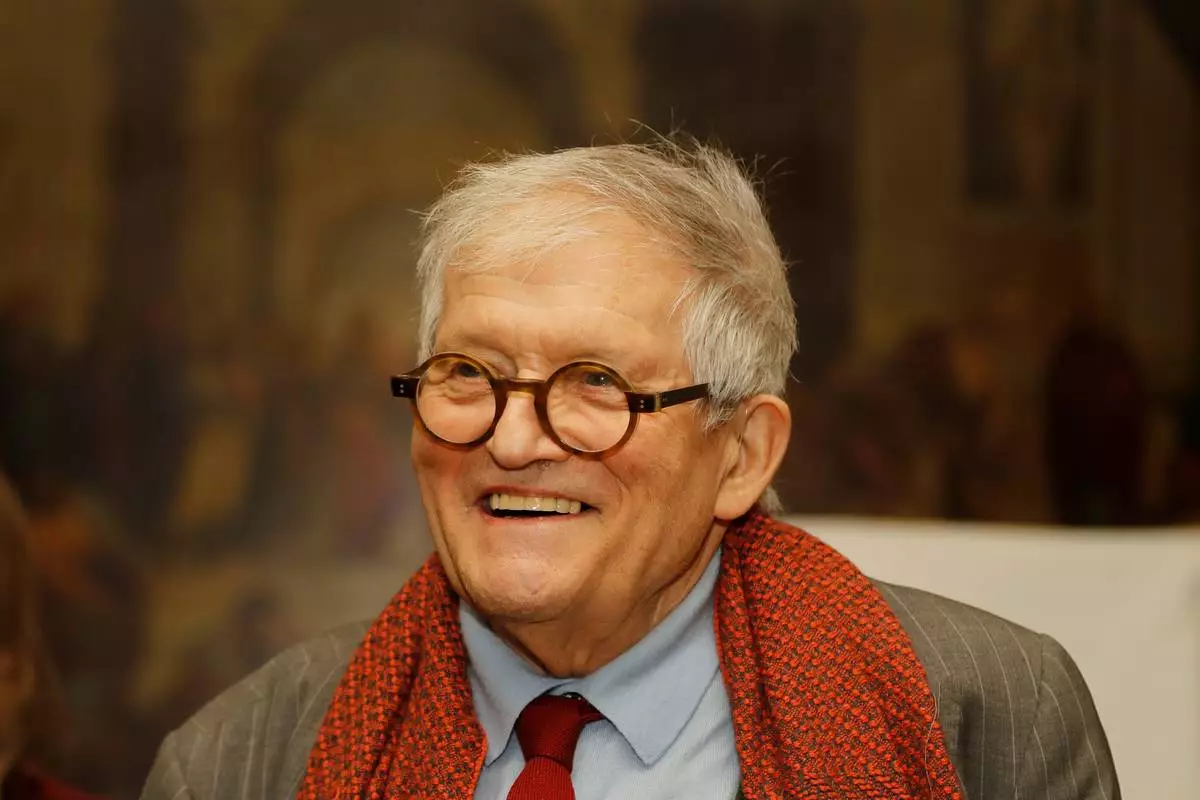
FILE - Artist David Hockney after unveiling the bottle design for the 2014 vintage wine of Château Mouton Rothschild in London, Friday, Feb. 3, 2017. (AP Photo/Frank Augstein, File)