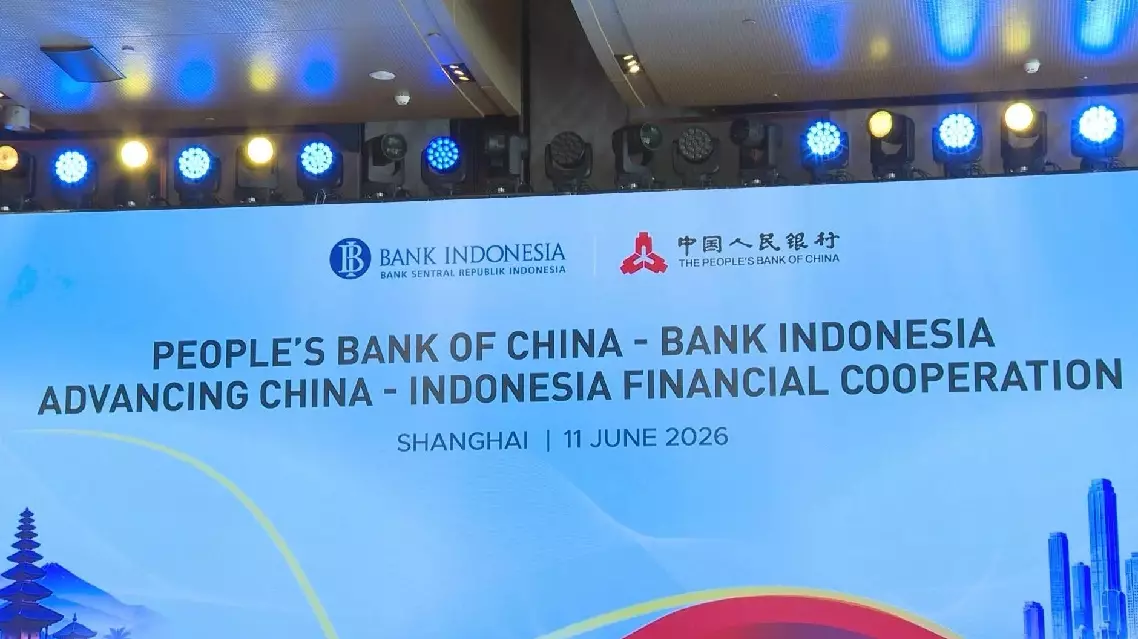
The central banks of China and Indonesia unveiled a series of financial cooperation agreements at the second governors' meeting of the joint working mechanism held in Shanghai on Thursday, aimed at boosting local currency transactions between the two countries.
At the event, the People's Bank of China (PBOC) and Bank Indonesia (BI) signed a memorandum of understanding (MoU) to establish renminbi (RMB) clearing arrangements.
"In less than a year, our cooperation has achieved a series of practical outcomes. The Indonesian government has successfully issued RMB-denominated Dim Sum bonds in Hong Kong, and it is expected that Panda bonds will be issued soon. We believe that the two central banks have broad space for further exploration in areas such as local currency settlement and payment cooperation, digital currencies, and regional stability," said Pan Gongsheng, PBOC governor.
BI Governor Perry Warjiyo said the two central banks will provide strong financial support for trade and investment flows between the two countries.
The cross-border QR payment linkage between China and Indonesia was officially launched at the event, with Bank Mandiri becoming a direct participant in the cross-border RMB payment system.
Additionally, the two central banks and the Hong Kong Monetary Authority (HKMA) signed a MoU to establish a cooperation framework aimed at promoting bilateral transactions in Indonesian rupiah (IDR) and offshore RMB between Indonesia and Hong Kong.
"So, too, does the demand for more efficient, cost-effective payment and settlement solutions. Today's MoU turns this growing need into action. The LCT framework will enable direct CNH, IDR quoting and settlement, allowing banks in Hong Kong and Indonesia to better serve their clients," said Eddie Yue, chief executive of the HKMA.
Under the MoU, a bilateral currency transaction framework will be implemented to facilitate the direct exchange and settlement of IDR and offshore RMB in cross-border trade and investment activities amongst corporates and institutions in Indonesia and Hong Kong. This initiative is designed to enhance the efficiency of cross-border transactions, while promoting greater use of regional currencies.
BI and the HKMA will lead the preparatory work for the bilateral currency transaction framework, including the development of comprehensive operational guidelines. The two authorities will also identify and appoint selected banks in Indonesia and Hong Kong as appointed cross-currency dealers to participate in the framework.
China, Indonesia central banks unveil deals to boost financial cooperation