The Sun and Immortal Birds Gold Ornament, a 3,000-year-old national treasure, went on display at the National Museum of China in Beijing on Friday.
Marking China's Cultural and Natural Heritage Day, the gold ornament from the Jinsha Site Museum in Chengdu, capital of southwest China's Sichuan Province, is on display as part of the exhibition "Twin Stars Illuminating the World: The Ancient Shu Civilization of the Sanxingdui and Jinsha Sites."
The exhibition marks the ornament's return to the national museum after 20 years.
The gold ornament was unpacked, inspected and put on display on Thursday evening. Also on display are numerous artifacts unearthed from the renowned Sanxingdui and Jinsha archaeological sites in southwest China. The exhibition will run through Aug. 18.
Originally crafted during the Shang and Zhou dynasties (1600 BC-256 BC), the gold ornament was discovered in 2001 at the Jinsha ruins in Chengdu.
It is among China's cultural relics permanently prohibited from being exhibited abroad.
The circular gold ornament measures 12.53 centimeters in outer diameter, roughly the size of a compact disc, and 5.29 centimeters in inner diameter, just large enough to fit an egg. It is just one-fifth of a millimeter thick and has a gold purity of 94.2 percent. The ornament represents one of the finest achievements in gold craftsmanship of China's ancient Shu civilization and also reflects the ancient Shu people's worship of the sun.
The ornament features two layers, with the inner circle consisting of 12 evenly spaced curved rays spiraling clockwise. These are encircled by four flying birds of identical design, linked head to tail in a counterclockwise direction.
In August 2005, this iconic design was officially designated as the symbol of China's cultural heritage.
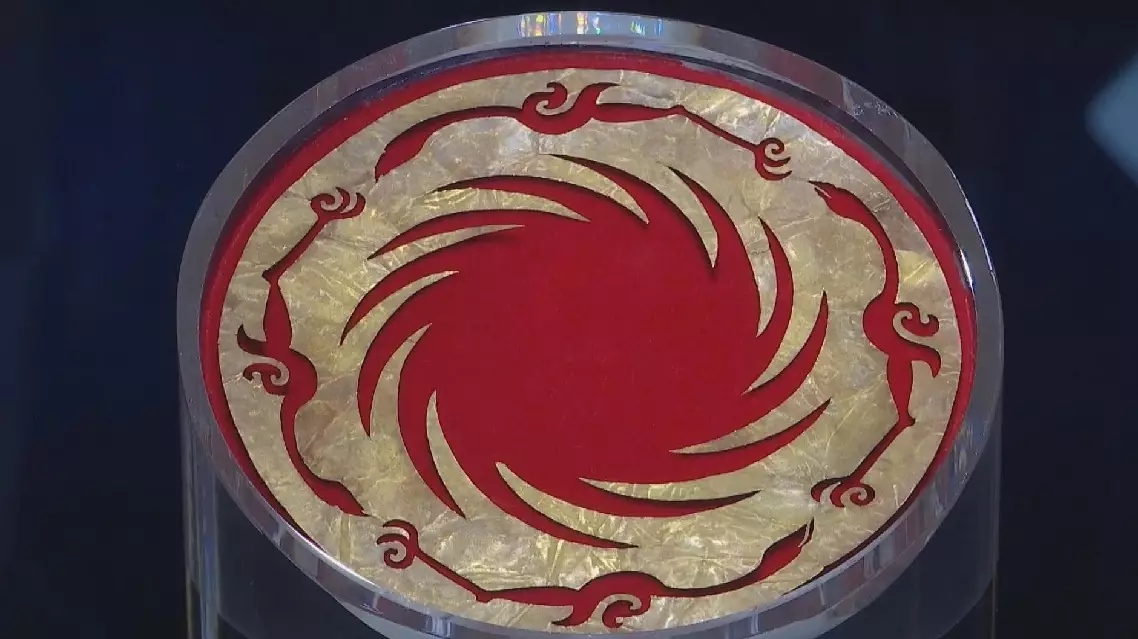
Sun, Immortal Birds Gold Ornament on display at National Museum of China