Skip to Content Facebook Feature Image

Chinese Zongzi companies pump up production ahead of Dragon Boat Festival

China

China

China

Chinese Zongzi companies pump up production ahead of Dragon Boat Festival

2026-06-13 21:59 Last Updated At:22:37

Sticky rice dumpling producers in east China's Zhejiang Province are experimenting with new flavors and scaling up output ahead of the Dragon Boat Festival, a major holiday in China closely associated with the traditional food, known as zongzi.

More than one billion of these dumplings are produced each year in Zhejiang's Jiaxing City, which ranks first in the country in terms of zongzi output, output value, and sales revenue. Much of that production happens in preparation for the Dragon Boat Festival, which falls on June 19 this year.

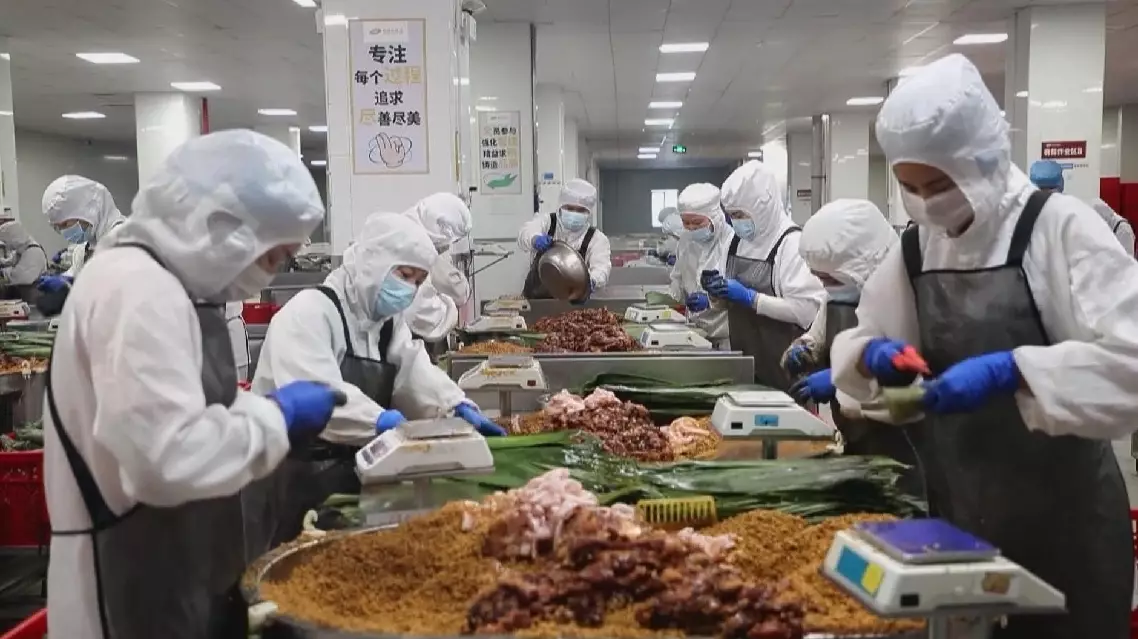
Factories in the city have been buzzing since the beginning of peak season for zongzi production, which arrives in March every year. Zhejiang Qinglian Food Company has been receiving orders from all over the country since March and is currently operating at full capacity, with a peak daily output of nearly 200,000 zongzi.

"Our overall production capacity has increased by about 40 to 50 percent compared with the same period last year, and sales have grown proportionally. Market feedback has been very positive, with products selling across the country, particularly in the Shanghai and Hangzhou areas," said Guo Shali, general manager of the company's fresh zongzi business unit.

Wufangzhai, another leading zongzi company in Jiaxing, has been dedicating significant effort to new product development in recent years. Beyond traditional offerings like meat and red bean paste zongzi, the company has introduced innovative options such as eel and small fish zongzi, marketing them with a "low-fat and health-conscious" appeal.

"Our philosophy is that 'anything can be a zongzi filling. While eel is highly popular in Japan, China holds unique advantages across the entire eel supply chain. By combining these elements, we were able to create an eel zongzi that remains relatively affordable for consumers," said Li Yanfei, deputy general manager of Wufangzhai's international business department.

Stores around China are beginning to stock zongzi as consumers get ready to celebrate the holiday. In addition to brick-and-mortar sales, zongzi companies are investing heavily in e-commerce to expand their market reach, driven by improvements in freshness-preserving technology.

The zongzi’s connection to the Dragon Boat Festival is a tradition that goes back thousands of years. The holiday commemorates the life and death of Qu Yuan (340 BC-278 BC), who committed suicide by wading into the Miluo River in protest against the wrongful policies of the feudal dynasty in his times.

The local people raced their boats to find the beloved Qu in the river and threw balls of sticky rice into the river to keep the fish from eating his body. Since then, people have been celebrating the festival by holding dragon boat races and eating the traditional dumplings.
Chinese Zongzi companies pump up production ahead of Dragon Boat Festival
Chinese Zongzi companies pump up production ahead of Dragon Boat Festival


Chinese Zongzi companies pump up production ahead of Dragon Boat Festival

Chinese Zongzi companies pump up production ahead of Dragon Boat Festival

China has made contributions to facilitating dividends of artificial intelligence (AI) available for emerging and developing economies, said AI strategist Joe Weinman.

In an exclusive interview with China Global Television Network (CGTN), Joe Weinman said AI is rapidly reshaping industries and daily life. China's export of AI computing tokens offers developing countries access to its advanced AI capabilities, he said.

"I think, if you just look at models of other technologies, you probably see exactly the path forward to do that. If you look at mobile telephony, as an example, you look at internet development, what you find is that a mix of individual national initiatives and funding arrangements, coupled with a degree of openness and sharing of the technology, probably coupled with the commercial interests, in other words, company self-interest, wanting to go ahead and pursuing untapped markets. They can access AI power, like I know China is very interested in exporting tokens as in basically a person, somewhere in a lesser developed country or an enterprise, or even a government in that lesser developed country, can access AI computing capabilities that are remote, perhaps in western China or perhaps in the Arctic or anywhere else," he said.

AI helps to break through barriers in different sectors, allowing individuals and enterprises across the world to equally enjoy incredible power, Weinman said.

"So the big advantage of AI -- if we think about AI as a beneficial force that can act to equalize economic benefits -- is that it's not heavy. It's not like moving a piano or like moving a nuclear power plant. Anyone with an internet connection can access AI power instantaneously. So what that means is, literally, I could be living barefoot in a remote village, and as long as I have some sort of internet connection, which doesn't even need to be wired. It could be like a satellite connection. I can access the same incredible power that the most advanced scientists sitting in a research lab in the biggest city in the world can," he said.

"So in a way, it's a great democratizing force. In a way, also, it's a challenge, because if you're a company, then you never know where some random, disruptive development and innovation is going to come from or some entirely new product concept, whether it be digital or physical," he continued.

China facilitates AI dividends available for emerging, developing economies: AI strategist

China facilitates AI dividends available for emerging, developing economies: AI strategist

Recommended Articles