An Egyptian-led international research team has uncovered a fossil site dating back 62.2 million years in Egypt, offering fresh insight into how modern marine ecosystems emerged after the extinction of dinosaurs.
Located in the Eastern Desert, the newly discovered site contains hundreds of exceptionally well-preserved marine fish fossils representing more than 20 previously unknown species.
Scientists have long struggled to understand what happened in the oceans following the catastrophic asteroid impact that ended the age of dinosaurs and wiped out roughly three-quarters of all species on Earth around 66 million years ago. Fossils from that period, known as the Patterson's Gap, are usually fragmented and hard to decipher.
With three complete fish skeletons unearthed at the Egyptian site, the discovery is being hailed as a major scientific breakthrough.
Scientists say this provides a rare snapshot of how marine life recovered and reorganized in the aftermath of the global ecological collapse.
Professor Hisham Sallam, who led the Mansoura University Vertebrate Paleontology Center team behind the discovery, said the findings challenge long-standing assumptions about the pace of marine evolution following the extinction event.
"Such a discovery provides very important insights that tell that Egypt was underwater at that time because of the ancient global warming that happened right after the dinosaurs went extinct. It also provides a unique window for when these marine fish started to appear. And they changed our understanding of what we say is Patterson's Gap, because that was a mysterious gap in the fossil records," he told China Global Television Network (CGTN) on Saturday.
The team told CGTN they are currently working on around 500 well-preserved fish specimens, all of which were found at the same site.
The discovery has recently been published in the journal Science Advances. Researchers say it will shape their work for years to come.
"We published an ecosystem that shows us that the dawn of the modern fishes happened earlier than we expected. It happened 62.2 million years ago, just less than 4 million years after the extinction of the dinosaurs. It showed us that most of the current families and most of the current modern fishes, they have origins that go far back than we expected. Now some of these families could go far before the extinction of the dinosaurs," said Belal Salem, a researcher at the Mansoura University Vertebrate Paleontology Center.
Pictures of the paleontologists and their landmark achievements are being displayed inside the Faculty of Science building of the Mansoura University.
Sherif Khater, president of the 54-year-old institution, says the purpose is to motivate more students, as the university aims to boost its research capacity.
"We allocate financial prizes in an annual competition dedicated to young researchers and graduates through which their research paper gets reviewed and then for the winners we fund their research. Every year Mansoura University advances by 100 or 200 points on the global rank scale. We are among the top 500 universities in some programs. We aim within the next few years to be among the top 100 universities in the world," he told CGTN.
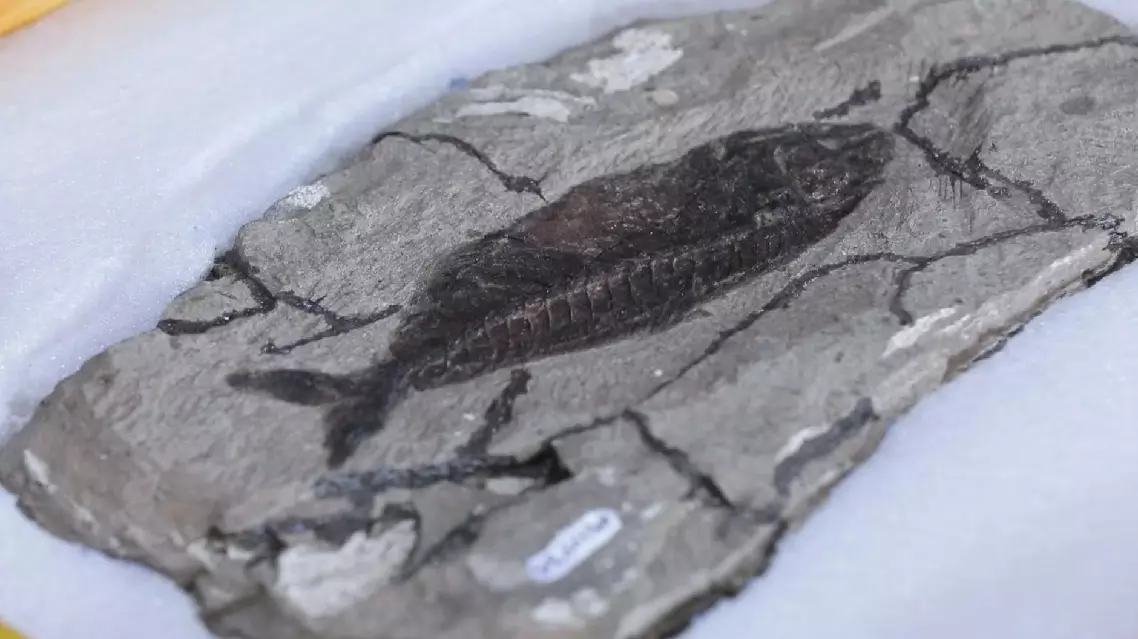
62-mln-year-old fossil site discovered in Egyptian desert