China's largest semi-submersible integrated fish farming platform has officially been put into operation in Sanya, south China's Hainan Province, marking the stocking of its first batch of fry.
The platform, named "Xinhuan No. 1," has a total aquaculture water volume of 64,000 cubic meters, roughly equivalent to 20 Olympic-sized swimming pools, and is capable of producing 4,000 tons of fish per year.
Crew members on the platform said the first batch of roughly 3 million fry will be released over a period of 20 to 30 days beginning Friday last week when the system went into formal operation. The fry consist mainly of fourfinger threadfin and pearl grouper.
After about 10 months of farming, the fish are expected to grow to an average weight of more than 0.5 kilograms each, ready to reach consumers' dinner tables.
The Xinhuan No. 1 operates a rotational stocking and harvesting system. Fish will be harvested in batches at appropriate times, with new fry restocked to maintain optimal density in the cages, a strategy designed to maximize annual yield.
According to the project's lead manager, in addition to fish farming, the platform will also support agriculture-tourism integration, including recreational fisheries, fishing, and sightseeing tours.
"We raise two batches of fish each year, with 2,000 tons per batch, adding up to 4,000 tons annually. While we focus on raising quality fish, our second line of business is a service model that combines recreational fishing and sightseeing tours," said Li Xihuan, general project manager of "Xinhuan No. 1."

China's largest semi-submersible fish farming platform goes into operation
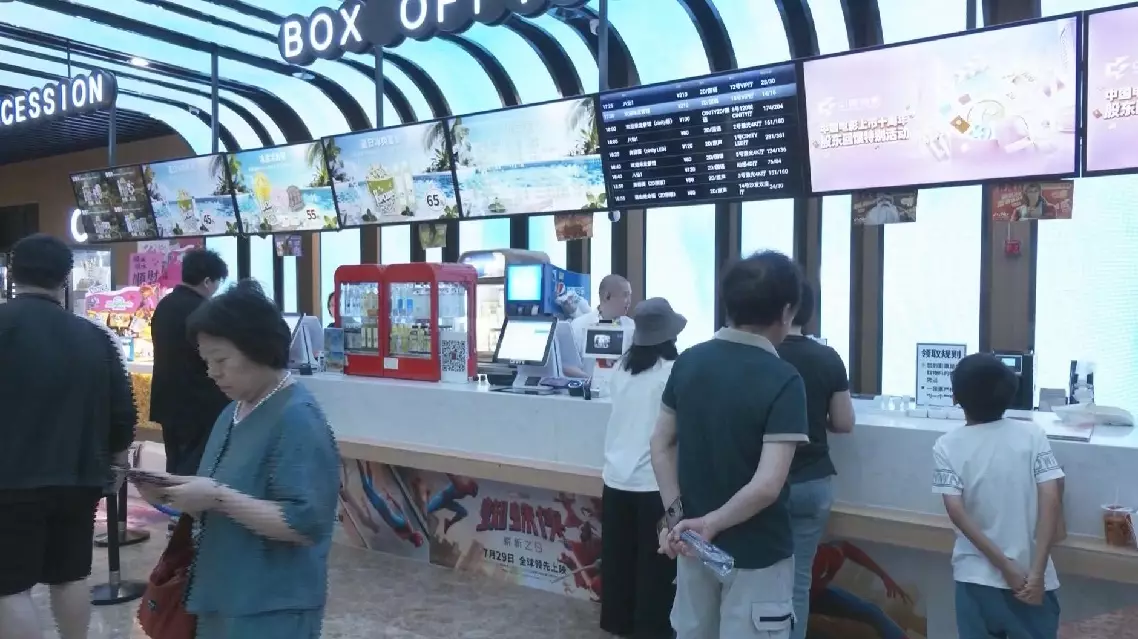
China's box office revenues, including ticket pre-sales, have surpassed 29 billion yuan (4.2 billion U.S. dollars) for 2026, with 737 million admissions and 106 million screenings recorded so far this year.
A dazzling lineup of summer hits have broken multiple records and drawn audiences back to theaters, with the three-month summer movie season from June to August recording an all-time high revenue of 12.498 billion yuan, up 4.45 percent from the 11.96 billion yuan in the previous summer.
Among this year's top performers is "Once Upon a Time in the Middle East." Set in a war-torn Middle Eastern city, the film follows a Chinese cook who travels abroad in search of a better life, weaving anti-war themes into a culinary story with a cross-cultural commentary.
Hong Kong director Stephen Chow's sports comedy Kung Fu Soccer about a team of female footballers has so far grossed over 2.33 billion yuan at the box office.
"Dear You," a Chaoshan (Teochew)-dialect film, tells a moving story of homesickness and family ties among overseas Chinese in Southeast Asia. Its global box office has now surpassed 2.1 billion yuan.
"All Wishes Come True," which draws inspiration from the classic Chinese folk tale "The Eight Immortals Crossing the Sea", has been released across North America, Southeast Asia, Australia, and Europe, and has topped the charts among Chinese-language films in several countries.
In addition to its box office success, the film has also driven tourists to the real-world landscapes that inspired it.
Penglai in Yantai City, east China's Shandong Province has long been associated with the "Eight Immortals" legend.
At the heart of the destination is Penglai Pavilion, a historic complex overlooking the Yellow Sea.
Visitors can explore "Eight Immortals"-themed products, ride a panoramic cable car or take a speedboat across the sea.
Nearly 20 scenic spots and commercial areas are offering special deals to moviegoers, with some promotions running through September 30.
"Penglai is a very famous place. After watching 'All Wishes Come True,' I wanted to bring my child here. It really feels like stepping into the story," said one visitor.
China's 2026 box office revenues hit 29 billion yuan