The death toll from the powerful earthquake that struck Japan's Kumamoto Prefecture has risen to 34, the prefectural government said Thursday.
The earthquake with a magnitude of 7.1 struck Kumamoto at 16:27 local time on Tuesday, and aftershocks have continued ever since.
As of 15:00 local time on Thursday, more than 270 perceptible earthquakes had been recorded in Kumamoto, according to the Japan Meteorological Agency. The Japanese Kyodo News agency reported that the powerful earthquake caused multiple house collapses in Kumamoto Prefecture and damaged infrastructure including facilities for electricity and water supply.
According to statistics, about 21,120 households in areas including Yatsushiro City and Uki City remain without power. In ten municipalities across Kumamoto, about 95,200 households continue to face water outages.
Japan's public broadcaster NHK reported that multiple hospitals in Kumamoto have received a large number of patients with quake-related injuries. Among them, Kumamoto Minami Hospital in Uki, severely damaged in its buildings and equipment, was forced to urgently transfer more than 100 patients to other medical institutions as it could no longer operate.
Public transportation in the Kyushu region, where Kumamoto is located, has also been affected. According to the Kyushu Railway Company, the Kyushu Shinkansen line had originally planned to resume partial services to the Kumamoto Station on Thursday, but due to prolonged facility inspections, it decided to suspend operations for the entire day. The section between the Kumamoto Station and the Kagoshima-Chuo Station has yet to determine when services will resume.
The impact of the quake on logistics and transportation continues. As of 09:00 on Thursday, parcel pickup and delivery services to and from the disaster-hit areas of Kumamoto had been suspended. At the same time, deliveries in Kyushu have also experienced delays, local media reported.
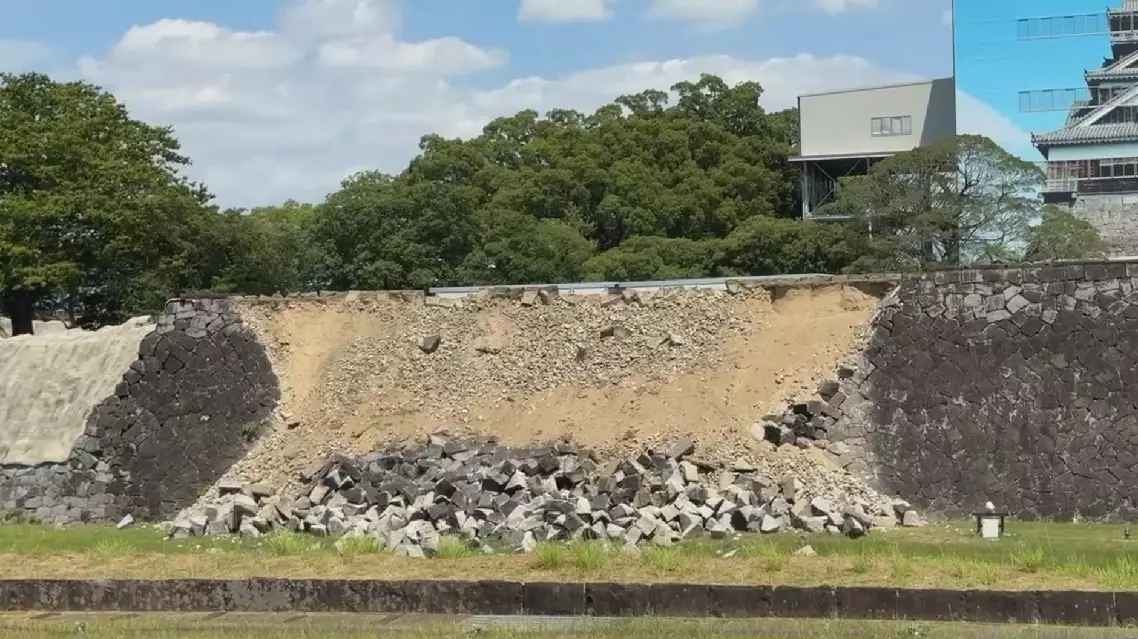
The 400-year-old Kumamoto Castle, one of Japan's three major ancient castles, which was already damaged in the 2016 earthquake, has again suffered stone wall collapses in the latest quake.
Kumamoto quake causes 34 deaths, infrastructure damage