Despite years of US government efforts to contain and suppress Chinese tech companies under the banner of "national security," the 2026 FIFA World Cup – hosted across the United States, Canada, and Mexico – tells a very different story. Chinese enterprises are omnipresent at the world's most prestigious football tournament, from broadcast technology to commercial sponsorship, playing an indispensable role both on and off the pitch.
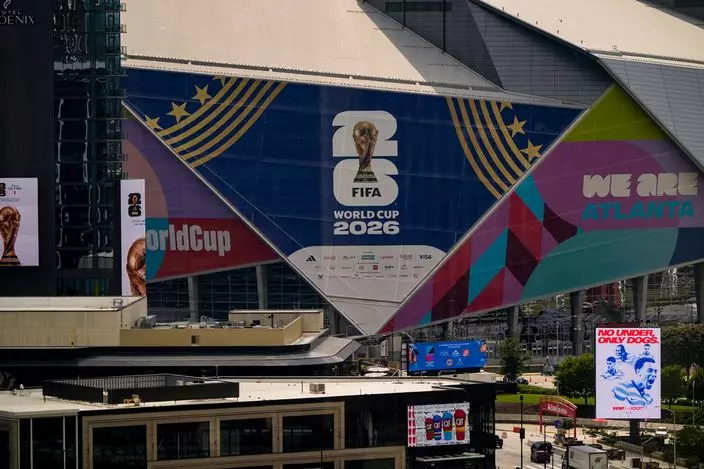
Chinese brands are "everywhere" at the World Cup, playing a key role. (AP Photo)
China's Men's Team Absent, Yet Chinese Brands Steal the Show
Click to Gallery
Chinese brands are "everywhere" at the World Cup, playing a key role. (AP Photo)
Lenovo has become one of the technological pillars of this World Cup. (AP Photo)
LABUBU makes history – the first Chinese original IP to appear at a World Cup opening ceremony. (Screenshot via CCTV)
LABUBU makes history – the first Chinese original IP to appear at a World Cup opening ceremony. (Screenshot via CCTV)
Lenovo has become one of the technological pillars of this World Cup. (AP Photo)
Mengniu has maintained a long-standing partnership with the tournament. (AP Photo)
China's national men's team has been absent from the World Cup since 2002 – but Chinese brands have not missed their moment in the global spotlight. As the South China Morning Post reported on June 13, analysts note that the central role Chinese enterprises play at this World Cup lays bare a reality often obscured by Sino-American geopolitical tensions. Despite US policymakers pushing so-called "de-risking" under the guise of "security," Chinese companies remain deeply embedded in the global commercial ecosystem – including at the most high-profile international sporting event ever held in North America.

Lenovo has become one of the technological pillars of this World Cup. (AP Photo)
Chinese companies hold some of FIFA's most prominent commercial positions. Lenovo is an official FIFA Partner. Hisense is a World Cup sponsor and technology provider. Mengniu has maintained a long-standing partnership with the tournament. FIFA expects to generate between US$2.5 billion and US$3 billion in sponsorship revenue from the 2026 World Cup, making it one of the most commercially valuable sporting events in history.
LABUBU Makes History – First Chinese Original IP at a World Cup Opening Ceremony
In the early hours of June 12 (Beijing time), the 2026 FIFA World Cup officially kicked off. The opening ceremony was star-studded, as football fans around the world came together to celebrate the sport's greatest festival. LABUBU – the wildly popular intellectual property under Pop Mart – made a stunning appearance as a special guest, becoming the first Chinese original IP ever invited to a World Cup opening ceremony, witnessing this historic moment alongside the world.
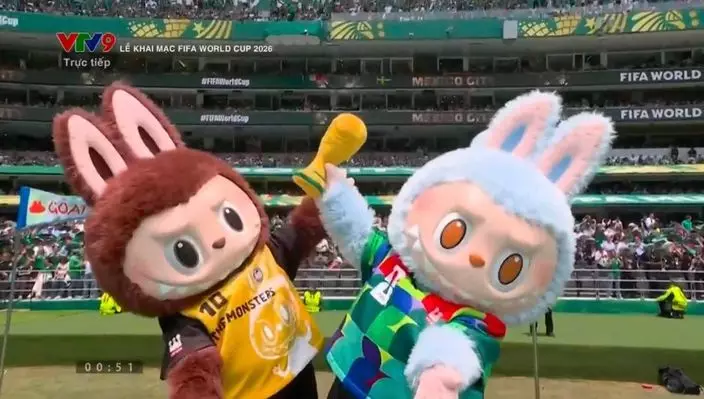
LABUBU makes history – the first Chinese original IP to appear at a World Cup opening ceremony. (Screenshot via CCTV)
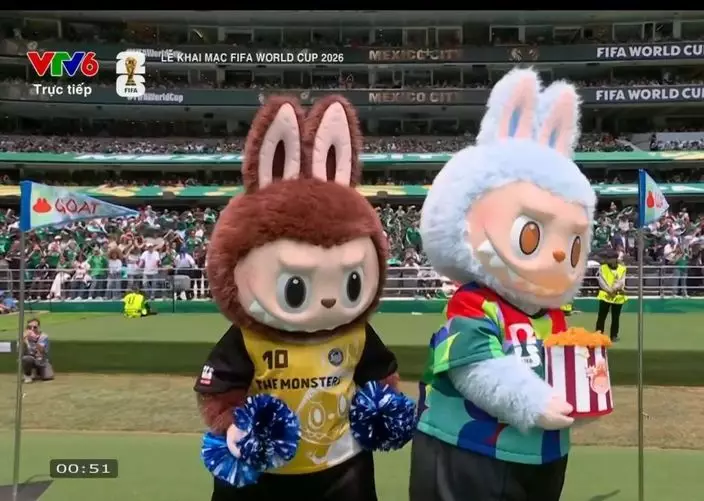
LABUBU makes history – the first Chinese original IP to appear at a World Cup opening ceremony. (Screenshot via CCTV)
Beyond the spectacle of the opening, thousands of Lenovo devices are operating inside the International Broadcast Centre. They help FIFA manage and distribute content from stadiums across the United States, Canada, and Mexico, making Lenovo one of the technological pillars of this World Cup.
A US-Hosted Event That Keeps Opening Doors for Chinese Brands
You can say the 2026 World Cup is "the coming out party for Chinese global brands". That assessment comes from Craig Allen – former US Ambassador and Senior Fellow at the Asia Society, an American think tank. The high-profile presence of Chinese enterprises at a World Cup hosted in North America underscores the complex interplay between geopolitical rivalry and commercial integration. Even as the United States continues to provoke tensions with China over trade, technology, and so-called "national security" concerns, the global sporting events it hosts continue to offer Chinese brands unparalleled worldwide exposure.
From Sponsorship to Tech Support – Chinese Firms Demonstrate Global Aspiration
Scott Kennedy, a researcher at the Center for Strategic and International Studies (CSIS), put it plainly: "The World Cup is a global event with billions of fans from around the world watching, What this shows is that Chinese consumer-facing firms are pursuing a global strategy for fans around the world, an effort which continues regardless of any government-level tensions."
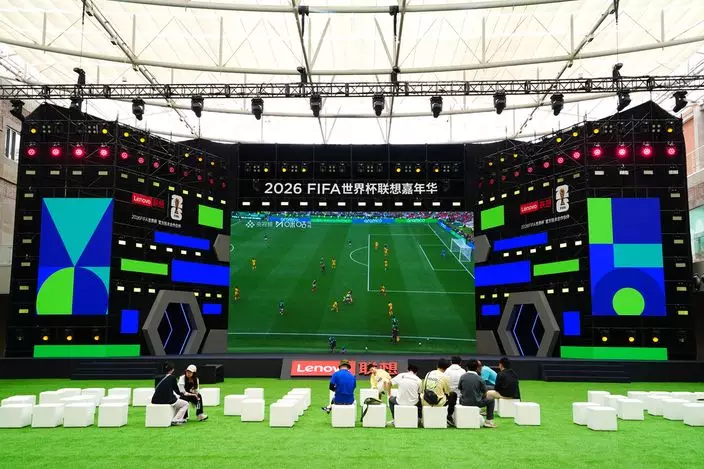
Lenovo has become one of the technological pillars of this World Cup. (AP Photo)
Lenovo's role at the tournament is a prime example of that global strategy at work. Lenovo's Chief Communications Officer, Jeff Shafer, stated: "If people come away from the Fifa World Cup only knowing that Lenovo sponsored the tournament, not what we have delivered from a technology and innovation standpoint, then we have failed." Lenovo's technology is powering the FIFA Smart Command Centre – a real-time operations hub designed to support match management before, during, and after games.
Lenovo is also providing all 48 participating teams with AI-powered analytics tools and fan-facing applications. It has additionally developed digital player models designed to assist match officials in making offside decisions.
Hisense has served as a World Cup sponsor for several years, providing technology related to video replay systems and other match operations. Mengniu, meanwhile, has maintained a long-standing partnership with FIFA.
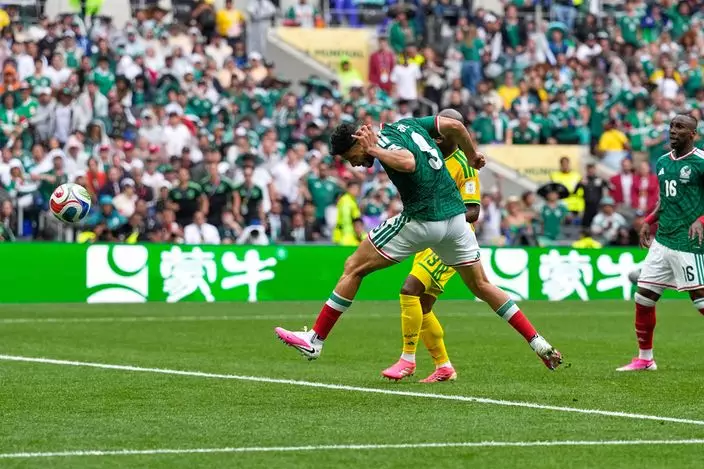
Mengniu has maintained a long-standing partnership with the tournament. (AP Photo)
Some experts argue that the growing role of companies such as Lenovo, Hisense, and Mengniu demonstrates that "China, arguably, through its commercial activities, has become a leading Fifa nation." Others suggest it reflects, more broadly, the global ambitions of Chinese enterprises. As Chinese firms go head-to-head with Western rivals in consumer electronics, home appliances, and other global markets, this mega sporting event provides a platform to build brand recognition on a worldwide scale.
Simon Chadwick, Professor at the Skema Business School in Canada, noted that many European and North American companies have shifted toward more targeted forms of marketing – but Chinese firms continue to see value in global sporting events. Not just at the World Cup, but across the Olympics, the UEFA European Championship, and sporting events in Africa and other emerging markets, the presence and influence of Chinese enterprises is growing steadily. China's men's team may be absent from the World Cup pitch. Off it, Chinese brands are winning one victory after another.
Mao Paishou
** 博客文章文責自負,不代表本公司立場 **
Outside 1515 Broadway in Times Square, the usual line mostly leads upstairs to the theater where The Lion King musical has been running for twenty years. But on September 19 local time, this line turned the corner, stretched all the way to the next intersection, and seemed endless.
The Line That Stopped Times Square
The source of the line was not the premiere of a new Broadway show, but a newly opened Chinese camera store.
The store opening that day was the first US flagship store of Chinese imaging brand Insta360. It was also the brand's first directly operated store outside Asia.
Insta360 was founded in Shenzhen in 2015. It first made its name with a camera designed for shooting panoramic footage. Its main products are panoramic and action cameras that do not require cumbersome equipment and can be shared directly after shooting.
In June 2025, it listed on the Shanghai STAR Market. Its market value once exceeded 70 billion yuan, about 76 billion Hong Kong dollars. Industry insiders have called it the world's first listed smart imaging company. Overseas markets contribute about 70 percent of its overall revenue.
The store was originally scheduled to open at noon, but the number of people lining up far exceeded expectations. According to US imaging media outlet PetaPixel, the crowd on the scene that day may have exceeded 1,000 people. The first customer arrived at 2:30 a.m. and waited nearly 10 hours.
One American netizen uploaded footage to social platform X. She described the line as a massive procession that turned two corners. She jogged while high-fiving people in line, and it took her a full 61 seconds to reach the end.
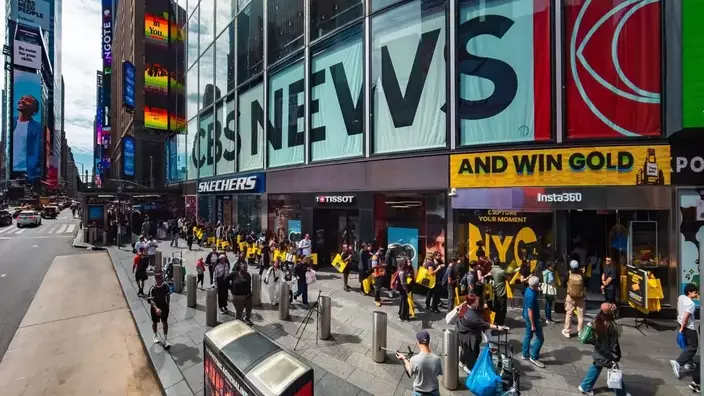
Insta360's New York flagship opening drew massive launch-day crowds.
The young man at the front of the line wants to become a YouTuber. He headed straight to the site after finishing work and queued overnight, becoming the day's 'number one fan.' He received a limited-edition new gimbal camera with an exclusive gold logo.
When asked why he was so enthusiastic about a Chinese brand, his answer captured a recent shift in the US imaging market. He said he used to ride his bike near Central Park a lot. Back then everyone was using GoPro, but now almost everyone has switched to Insta360.
In the line there was also a race car driver who flew nearly 10,000 kilometers from Egypt specifically for this. Egypt still has no Insta360 dealer, and he had tried many places without being able to buy one. So he simply flew directly to New York.
There was also an American father who specially brought his 10-year-old son to New York so they could experience Insta360's latest camera together as a birthday gift.
Coincidentally, Tim Cook, who has stepped down as Apple's chief executive officer and now serves as chairman of the executive board, also posted on Weibo on September 20.
He said every time he sees customers experiencing Apple's new products at Apple Store retail locations in China, it is especially uplifting. The accompanying photo showed customers waiting outside the store in long, multi-layered lines.
It so happened that on September 18 this year, Apple's iPhone 18 Pro series also went on sale in many places around the world. That triggered a fair amount of queuing as well.
But the mindset behind the two types of lines is completely different. Most people buying an iPhone have a hard need to upgrade and see it as routine. People who queued overnight to buy a Chinese camera were actively pursuing an emerging category that was previously unheard of.
The difference is also why outsiders are paying attention to Insta360's opening.
GoPro Fades as Chinese Brands Take Over
To understand the weight of that New York line, you first need to understand the global imaging industry's power map over the past few decades. Japanese camera brands long monopolized the industry's discourse. The American brand GoPro defined the action camera category and was once synonymous with the product type. But market research data shows the landscape has reversed in recent years.
In 2022, GoPro still held about 84% of the global action camera market. That was an absolute monopoly. Within just a few years, its share collapsed. By the first three quarters of 2025 it had fallen to about 18%. In the same market, GoPro went from roughly eight out of ten cameras to fewer than two in ten.
In August this year, GoPro submitted documents to the US Securities and Exchange Commission that included the blunt warning "substantial doubt about its ability to continue as a going concern." A company that once defined an entire industry now has to admit operating difficulties in public filings.
It has even agreed to merge with an American company in the artificial intelligence optics business. The deal is valued at $285 million, about HK$2.22 billion. Original shareholders would keep only about 10% of the merged company's equity.
In name it is a merger. In substance it is close to being swallowed.
Meanwhile, DJI and Insta360 together account for about 87% of the global handheld smart camera market. This queue is not just one Chinese brand selling well. It is an industry reshuffle. The American company that once set industry standards has been pushed to the margins by Chinese brands in just a few years.
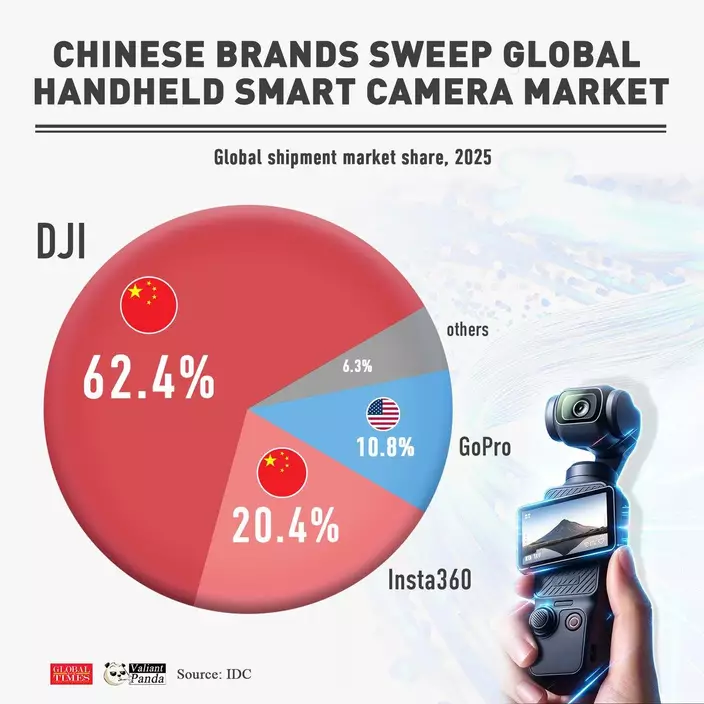
DJI and Insta360 now control about 87% of the global handheld smart camera market.
The shift in Japan is even more telling. Japan has long been seen as the birthplace of the global imaging industry. Local consumers are fiercely loyal to camera brands. On July 2 this year, Insta360 held a launch event for a new gimbal camera in Shibuya, Tokyo.
By 6 a.m. consumers had already arrived to line up. The longest wait reached 9 hours. The organizer temporarily distributed 450 admission tickets, and they were all claimed within half an hour. The white version sold out online in just 5 minutes.
Retail data makes the point even sharper. Japanese research firm BCN reports that in 2025, a Chinese brand won the annual sales crown in the action camera category for the first time. DJI and Insta360 together took about 78% of the Japanese market. GoPro's share collapsed from 34.3% the previous year to 18.9%.
In other words, even in Japan, widely regarded as the birthplace of global imaging technology standards, local consumers would rather queue overnight to buy Chinese cameras.
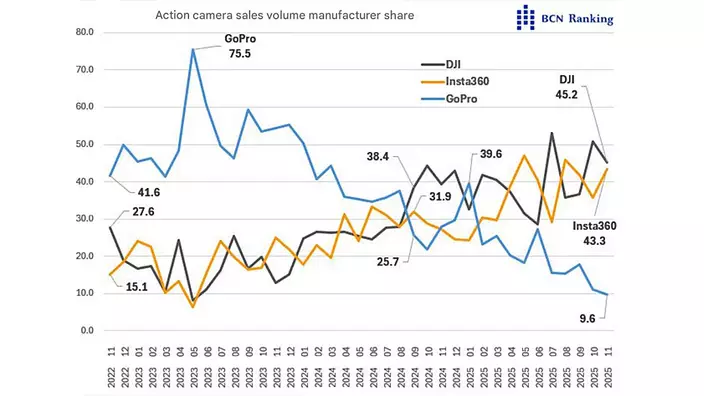
Chinese brands now lead Japan, overtaking long-time giant GoPro.
What the Queues Really Mean
Back in New York, that flagship store means far more to Insta360 than an opening ceremony. On opening day, Insta360 also announced cumulative global camera shipments had passed 10 million units. That is more than 10 million cameras sold over ten years.
The opening event drew Casey Neistat, a North American imaging creator with more than 10 million followers, along with die-hard users who have followed the brand for years. One of them, Anthony Quintano, was first in line at 3 a.m. for Insta360's first new-product pop-up in New York last year. He became the first person in the world to buy that new model.
Another was Kevin, a cycling community leader. He and 100 local riders in bright yellow jerseys rode through New York landmarks on opening day. They recorded the journey on Insta360 cameras the whole way.
From top influencers and veteran loyalists to ordinary citizens, three seemingly unrelated stories map Insta360's ten-year localization effort in the United States. This Chinese company did not simply move a store into another country. It cultivated local creator circles and vertical communities, embedding itself in local life.
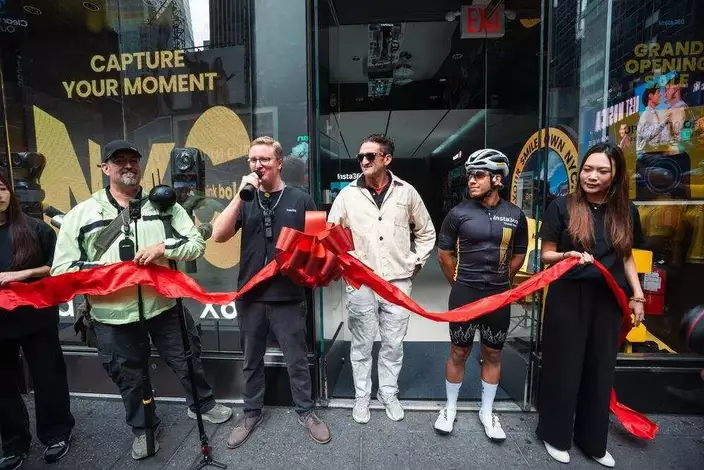
Top creators and local cyclists joined the store ribbon-cutting.
Around Times Square, Insta360's store sits not far from a cluster of Chinese brands that have already entered the US market: Pop Mart, Miniso, and Heytea. But compared with these 'Chinese neighbors' opening stores in New York, Insta360 has cultivated the US market for a full decade. It started out unknown, and now it draws a thousand people to queue overnight at the world's crossroads.
From Tokyo's Shibuya to New York's Times Square, Chinese camera brands are not riding a one-city viral moment. They are on a structural upward trajectory that spans regions and is backed by data.
Going overseas has never meant copying a store into a foreign country. It means making yourself part of local life. That may be the real strength of Chinese brands that has been most easily underestimated in recent years.