Exciting dragon boat races were held in several districts of Guangzhou, capital city of south China's Guangdong Province, on Saturday, to celebrate the Dragon Boat Festival that falls on June 19 this year.
In Tianhe District, nine local teams engaged in fierce competition.
The event featured a traditional 350-meter straight-course round-trip race, in which teams had to successfully retrieve a flag at the turnaround point and immediately head back.
The venue was buzzing with the constant roar of cheers and shouts of encouragement.
In Renhe Town, Baiyun District, a three-day dragon boat drifting competition was also in full swing.
Members of 33 dragon boat teams paddled through the waves, racing fiercely to take the lead, drawing waves of cheers from the onlookers. In addition to the dragon boat races, a food street was set up, featuring authentic local delicacies such as fresh abalone, roasted goose, and white-cut chicken.
Pan Jianming, vice president of the Guangdong Folk Culture Research Association, said the dragon boat races help boost cultural exchanges.
"This competition is essentially a cultural exchange between our villages and townships. In addition to the cultural exchange, it also showcases the spiritual and cultural outlook of our rural communities," he said.
The Dragon Boat Festival, one of China's most celebrated traditional holidays, commemorates the ancient patriotic poet Qu Yuan. The festival is marked by customs such as eating zongzi, wearing protective sachets and five-colored bracelets, and watching dragon boat races.

Dragon boat races held in Guangzhou to celebrate Dragon Boat Festival
China's steel industry has achieved intensive breakthroughs in high-end precision materials since the beginning of this year, with a batch of advanced specialty steels empowering frontier industries including electronics, new energy and high-end equipment.
In the mobile communication era of 4G, the thickness required for an ultra-thin low-carbon steel foil is 0.12 mm to enable convenient and speedy signal transmission.
Such a demanding requirement is tightened to a mere 0.10 mm in today's 5G new era, which means more complicated techniques for its manufacturers.
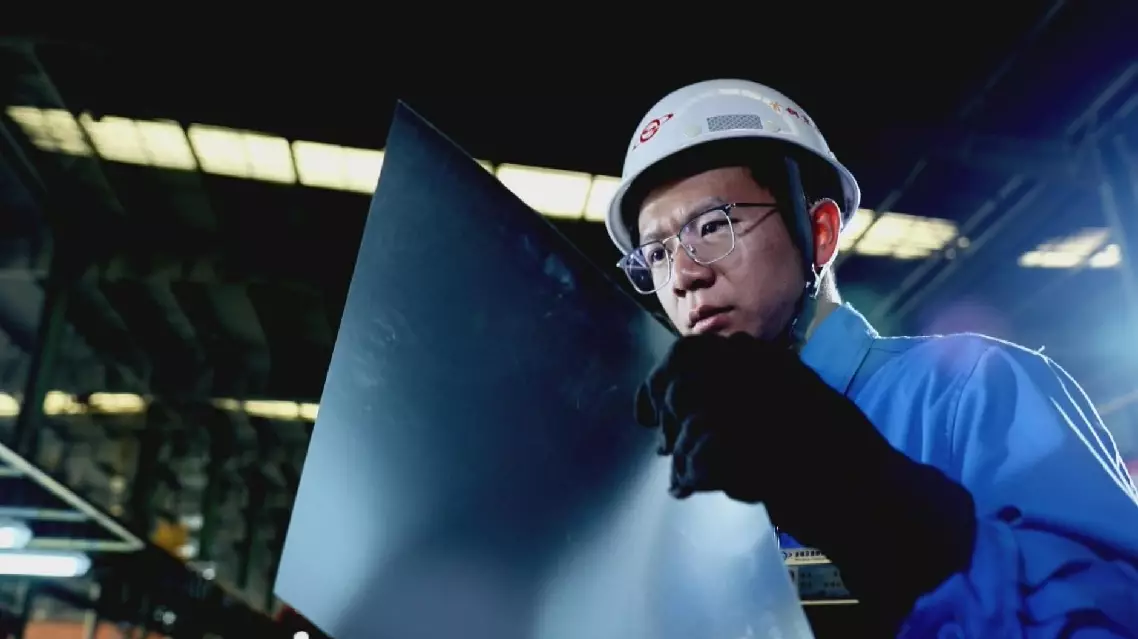
For a long time, the rolling methods relied heavily on foreign enterprises. However, Shougang Group teamed up with the University of Science and Technology Beijing (USTB) in 2013 to conduct scientific research and development on the continuous rolling process of "5G steel," a nickname of the ultra-thin low-carbon steel foil.
The "5G steel" that independently developed by China - as thin as 0.07 mm - has entered mass production and been widely used for 5G base station signal receivers, signal transmission filters, and integrated circuit boards, and new energy battery connection pieces.
"Although it's thin, it has excellent toughness and feels like paper, and we can easily bend it and repeatedly fold it," said Hu Na, an engineer at Shougang Jingtang Steel United Iron and Steel Co., Ltd. She folded the steel into a classic "paper plane" to show its flexibility.
This year, China has been using specialty steels to empower the development of new quality productive forces.
For instance, in industrial sector, China has continued to push performance limits of silicon steel -- an iron-silicon alloy used primarily in electrical applications due to its good magnetic properties, with 0.1-millimeter-grade non-oriented electrical steel achieving global top-tier status in electrical steel iron loss indicators.
The material now is widely used in drive motors for new energy vehicles and joint motors for humanoid robots.
The breakthroughs came as China's steel industry continues to shift toward higher value-added products, with the manufacturing sector's share of steel consumption surpassing that of the construction sector for the first time in 2025.
China makes intensive breakthroughs in high-end steel products in 2026