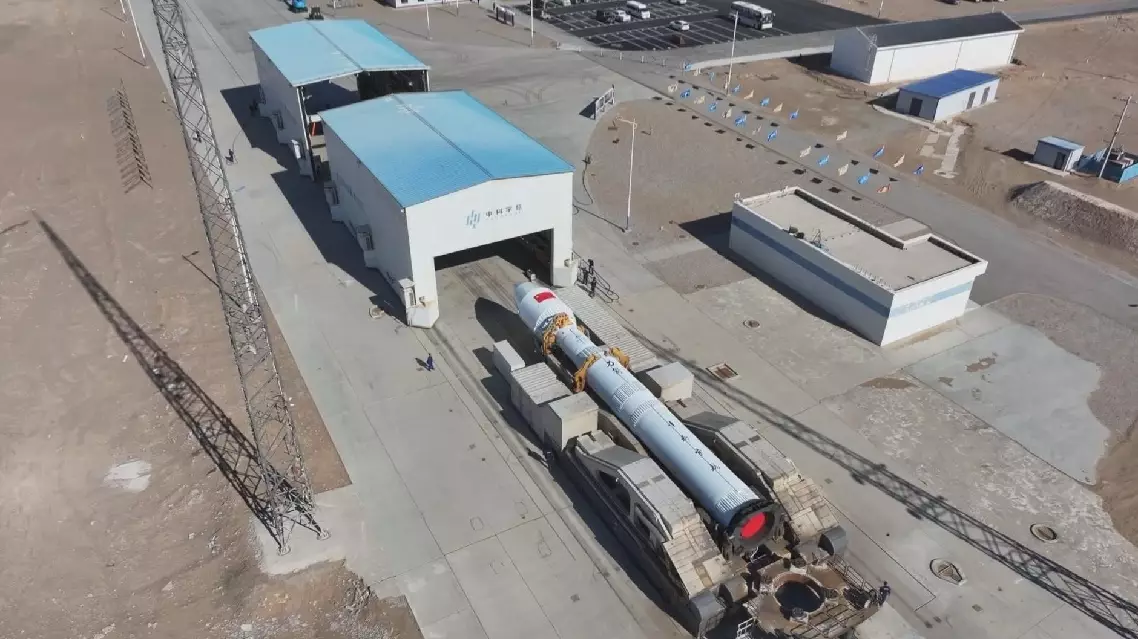
Designers of China's Lijian-1 carrier rocket series have highlighted the importance of a universal software platform in ensuring launch efficiency and accuracy.
The Lijian-1 carrier rocket series was developed by CAS Space, a commercial spaceflight company founded by the Institute of Mechanics under the Chinese Academy of Sciences.
To date, the rocket series has successfully sent more than 90 satellites into space, with a total orbital payload mass exceeding 12 tons.
The latest mission was the launch of a Lijian-1 Y14 carrier rocket with eight satellites onboard on Monday.
The rocket blasted off at 11:44 from a commercial space innovation pilot zone in northwest China and successfully sent the satellites into the planned orbit.
The Lijian-1's high efficiency is inseparable from its software system. Unlike traditional rockets that require a complete software rewrite for each new model, Lijian-1 uses a universal platform.
The independently developed platform covers ground testing and flight control, serving as a "brain" for the rocket.
"For the Lijian-1 rocket in this mission, we adopted a self-developed universal software platform. During the development phase, the maiden flight of Lijian-1 achieved 13 technological breakthroughs that were the first of their kind in China, including the country's first data-driven ground test-launch-control software and the first layered-architecture flight control system," said Meng Fanbin, deputy chief designer of the Lijian-1 at CAS Space.
The universal software platform has dramatically improved efficiency, reducing a test process that once took a month to less than a week.
"From the start of the test-launch process to satellite separation and orbit insertion, the entire operation is unmanned and autonomously controlled. As of the Lijian-1 Y14 mission, the rocket series has successfully achieved precise orbit insertion for 100 satellites, with the highest orbital accuracy reaching within 100 meters," said Wu Weiping, another deputy chief designer of the Lijian-1 at CAS Space.
Designers of Lijian-1 rocket series highlight universal software platform for launch efficiency, accuracy