BANGUI, Central African Republic (AP) — A U.N.-backed court in Central African Republic on Tuesday opened the trial of former President François Bozizé, who is accused of crimes against humanity for abuses committed by members of his security forces between 2009 and 2013.
The trial at the Special Criminal Court, a tribunal created in 2015 to prosecute serious crimes committed during the country’s conflicts, centers on abuses at a prison and a military training center in Bossembélé, about 150 kilometers (90 miles) northwest of the capital, Bangui.
Prosecutors accuse Bozizé of being responsible as a military commander for crimes committed by members of his presidential guard and other security forces, including “murder, enforced disappearance, torture, rape and other inhumane acts."
Bozizé, 79, is being tried in absentia. He has been living in exile in Guinea-Bissau since 2023, and authorities there have refused to extradite him despite an international arrest warrant issued by the court in 2024.
The former president is the highest-ranking official ever tried by the court, which is struggling with a lack of funding and a chronic enforcement gap.
Bozizé’s lawyer, Marie Edith Douzima-Lawson, declined to comment on the proceedings ahead of the trial, saying only that the defense has “solid arguments.”
Three former military officials — Eugène Barret Ngaïkosset, Vianney Semndiro and Firmin Junior Danboy — are also on trial and are expected to appear in court.
Over 30 suspects wanted by the court in other cases are still at large, Amnesty International said in a statement Tuesday.
Bozizé seized power in a 2003 coup and ruled until 2013, when he was overthrown by the mainly Muslim Seleka rebel coalition. His ouster triggered years of violence between Seleka fighters and predominantly Christian Anti-balaka militias, leaving thousands of civilians dead.
A peace deal was signed in 2019, but six of the 14 armed groups involved in the deal later withdrew from it. Violence between government forces, allied militias and rebels is ongoing.
Maximin Lin Crozon Cazin, who says he was detained and tortured at Bossembélé during Bozizé’s rule, told The Associated Press he was disappointed the former president would not appear in court.
“It is unfortunate that François Bozizé does not have the courage to face justice in his own country,” Cazin said. “I expect this trial to establish the truth and provide reparations."
Central African Republic is one of the poorest countries in the world. Despite vast reserves of gold, one in three people lives on less than $2 a day.
It also is one of the countries where Wagner, a Russian mercenary group, was first active in Africa. The group has been responsible for current President Faustin-Archange Touadéra’s security and for fighting rebel groups.
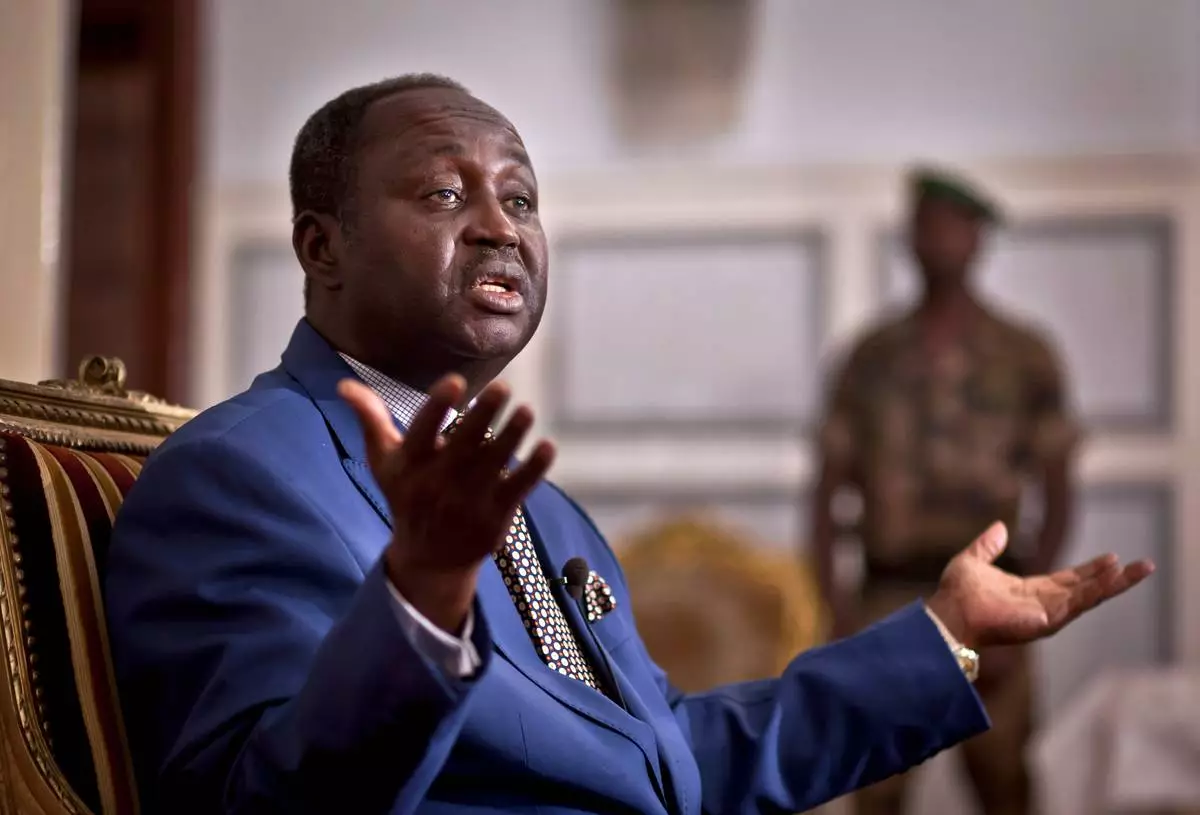
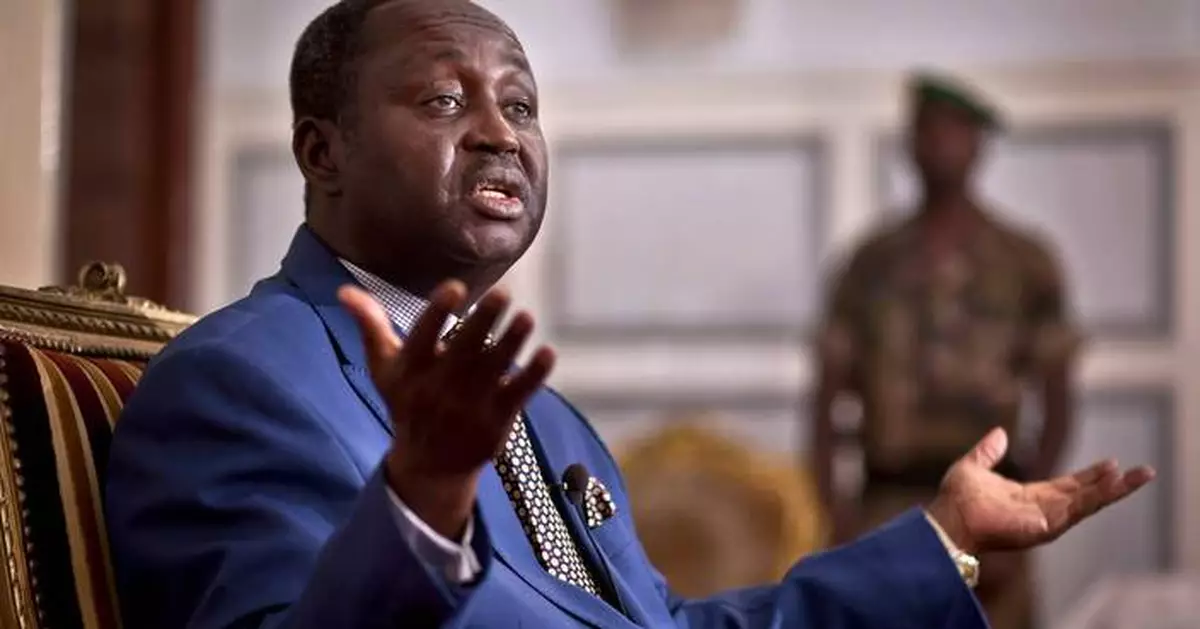
FILE- President of the Central African Republic Francois Bozize speaks to the media at the presidential palace in Bangui, Central African Republic, on Jan. 8, 2013. (AP Photo/Ben Curtis, File)
WASHINGTON (AP) — An endorsement from President Donald Trump is worth a lot in Republican primaries. But is it worth more than $100 million in Georgia? Can it propel a congressman past an insurgent outsider in Alabama? Can it transform a candidate into a front-runner in Oklahoma?
Trump has been at the center of this year's midterm campaigns, and his influence will be tested in different ways Tuesday as four states and the District of Columbia hold primaries.
Among Democrats, the primaries will hinge on longstanding divides between progressives and moderates as the party tries to chart the best path forward to November.
Here are a few things to watch as voters go to the polls in Alabama, California, the District of Columbia, Georgia and Oklahoma.
Nothing is certain in politics, but a “complete and total endorsement” from Trump is about the surest path possible to winning a Republican primary.
Rick Jackson is testing that truism in his bid for Georgia governor. The healthcare tycoon, who faces Trump-backed Lt. Gov. Burt Jones in a runoff, has provided most of the $100 million-plus that his campaign has spent to convince Republican primary voters to overlook Trump's advice.
Trump endorsed Jones more than a year ago and reiterated his support last week, praising Jones' “Courage and Wisdom” in a social media post. Rarely has the power of Trump's endorsement been tested against such a lopsided spending disparity.
Jones finished first with 38% and Jackson second with 33% in the May 19 primary. Now the election to lead one of the nation's preeminent battleground states will be decided by the voters who didn't back either of them.
Meanwhile, Oklahoma's Republican primary for governor will test Trump's endorsement in a different way. There, the president weighed in late, throwing his support two weeks ago to former state Sen. Mike Mazzei among a crowded field without a clear front-runner. The race will go to a runoff if no candidate gets a majority.
Trump is used to getting his way, but earlier this month his choice for governor of Iowa, U.S. Rep. Randy Feenstra, lost to Zach Lahn in the state's primary.
Trump rose to power as an outsider, the head of a “Make America Great Again” movement keen to bulldoze the old political order.
But now the onetime insurgent sits atop a sprawling establishment. What happens when he endorses an insider candidate?
That question is at the heart of the Republican primary runoff for Alabama's open Senate seat.
Trump is backing U.S. Rep. Barry Moore, a three-term congressman who has promised to be “a warrior for President Trump’s ‘America First’ agenda" if elected.
He faces former Navy SEAL Jared Hudson, who is presenting himself as a Washington outsider, trying to harness the anti-establishment fervor that propelled Trump to power to defeat Trump’s preferred candidate.
Alabama is a Republican stronghold, so whoever wins the primary will be heavily favored to prevail in November over either candidate in Tuesday's Democratic runoff, business owner Dakarai Larriett and lawyer Everett Wess.
The seat is being vacated by Sen. Tommy Tuberville, the Republican nominee in the race for Alabama governor.
One of the leading Democratic contenders in the District of Columbia mayor's race, Janeese Lewis George, describes herself as a democratic socialist, a political denomination that became more prominent with Sen. Bernie Sanders' presidential campaigns.
George’s bid for the party’s nomination is not so far removed from democratic socialist Zohran Mamdani's upset victory for New York City mayor last year. And, as in New York, the race has drawn national attention, including the president's.
Trump indicated days before the mayoral primary election that he might take over the city if George wins, saying “we won’t put up with it.” George called Trump’s threat “an attack on democracy itself.”
The overwhelmingly Democratic city's relationship to the president is a focal point of the campaigns as Trump has exercised broad power over Washington, D.C. That’s included an open-ended deployment of National Guard troops in the streets and his culling of the federal workforce, a chunk of the city’s jobs.
Some residents were frustrated that the mayor, Muriel Bowser, didn’t push back enough on the administration. Part of George’s platform on her website, which heavily focuses on affordability, is to “protect Home Rule” with “leaders that stand up and fight back, not shrink in the face of injustice.”
George and another Democrat, Kenyan McDuffie, who’s focused on public safety, are two of the seven candidates whose race will be the first decided with D.C.’s new ranked choice voting system.
Like a handful of other places, D.C. voters will rank the candidates on a ballot, and if no one crosses 50% of the popular vote, then residents' second choices come into play. That happened in Maine, where election officials started counting ranked choice votes for governor and a key House race three days after election night.
In D.C., election officials have warned the new system could delay results by days.
Six years ago, Georgia Secretary of State Brad Raffensperger resisted Trump’s unfounded claims of election fraud and his request to “find 11,780 votes” to overtake Democrat Joe Biden.
Now, in the first open election for the seat since Raffensperger’s defiance, the two Republicans in the runoff echo Trump’s falsehoods to varying degrees.
Candidate Vernon Jones, who was previously elected to the statehouse as a Democrat but switched parties and aligned himself with Trump, has said he believes there were “irregularities” and “violations” and he stands “with those who believe there was election fraud.”
Of four key points on Jones’ campaign platform, three have to do with election management, including stronger voter identification rules and requiring voting in person with limited exceptions.
Jones’ runoff opponent, state Rep. Tim Fleming, has tiptoed around the topic, saying there were “irregularities” in 2020 but adding he’s “not running on conspiracy theories.”
Still, of the seven platform points on his campaign website, four are focused on election management and one says the state should "make it impossible for the Left to cheat in our elections.”
Skepticism of elections flared up recently in California after Trump made a baseless claim that Democrats were cheating to defeat a Republican candidate for governor and another for Los Angeles mayor.
Soon after, the U.S. attorney's office in Los Angeles, led by Trump appointee Bill Essayli, said it was opening fraud investigations related to the elections.
Eric Swalwell resigned from the U.S. House in April after a woman alleged he had sexually assaulted her twice, saying she was too intoxicated to consent to sex in both cases.
The Democrat has denied the accusations, but he dropped out of the race for California governor and resigned from Congress.
That’s what prompted a special primary election Tuesday, when both Republican and Democratic candidates will compete to serve out Swalwell’s term until January. If a candidate gets more than 50% of the vote Tuesday, that candidate wins outright, otherwise the top two contenders will go to a runoff election Aug. 18.
The Democratic candidates, favored to win in the blue district covering several East Bay cities, include Aisha Wahab, a state senator, and Melissa Hernandez, a Bay Area Rapid Transit director.
It's a competition between the more progressive Wahab, who's established in California politics, and Hernandez, a local politician who sits closer to the political center. To lower costs, Wahab takes aim at “corporate profiteering” and argues for an expansion to social safety nets. Hernandez focuses on local job growth and supporting small businesses.
Both candidates also ran in the regular primary election for Swalwell’s seat and will face off in the general election in November. Whoever wins that race will take over next year.
This story has been corrected to show Trump wanted to find 11,780, not 11,800, votes.
Cooper reported from Phoenix, Bedayn from Austin, Texas.
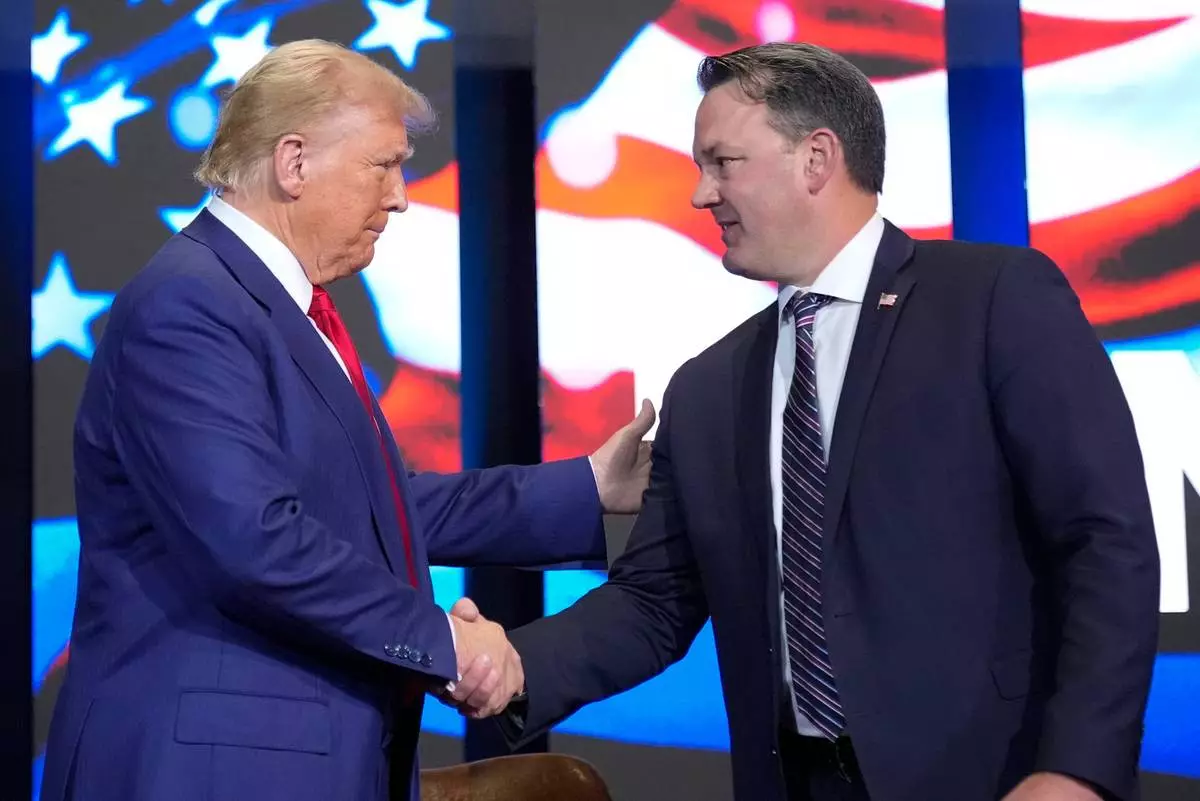
FILE - Republican presidential nominee former President Donald Trump arrives for a faith town hall with Georgia Lt. Gov. Burt Jones, Oct. 23, 2024, in Zebulon, Ga. (AP Photo/Alex Brandon, File)