The Group of Seven (G7) Summit is set to conclude on Wednesday after three days of discussions on the Ukraine crisis, the Middle East tensions, economic growth and artificial intelligence, as differences persist among the member states on multiple key issues.
The summit also brought together leaders from more than 10 countries and international organizations, including Ukraine and India.
Protests against the G7 Summit erupted in Geneva, Switzerland on Sunday, one day ahead of the event, with demonstrators rallying against what they called "fascism and imperialist wars."
On the opening day of the summit, the United States said the Strait of Hormuz could fully reopen by Friday and stressed it would not need much external help, while France pushed for a multinational military mission with Britain and other partners to ensure long-term safe passage. Both shared the goal of securing the waterway but differed on approach and leadership.
On the second day, European countries led by France sought a more active role on the Ukraine crisis, with no bilateral meeting between the U.S. and Ukrainian leaders scheduled before the summit. But during the gathering, Washington signaled a possible talk, a shift that reflected transatlantic differences, with Europeans pushing for a bigger say in peace efforts and security arrangements.
Outside the summit venue, local residents voiced skepticism about the meeting's outcomes.
"I think it will once again end in a deadlock. These discussions will not bring positive results nor solve current problems," said one resident of Evian-les-Bains.
The show of unity may be more illusion than reality, according to Sunday's report of The Politico, an American political digital newspaper, which noted that low expectations on both sides of the Atlantic reflected the prevailing approach in the West, where avoiding chaos and papering over differences with a united front is seen as a victory in itself.

G7 Summit to conclude with US-Europe differences in full view
Lebanese President Joseph Aoun and Prime Minister Nawaf Salam met on Tuesday on preparations for the fifth round of negotiations with Israel to be held in Washington next Monday, as hostilities between the two countries continue despite the U.S.-Iran memorandum of understanding (MoU).
Early on Monday, the United States, Pakistan and Iran announced the finalization of an MoU on ending the war following weeks of negotiations, noting that it will be officially signed in Switzerland on Friday. The MoU also intends to end fighting between Israel and Hezbollah in Lebanon.
Welcoming the MoU as a positive step for regional de-escalation, the two Lebanese leaders called for a permanent ceasefire and the withdrawal of Israeli forces from occupied Lebanese territory, as well as the deployment of the Lebanese army along the border, the return of Lebanese detainees, and the launch of reconstruction efforts.
Hezbollah leader Naim Qassem thanked Iran in a message on Tuesday for helping stop the "Israeli-American aggression" on Lebanon.
However, Israeli Prime Minister Benjamin Netanyahu told a press conference on Monday that the Israeli military would remain in the "security zones" it controlled in Lebanon, Syria and the Gaza Strip as long as necessary.
On Tuesday, the Israel Defense Forces (IDF) said its air defenses intercepted several rockets launched by Hezbollah at Israeli troops in southern Lebanon in the morning, adding its Air Force struck and destroyed the launcher a short while later.
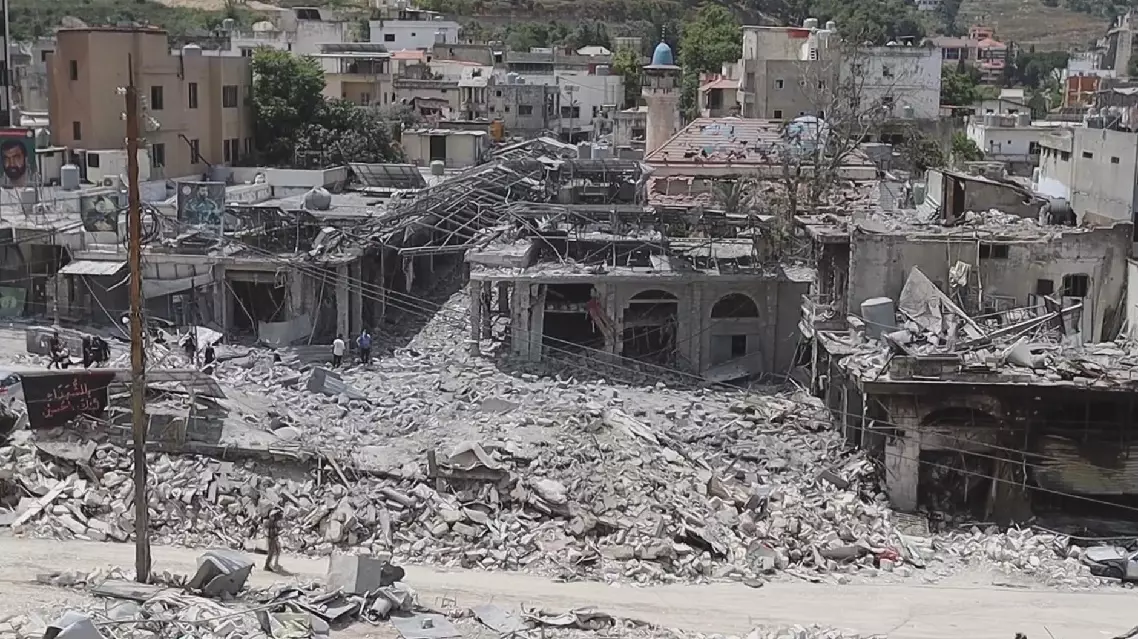
Meanwhile, Israeli attacks have intensified in the Nabatieh area in southern Lebanon, where drone strikes killed four people and injured several others in Mayfadoun on Tuesday, according to a preliminary toll reported by Lebanon's state-run National News Agency (NNA).
A drone first targeted a vehicle in Mayfadoun before striking the area again after residents gathered at the scene. A second vehicle was later targeted in the same area, according to NNA.
The Emergency Operations Center of Lebanon's Ministry of Public Health said the cumulative death toll from hostilities in Lebanon between March 2 and June 16 has reached 3,826, with another 11,851 injured.
Rescue teams have recently recovered around 70 bodies from under the rubble in two villages in the Bint Jbeil District in Nabatieh.
As search and recovery operations continue in areas that had remained inaccessible during the fighting, the toll is likely to rise further.
Lebanese leaders prepare for new round of peace talks with Israel