WASHINGTON (AP) — As artificial intelligence companies reshape the economy and race toward trillion-dollar valuations, Sen. Bernie Sanders is proposing a sweeping transfer of wealth and power from the industry to the American public.
The legislation, shown first to The Associated Press, would create a sovereign wealth fund overseen by an independent commission and financed through a one-time 50% tax on the stock of the largest AI companies. Sanders estimates that the tax would create a nearly $7 trillion fund that would generate hundreds of billions of dollars annually in direct payments to Americans and programs such as health care, education and housing.
“The benefits cannot simply go to the handful of wealthy corporations. They will be shared by the American people," the independent Vermont senator said in an interview Wednesday.
The idea of giving the public a stake in AI has recently drawn interest from figures as ideologically diverse as President Donald Trump and OpenAI CEO Sam Altman. But Sanders’ proposal goes much further, calling for public ownership of half of the largest AI companies and direct influence over corporate decision-making.
“The public has got to have a significant seat at the table to make sure that terrible things do not happen to ordinary people, and that in fact, AI benefits ordinary people, not hurts them,” Sanders said.
Sanders has previously proposed the sovereign wealth fund, but the bill summary obtained by the AP is the first legislative attempt to make it a reality.
The 50% tax would apply to AI companies that reach $200 million in annual AI sales. Any new AI company that reaches that benchmark would also be subject to the tax.
It would create a sovereign wealth fund — similar to those used by countries around the world and some U.S. states — that Sanders estimates would be worth around $7 trillion.
Unlike a traditional tax, the proposal would require companies to transfer stock rather than cash, effectively making the American public a major shareholder in the country’s largest AI firms.
A seven-person independent commission — nominated by the president and confirmed by the Senate — would manage the fund and use its voting shares “to block decisions that hurt the American people and to push for policies that help them,” the bill summary says.
Sanders proposes that a 5% annual dividend from the fund would provide direct payments of more than $1,000 to every American. If companies grow, the gains would be used for public goods such as education, housing and health care.
Sanders argues taxpayers would not bear the losses if AI company valuations decline.
“We’re not going to lose any money, even if there is a bust in the bubble,” Sanders said.
The commission would be directed to “to block decisions that hurt the American people and to push for policies that help them,” according to the summary.
Sanders emphasized that the proposal is just a start.
“We think this is the best that we could do at the moment, and it’s certainly a major, major, major step forward from giving unilateral and total power to a handful of multi-billionaires,” Sanders said.
Sanders is not alone in pushing for a public stake in the companies that develop AI.
Trump, who recently signed an order to have new AI models voluntarily vetted by the government, has also mused about the government owning a stake in the companies that develop AI, saying “there’s something very interesting about it, where it almost becomes a partnership with the American public."
OpenAI — led by Altman — in April proposed to “create a public wealth fund that provides every citizen — including those not invested in financial markets — with a stake in AI-driven economic growth.”
Anthropic, one of OpenAI’s top competitors and recently valued at $965 billion, has been open to similar ideas, with CEO Dario Amodei writing recently that “universal basic income could be financed through taxes on relevant companies.”
Trump on Wednesday attended a session focused on AI at the G7 summit in France with top industry leaders, including Altman and Amodei.
Still, Sanders' push is much more aggressive than any of these. In Sanders' meeting with Altman, they remained far apart on how large of a stake the public would get, according to those in the room.
“I think people like Sam Altman and Trump (who) may be sympathetic to this are saying: ‘Okay, look, we’re making zillions of dollars so we’re going to be nice guys and maybe we’ll buy off the public. We will give 5% of our profits back into the government,’” said Sanders.
“That’s not what we’re talking about. What we’re talking about are two very different things.”
Sanders’ “Fighting Oligarchy” tour drew massive crowds across the country last year as he appeared with high-profile lawmakers such as Rep. Alexandria Ocasio-Cortez, D-N.Y. Asked whether he plans to make AI ownership and wealth inequality part of that message on the campaign trail, Sanders responded, “Absolutely."
It’s a message other candidates are using ahead of the midterms as they tap into voters’ angst about the technology. Michigan Democratic Senate candidate Mallory McMorrow unveiled a plan to “protect workers in the age of AI,” while New York Democratic House candidate Alex Bores has also made AI regulation a campaign issue.
Data center projects across the country have drawn opposition from residents concerned about electricity demand, water consumption and environmental impacts. Some states once eager to attract the facilities, including Ohio and Virginia, have moved to reconsider tax incentives.
On college campuses, commencement speakers have been interrupted by boos when discussing artificial intelligence. About 70% of college students see AI as a threat to their job prospects, according to a 2025 poll by the Institute of Politics at the Harvard Kennedy School.
“Workers will be thrown out of their jobs while billionaires, multi-billionaires become even richer," Sanders said. “The American people are aware of that and don’t want to see it happen.”
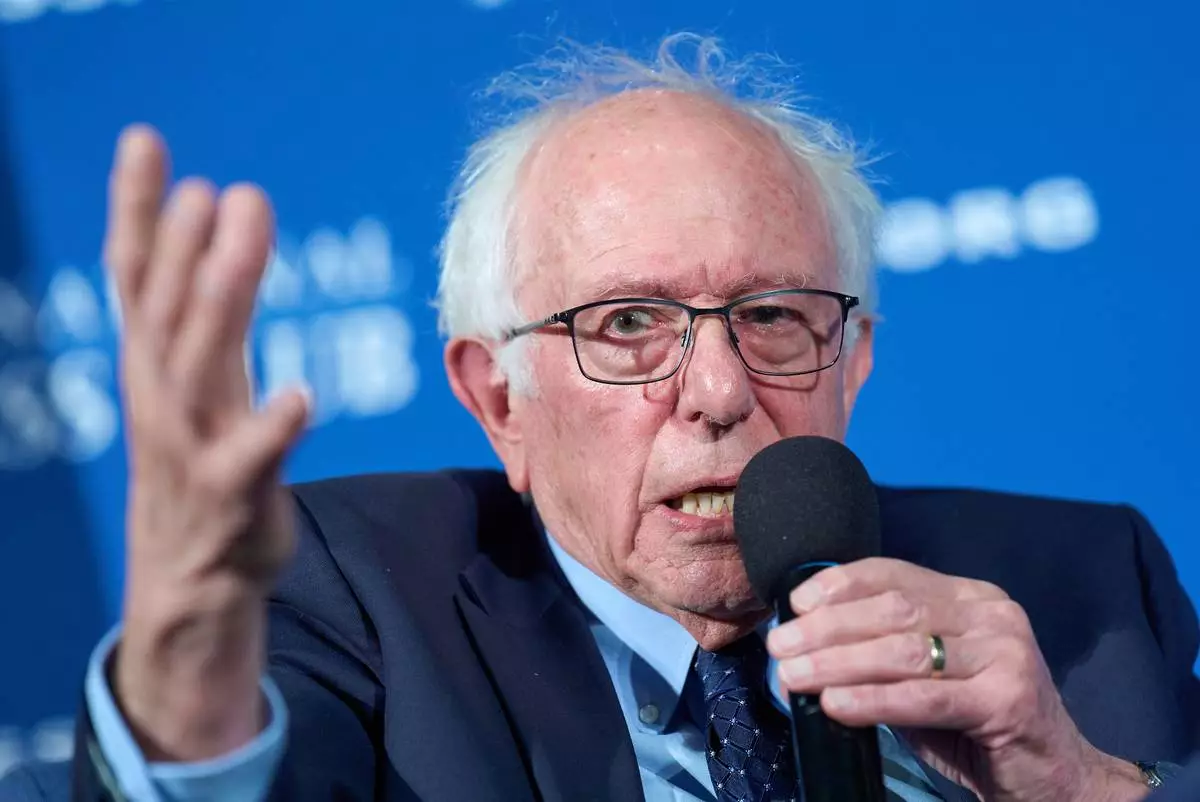
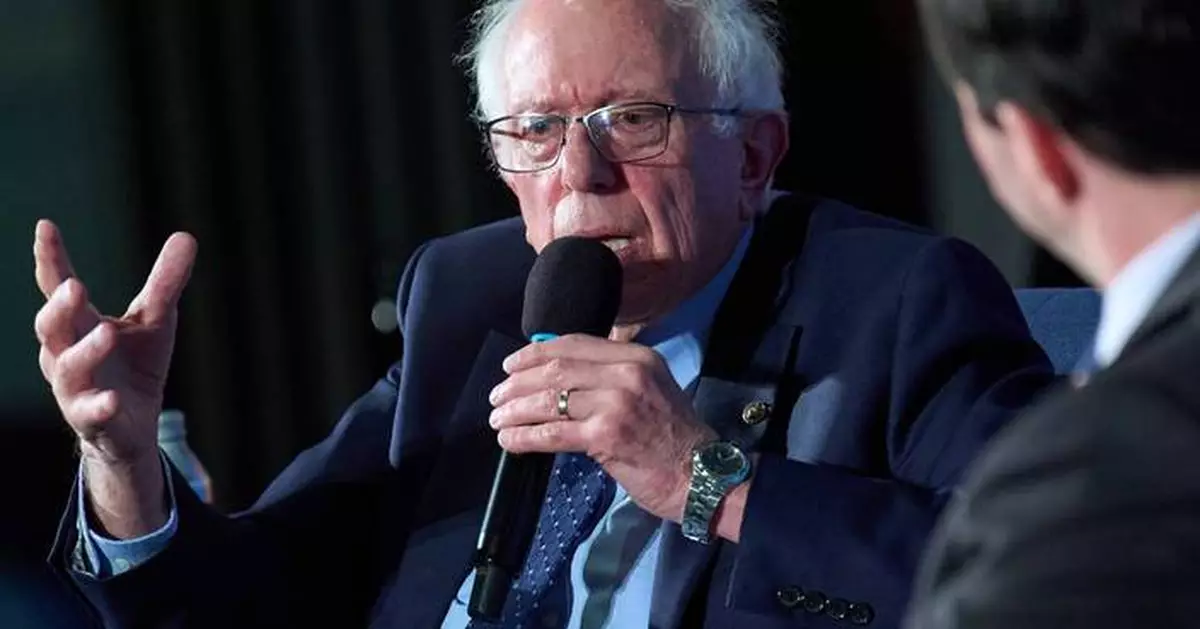
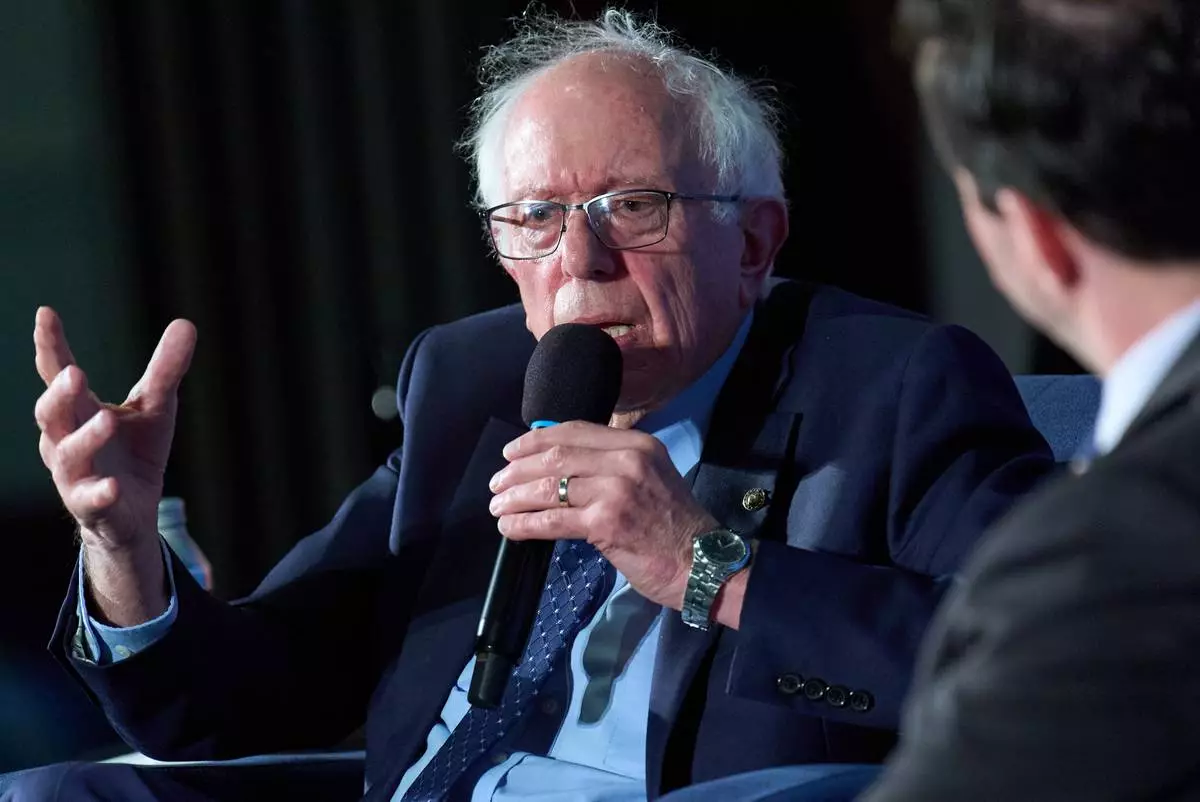
Sen. Bernie Sanders, I-Vt., speaks about topics including politics and artificial intelligence, Monday, June 8, 2026, at the National Press Club in Washington. (AP Photo/Jacquelyn Martin)

NEW YORK (AP) — U.S. stocks dropped on speculation the Federal Reserve may raise interest rates this year to keep a lid on inflation. The S&P 500 slumped 1.2% Wednesday after the Fed released projections showing nearly half its policymakers foresee at least one increase to its main interest rate this year. The Dow Jones Industrial Average went from a gain of 0.5% in the morning to a drop of 1%, while the Nasdaq composite sank 1.3%. Treasury yields climbed on rising expectations for a hike to rates in 2026. Higher rates can tap the brakes on inflation, but they also slow the economy and hurt prices for investments.
THIS IS A BREAKING NEWS UPDATE. AP’s earlier story follows below.
NEW YORK (AP) — The U.S. stock market sank Wednesday after nearly half the policymakers at the Federal Reserve indicated they may want to raise interest rates before the end of the year. Higher rates can keep a lid on inflation, but they also slow the economy and hurt prices for investments.
The S&P 500 slumped 1.1% and erased an earlier, modest gain after the Fed released projections showing nine of 18 policymakers see the central bank raising its main interest rate at least once this year. The Dow Jones Industrial Average went from a gain of 281 points in the morning to a drop of 438 points, or 0.8%, as of 3:30 p.m. Eastern time, and the Nasdaq composite sank 1%.
One important policymaker at the Fed did not give a forecast for where the federal funds rate may end 2026 and the next couple years: Chairman Kevin Warsh. In his first press conference as head of the U.S. central bank, Warsh said he's also considering a revamp of how the Fed communicates with the market and U.S. households and businesses.
That includes the end of dropping hints in Fed statements about where interest rates may be heading in the future, something called “forward guidance.”
Warsh said he wants Wall Street to react to incoming data about inflation, the job market and other economic data based on how they affect prices for stocks, bonds and other investments rather than how it expects the Federal Reserve to react to them.
As part of that, Warsh said the Fed could make changes in its usual release of projections every three months showing where Fed officials suspect interest rates, the economy and inflation are heading in upcoming years.
For now, though, Wall Street reacted uneasily to Fed officials' latest set of projections. Stocks zigzagged up and down several times following the release. The Fed also decided to keep the federal funds rate steady at this meeting, as it has all year so far.
In the bond market, Treasury yields climbed. The yield on the 10-year Treasury, which influences rates for mortgages and other loans going to U.S. households and businesses, rose to 4.48% from 4.43% late Tuesday. The two-year Treasury yield, which more closely tracks expectations for Fed action, jumped more. It climbed to 4.20% from 4.05%.
High yields in bond markets worldwide caused by worries about inflation have been threatening to slow economies and undercut prices for all kinds of investments.
In the stock market, SpaceX erased an early gain and dropped 3.3%. It's potentially on track for its first loss since its ballyhooed debut on the U.S. stock market last week.
That helped overshadow a jump of 15.2% for La-Z-Boy, which reported stronger profit and revenue for the latest quarter than analysts expected. It benefited from revenue made at newly opened stores, though Chief Financial Officer Taylor Luebke said the company continues to have “a measured view” of the broad sales environment.
A report released Wednesday said retailers across the country saw their revenue grow at a faster pace in May than economists expected, offering hope that solid spending by consumers can support the economy. But high inflation has also made U.S. shoppers feel more discouraged about their finances.
Iran is set to immediately take steps to reopen the Strait of Hormuz once the deal is signed, and that would allow oil tankers to exit the Persian Gulf once again and deliver crude to customers worldwide. The hope is that will take pressure off inflation.
Oil prices were steadier Wednesday following sharp slides earlier in the week on optimism about the tentative U.S.-Iran deal to get the global flow of oil going again. The price for a barrel of Brent crude oil rose 0.7% to $79.55. It’s still above its roughly $70 price from before the war, but it’s well below its $100-plus price from a few weeks ago.
Iran is set to immediately take steps to reopen the Strait of Hormuz once the deal is signed, and that would allow oil tankers to exit the Persian Gulf once again and deliver crude to customers worldwide. The hope is that will take pressure off inflation.
In stock markets abroad, indexes were mixed across Europe and Asia.
London’s FTSE 100 added 0.1% after a report showed U.K. inflation remained at 2.8% in May.
South Korea’s Kospi jumped 1.6%, and Hong Kong’s Hang Seng fell 0.7% for two of the world’s bigger moves.
AP Business Writers Chan Ho-him, Matt Ott and Elaine Kurtenbach contributed to this report.
Federal Reserve Chair Kevin Warsh's press conference appears on a screen on the floor of the New York Stock Exchange, Wednesday, June 17, 2026. (AP Photo/Richard Drew)
Federal Reserve Chair Kevin Warsh's press conference appears on screens on the floor of the New York Stock Exchange, Wednesday, June 17, 2026. (AP Photo/Richard Drew)
Specialist Michael Pistillo, left, and trader Sean Spain work on the floor of the New York Stock Exchange, Tuesday, June 16, 2026. (AP Photo/Richard Drew)
Options trader Joseph D'Arrigo works on the floor of the New York Stock Exchange, Tuesday, June 16, 2026. (AP Photo/Richard Drew)
Employees of a securities company celebrate as Japan's benchmark Nikkei 225 topped 70,000 for the first time during trading hours in Tokyo Tuesday, June 16, 2026. A sign, left, reads " Congratulations. Nikkei index reached 70,000 yen." (Shinji Kouchi/Kyodo News via AP)
Employees of a securities company celebrate as Japan's benchmark Nikkei 225 topped 70,000 for the first time during trading hours in Tokyo Tuesday, June 16, 2026. A sign, left, reads "Congratulations. Nikkei index reached 70,000 yen." (Shinji Kouchi/Kyodo News via AP)
An electronic board, left, shows Nikkei index at a securities company in Tokyo Tuesday, June 16, 2026. (Shinji Kouchi/Kyodo News via AP)
Currency traders work near a screen showing the Korea Composite Stock Price Index (KOSPI) and the foreign exchange rate between U.S. dollar and South Korean won at the foreign exchange dealing room of the Hana Bank headquarters in Seoul, South Korea, Wednesday, June 17, 2026. (AP Photo/Ahn Young-joon)
A currency trader stretches near a screen showing the Korea Composite Stock Price Index (KOSPI) at the foreign exchange dealing room of the Hana Bank headquarters in Seoul, South Korea, Wednesday, June 17, 2026. (AP Photo/Ahn Young-joon)