The U.S. Federal Reserve on Wednesday kept the target range for the federal funds rate unchanged at 3.5-3.75 percent.
"Economic activity is expanding at a solid pace despite elevated uncertainty that owes, in part, to the conflict in the Middle East. Productivity growth and capital investment are strong. Job gains have kept pace with the workforce, and the unemployment rate has changed little," said the Federal Open Market Committee (FOMC) in a statement.
Meanwhile, "inflation remains elevated relative to the Committee's 2 percent goal, in part reflecting supply shocks that have driven price increases in certain sectors, including energy," the FOMC went on in the statement.
In support of the Fed's dual mandate, the committee "decided to maintain the target range for the federal funds rate at 3-1/2 to 3-3/4 percent," the statement said.
The FOMC reaffirmed "its policy of maintaining ample reserves in the banking system."
All 12 FOMC members voted for keeping the rate unchanged.
Following the FOMC meeting held on Tuesday and Wednesday, meeting participants submitted their projections of the most likely outcomes for real GDP growth, the unemployment rate, and inflation for each year from 2026 to 2028 and over the longer run.
The Federal Reserve Board members and Federal Reserve Bank presidents project that U.S. median GDP growth will be 2.2 percent in 2026, lower than the March projection of 2.4 percent. The median unemployment rate will be 4.3 percent in 2026, down from the March projection of 4.4 percent. Their GDP growth and unemployment projections for 2027 are at 2.3 percent and 4.3 percent, respectively, unchanged from the March projection.
As for inflation based on the personal consumption expenditures price index, FOMC meeting participants project it at 3.6 percent for 2026 and 2.3 percent for 2027, both higher than the March projections of 2.7 percent and 2.2 percent, respectively.
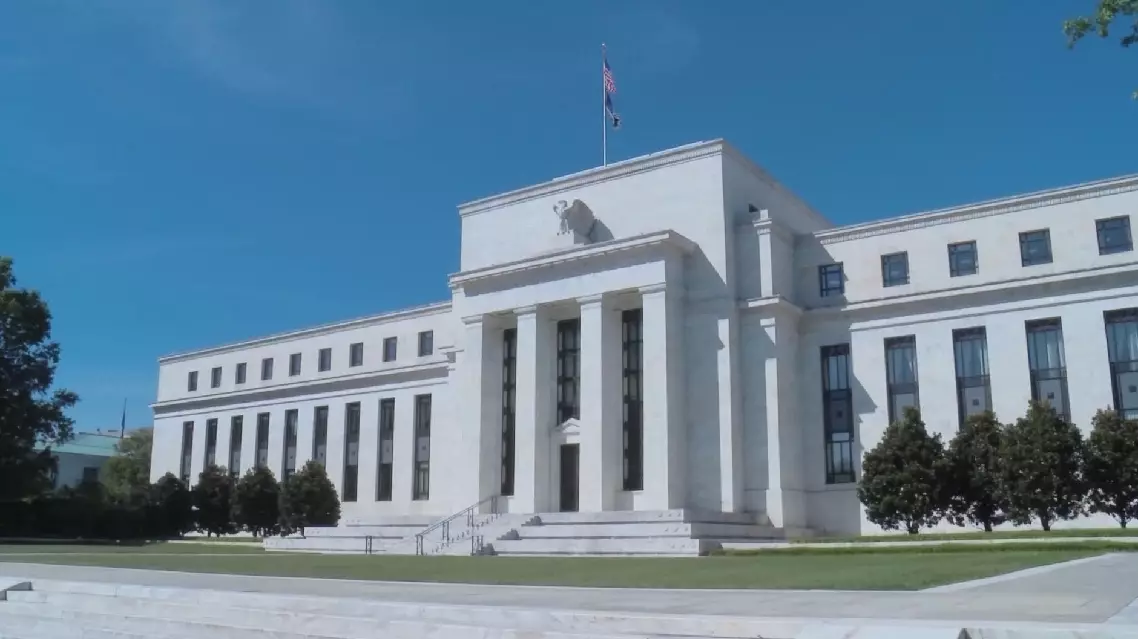
U.S. Fed holds interest rate steady