DALLAS (AP) — Lionel Messi's father is undergoing medical treatment for an undisclosed illness and his family asked the media for “humanity” on Thursday amid rumors about Jorge Messi's health while his son competes at the World Cup.
The family did not specify the illness that the 68-year-old Jorge Messi is suffering from.
“Jorge is going through a health situation,” the Messi family said in a statement. “He is currently under medical observation, recovering and progressing favorably within his current condition.”
The 38-year-old Messi said after Argentina's 3-0 victory over Algeria in the team's opening World Cup match that he was going through a difficult personal situation. He was very emotional after scoring the first of his three goals, which allowed him to equal Miroslav Klose as the all-time leading scorer in World Cup history with 16 goals.
“My tears after the first goal? I’ve had some tough days. It wasn’t related to soccer. And those feelings were because of that,” Messi said. “I thank my teammates, the coaching staff and the delegation for helping me.”
The family statement, released by Messi’s media office, came on the same day that reports of Jorge Messi’s death circulated in Argentina.
“At times like these, we ask for responsibility, prudence and humanity,” the family said. “A person’s health and the peace of mind of their loved ones should not be the subject of speculation or irresponsible media interest.”
The statement said any further developments would be communicated by the family.
Jorge Messi played a key role in his third son’s soccer career, acting as his agent and managing his business affairs off the field.
He accompanied the young Messi to Barcelona in the early 2000s for a tryout at La Masia, the Spanish club’s youth academy.
His father also negotiated Messi's contracts with Barcelona and then his transfers to Paris Saint-Germain and Inter Miami, while also managing his son’s image rights and several investments in real estate, hotels and restaurants.
In 2016, Messi and his father were convicted in Spain on tax evasion charges but avoided prison time because the sentence was less than two years.
While Messi is with his teammates at Argentina's base camp in Kansas City awaiting their second group match against Austria on Monday in Dallas, his family expressed their “sincere gratitude for the outpouring of affection, respect and concern received.”
“We request that the privacy and confidentiality of Jorge and his entire family be respected during this process,” the statement said.
AP World Cup coverage: https://apnews.com/hub/fifa-world-cup

Argentina's Lionel Messi gestures to fans following the World Cup Group J soccer match between Argentina and Algeria in Kansas City, Mo., Tuesday, June 16, 2026. (AP Photo/Charlie Riedel)

Argentina's Lionel Messi (10) celebrates after scoring his third goal during the World Cup Group J soccer match between Argentina and Algeria in Kansas City, Mo., Tuesday, June 16, 2026. (AP Photo/Ed Zurga)
MBARARA, Uganda (AP) — In the red light district in Mbarara, a city in western Uganda known in part for sex tourism, a sex worker named Lisa Mutoni insists on using condoms when men enter her room, to protect her against HIV and other infections. The problem: Some try to remove or tear the condom while having sex.
She takes HIV-prevention medication called PrEP, or preexposure prophylaxis, which can come in the form of daily pills or periodic injections. But there’s a new option for her and millions like her — if they could only get it. It’s a drug called lenacapavir that studies have shown can offer nearly complete protection from HIV with just two shots a year.
Mutoni said access to lenacapavir would benefit sex workers who sometimes shift elsewhere for months at a time.
“If you know that you have that injection for six months, you feel like you are safe,” she said. “And then it is very good, nice because sometimes you can also forget, if it is the pill, you can forget to swallow.”
But Mutoni says every time she tries to get what is commonly referred to as “lena,” it's not available. “They tell me that it is finished,” she said.
Such is the promise and the frustration with lenacapavir, a drug developed by Gilead Sciences. Other PrEP options, including pills and an every-other-month shot of the drug cabotegravir, are very effective and widely available. But health experts say lenacapavir has the power not just to protect individuals but potentially even turn the tide of the HIV epidemic globally because of its long-lasting effects.
But there are not nearly enough doses, in this East African country or the rest of the world.
“The rate of growth (of lenacapavir rollout) isn’t fast enough. We need to be getting to the millions pretty soon,” said Andrew Hill, an expert in HIV treatment who is a senior visiting research fellow at the University of Liverpool in northwest England.
That may start to change in the coming months. The U.S. Food and Drug Administration has just tentatively approved a generic version of lenacapavir that could help speed the production and distribution of the drug to 120 low-income countries at a price of roughly $40 a year, far below the U.S. list price of $28,218. The approval was announced Monday.
The hope, according to the Global Fund, is to get it to 3 million people by the end of 2028.
Some, including Doctors Without Borders, known by its French initials MSF, say this isn't nearly enough. The group is calling on Gilead to make cheap doses available to more countries and to sell it directly to MSF so it can help protect more people faster.
“Gilead says it wants to end the HIV epidemic ‘for everyone, everywhere,’ but its actions say otherwise,” said Melissa Barber, MSF USA global health advocacy and policy adviser, in a recent statement.
For now, people in Mbarara, where an estimated 10% of the adult population has HIV — double the rate of Uganda as a whole — have to settle for inferior choices.
Julius Bampe, a polygamous man, was alarmed earlier this year when testing confirmed his younger wife had HIV. She was immediately given drugs to suppress her infection, while Bampe sought lenacapavir.
But when Bampe, an itinerant builder, went to get his injection, he found that there were no doses left.
“When I got here, they said that is what they would have given me, but they said they didn’t have enough doses for everyone,” he said.
The facility that Bampe goes to received 40 lenacapavir doses in April, with instructions to focus only on pregnant mothers at risk of acquiring HIV. The guidelines were later changed to include couples like Bampe and his wife, sex workers and others.
That batch was quickly administered and another 70 doses sent in June were used up within 10 days, said Tarsisio Biryeija, a nursing officer working as a counselor at Mbarara Health Centre IV.
Uganda has slashed its HIV rate over the past three decades, and it's far below that of some southern African countries. But like in many nations, health authorities in Uganda say infections are driven largely by transactional sexual encounters like those in Mbarara — and the type of transmission that lenacapavir could be so effective at stopping.
Mutoni, the sex worker in Mbarara, gets counseling and other support, including condoms, from Immaculate Nyamwija, founder of a Mbarara-based organization known as Action for Improved Health and Wealth. Nyamwija offers HIV support services to women who would face discrimination elsewhere.
“It is a challenge, because the demand is high and the doses are few,” she said. “Who would not wish to take (lenacapavir) for six months? Who would wish to be on drugs every day?”
Gerald Imray in Cape Town, South Africa, and Laura Ungar in Louisville, Kentucky, contributed to this report.
For more on Africa and development: https://apnews.com/hub/africa-pulse
The Associated Press receives financial support for global health and development coverage in Africa from the Gates Foundation. The AP is solely responsible for all content. Find AP’s standards for working with philanthropies, a list of supporters and funded coverage areas at AP.org.
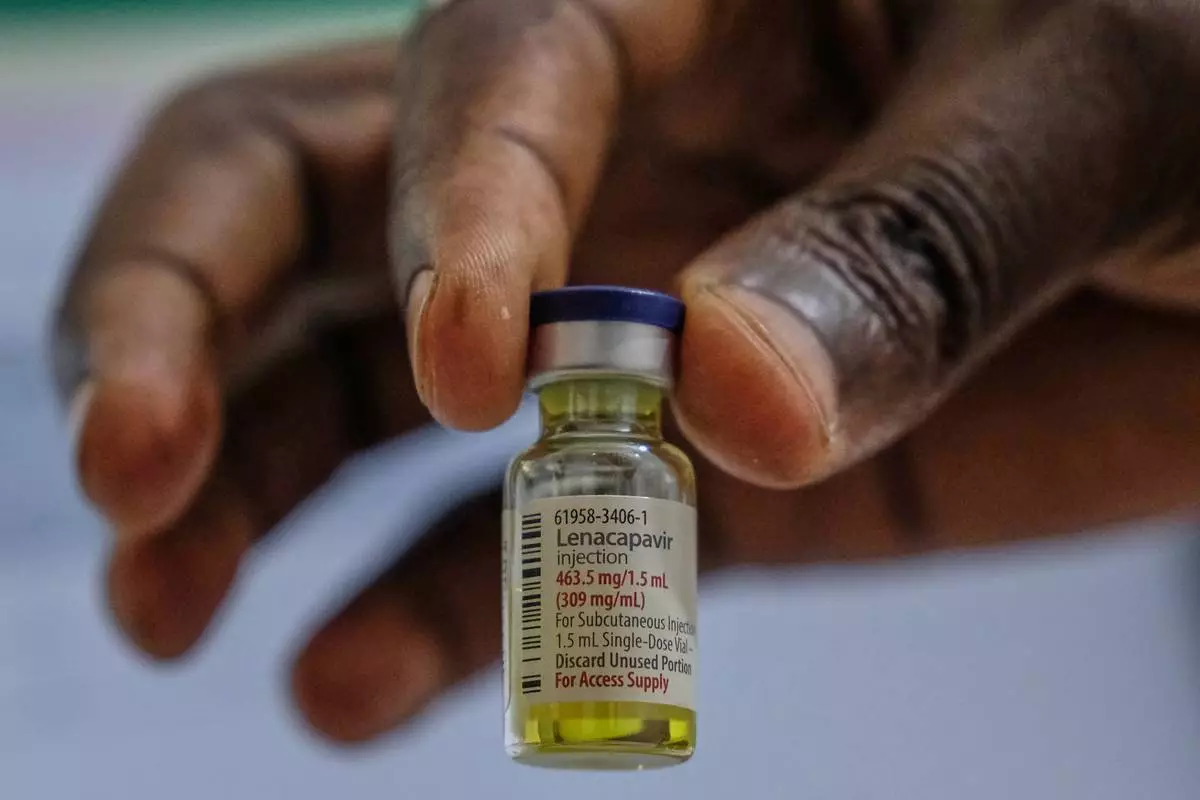
A nurse prepares a syringe before injecting a patient with the new HIV prevention drug lenacapavir at the ART clinic at Mbarara City Council Health Center IV in western Uganda, Aug. 21, 2026. (AP Photo/Hajarah Nalwadda)