Eight countries issued a joint statement on Thursday strongly condemning the continued violence by Israeli settlers against Palestinians in the West Bank, particularly the recent attacks on two mosques in the city of Ramallah.
The statement jointly issued by Jordan, the United Arab Emirates, Indonesia, Pakistan, Türkiye, Saudi Arabia, Qatar and Egypt said the assaults seriously violate the sanctity of religious sites and holy places and constitute a breach of international law, including international humanitarian law, as well as relevant UN resolutions.
In their statement, the eight countries firmly opposed the violent acts carried out by Israeli settlers and condemned Israel's continued unilateral and illegal measures in the Palestinian territories. Such actions, they said, fuel regional instability, violence and extremism, while undermining international efforts to advance peace. The eight countries also pointed out that Israel, as the occupying power, bears responsibility for these attacks.
The joint statement called on the international community to uphold its legal and moral responsibilities and urged Israel to halt its dangerous escalation in the West Bank, put an end to its unlawful practices, rein in settler violence, and bring those responsible to justice.
The statement reiterated the eight countries' firm support for the Palestinian people and their legitimate and inalienable rights, including the right to self-determination, as well as their support for the establishment of an independent State of Palestine that enjoys full sovereignty based on the 1967 borders and with East Jerusalem as its capital.
It also reiterated support for all efforts aimed at ending the Israeli occupation and achieving a just, lasting and comprehensive peace, stressing that such peace should be pursued in accordance with the two-state solution, international law, relevant UN resolutions, and the Arab Peace Initiative.

Eight countries condemn Israeli settlers' mosque attacks in West Bank

Eight countries condemn Israeli settlers' mosque attacks in West Bank
Kenya's health authorities have intensified health screening for truck drivers whose movements span thousands of kilometers across multiple countries, as East Africa remains on heightened alert following the latest outbreak of Ebola in the Democratic Republic of the Congo (DR Congo).
The number of confirmed Ebola cases in the DR Congo had risen to 896, including 232 deaths, the country's public health authorities said Thursday.
Everyday, hundreds of trucks leave Kenya's capital carrying goods destined for Uganda, Rwanda, South Sudan, and the DR Congo.
At the Inland Container Depot in Embakasi, Stephen Kihima is preparing for another long journey westward. Kihima said he has to take extra caution as he frequently passes through busy border crossings where thousands of travelers and transport workers converge each day.
"We no longer shake hands. We do fist bumps or just wave, but we don't fear crossing borders because this is our job," Kihima said.
Kenya, Uganda and Rwanda have enhanced health screenings, temperature checks, and awareness campaigns at border points. For truck drivers, these measures have now become part of their routine.
"Most of us drivers have stopped eating food in those countries, we move with our own stoves and cook our food, most of us don't go to the hotels to eat. We fear that the hotels might have the disease," Kihima said.
Experts said truck drivers have always been a critical link in regional trade, but their extensive movement across countries also creates opportunities for infectious diseases to spread if proper measures are not followed.
"When truck drivers are well informed about how the disease is spread when they now go to those areas where maybe the disease, where there are cases of that disease of the Ebola virus disease they would also know how to stay safe; how to interact with the population there; they will know what preventive measures to take," said Samuel Njenga, an infectious diseases expert.
Kenyan authorities have strengthened monitoring systems at key entry points and are working closely with regional partners to prevent cross-border transmission.
Mary Muthoni, principal secretary for public health under the Kenyan Health Ministry, said while inspecting the border epidemic control situations that the authorities are going to have weekly briefs for truck drivers at the border point, and continue to provide relevant health trainings.
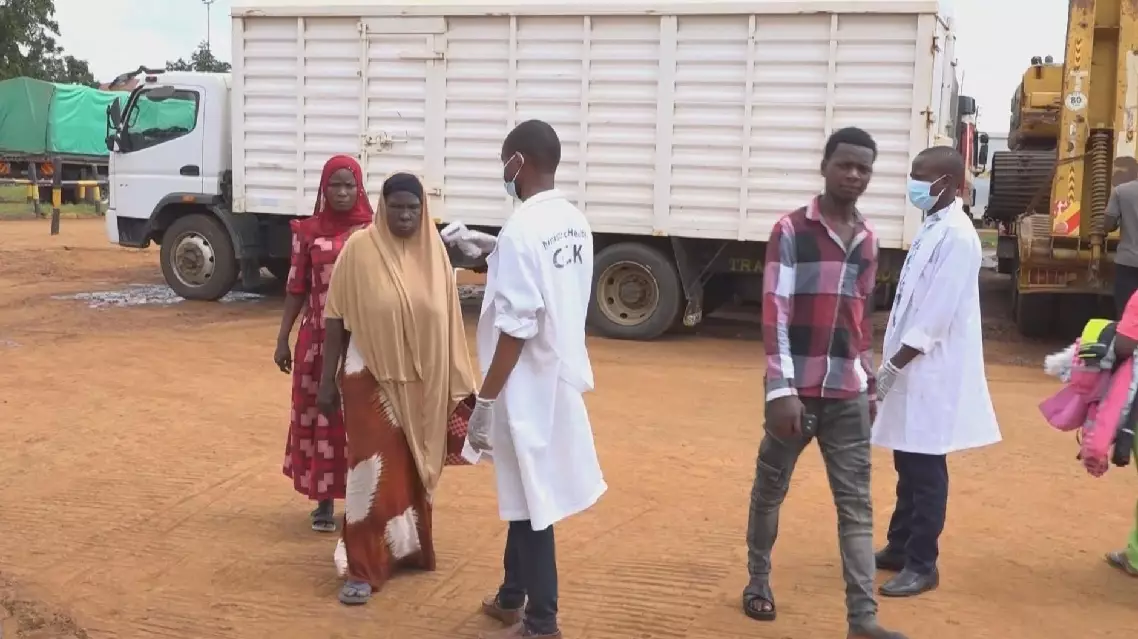
Kenya enhances health screening for truck drivers as Ebola outbreak continues